Reefer Sanity
On the record.

Hall of Shame.

Officials who sold fear about THC, THCA, hemp, and cannabis — quoted verbatim, archived, and checked against the research.

Every quote is verbatim, and archived

Each card is a public statement we opened ourselves: a Congressional Record speech, an official press release, a presidential message, a Justice Department memo, a state AG release, or a post on X. We saved the page and took a snapshot. We criticize the claims. We do not invent motives, and we do not allege bribery. Where a quote comes only from a contemporaneous news report of the remark, the card is marked.

72 statements, compiled 2026-11-16 09:05 AM America/Chicago.

Jump to Follow the Money ↓

Snapshot of the source for Pete Ricketts
Public record
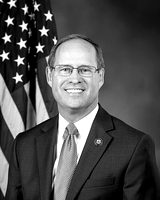
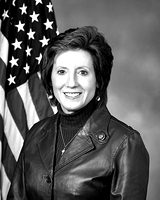
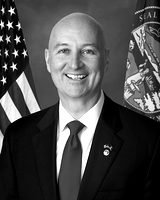
Official portrait of Pete Ricketts
On record
November 12, 2026
Photo: United States Congress, Public domain

Pete Ricketts

U.S. Senator (R-NE) · November 12, 2026

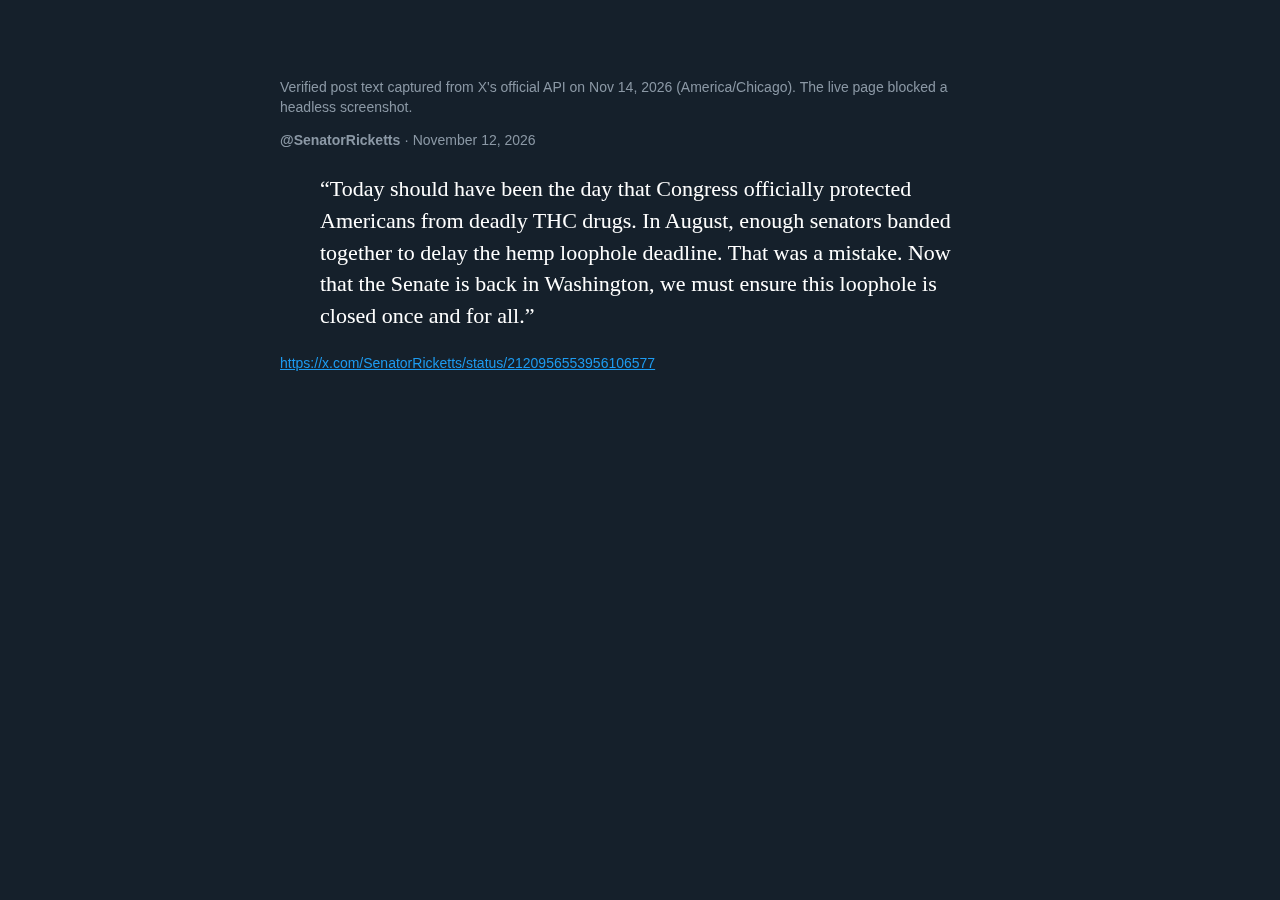
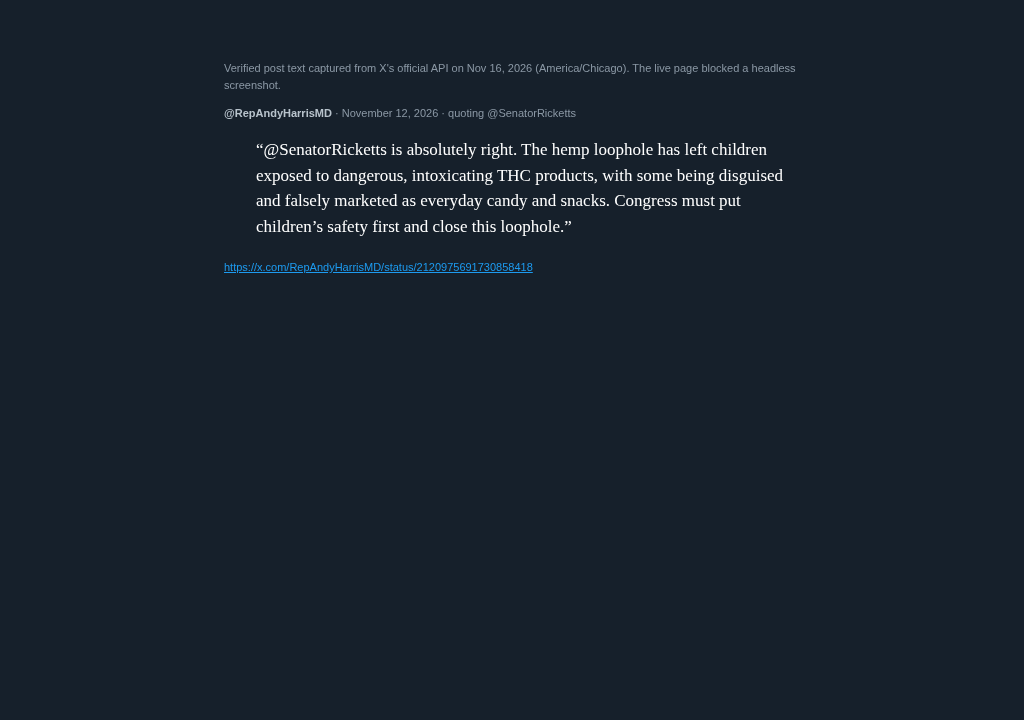
“Today should have been the day that Congress officially protected Americans from deadly THC drugs. In August, enough senators banded together to delay the hemp loophole deadline. That was a mistake. Now that the Senate is back in Washington, we must ensure this loophole is closed once and for all.”

Headless screenshot of x.com failed; image is a typographic card of the verbatim post text retrieved via the X API, with the original URL.

The evidence

“Deadly THC drugs” is the sharpest overstatement in this set. CDC tracks cannabis-involved emergency visits and accidental pediatric ingestions; it does not treat cannabis as a lethal-overdose drug comparable to alcohol or opioids. The 2015 comparative-risk study found cannabis had a margin of exposure above 10,000, the lowest-risk score of the drugs assessed, while excessive alcohol use accounts for about 178,000 U.S. deaths a year. Protecting kids from mispackaged edibles does not require calling THC deadly.1 2 3 26
Back to index

Snapshot of the source for Pete Ricketts
Public record
Official portrait of Pete Ricketts
On record
November 12, 2026
Photo: United States Congress, Public domain

Pete Ricketts

U.S. Senator (R-NE) · November 12, 2026

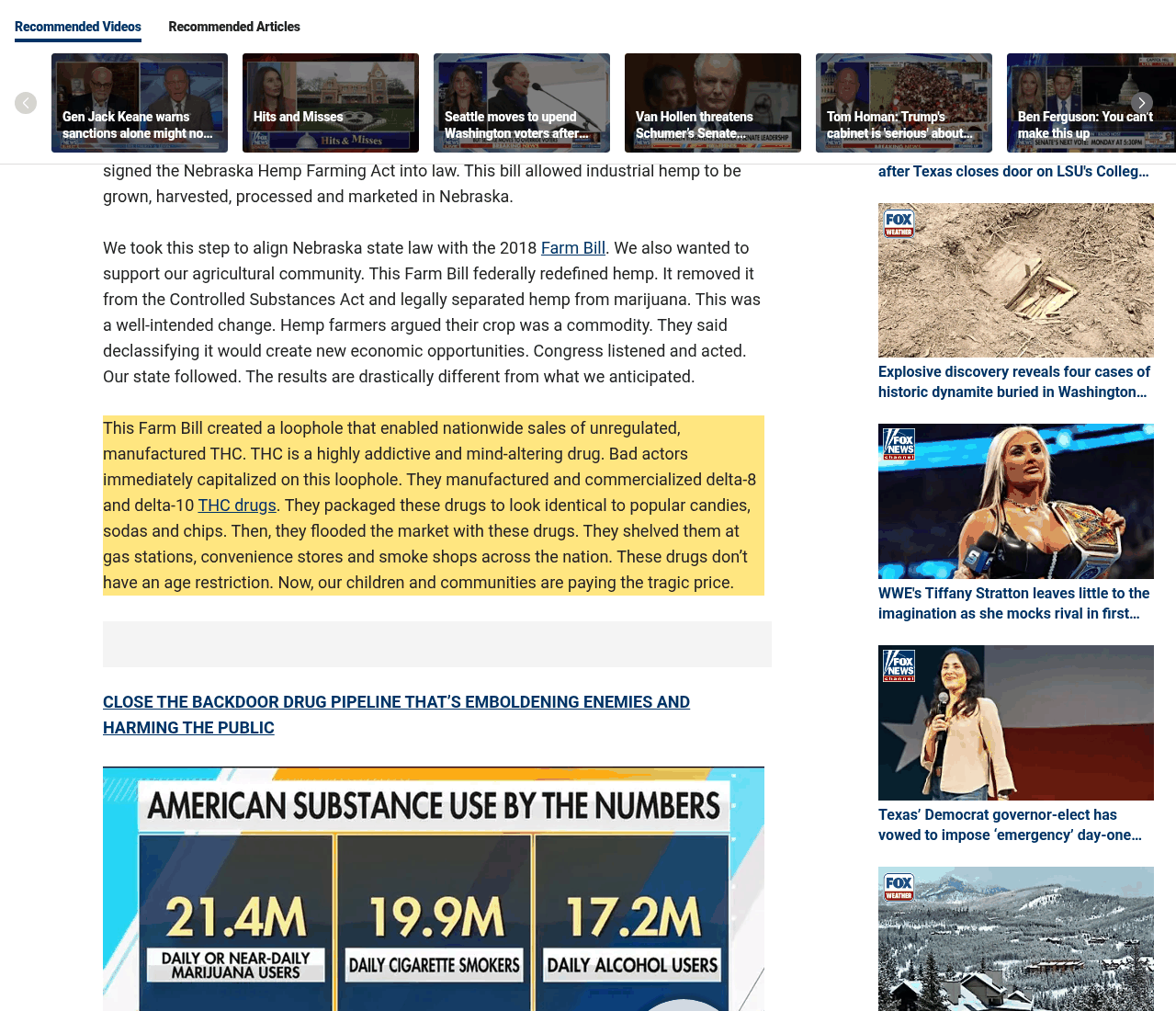
“This Farm Bill created a loophole that enabled nationwide sales of unregulated, manufactured THC. THC is a highly addictive and mind-altering drug. … We know that THC drugs are increasingly linked to IQ loss and significant mental health issues. THC is linked to depression, suicidality, psychosis and anxiety. Allowing these drugs to stay on the market is a disaster.”

From an op-ed under Ricketts’s own byline in Fox News Opinion, “Congress promised to close the THC loophole. Our kids are still waiting” (Nov. 12, 2026, 11:30 a.m. ET). His same-day X post (the “deadly THC drugs” card) linked to this piece; this card quotes different sentences from the op-ed itself.

Headless Chromium screenshot of the live page with pop-ups and sticky overlays removed; the yellow highlight on the quoted paragraph was added by us.

The evidence

Cannabis can cause dependence, and the risk is real for heavy and early users. “Highly addictive” still overstates it. In the large U.S. NESARC study, the estimated lifetime chance of moving from first use to dependence was 8.9% for cannabis, compared with 22.7% for alcohol and 67.5% for nicotine. A 2020 meta-analysis found about 22% of people who use cannabis meet criteria for any cannabis use disorder. The risk rises to about 33% for young people who use weekly or daily, which is a case for age limits, not for treating every adult product as a disaster. The National Academies found substantial evidence linking cannabis to psychosis, mostly among the most frequent users, and moderate evidence of a small rise in depression risk. Those are associations concentrated in heavy and early use, and the IQ-decline finding comes from a study of persistent heavy users who started as teenagers.3 8 9 10 23

Back to index

Snapshot of the source for Andy Harris
Public record
Official portrait of Andy Harris
On record
November 12, 2026
Photo: US House of Representatives, Public domain

Andy Harris

U.S. Representative (R-MD-1) · November 12, 2026

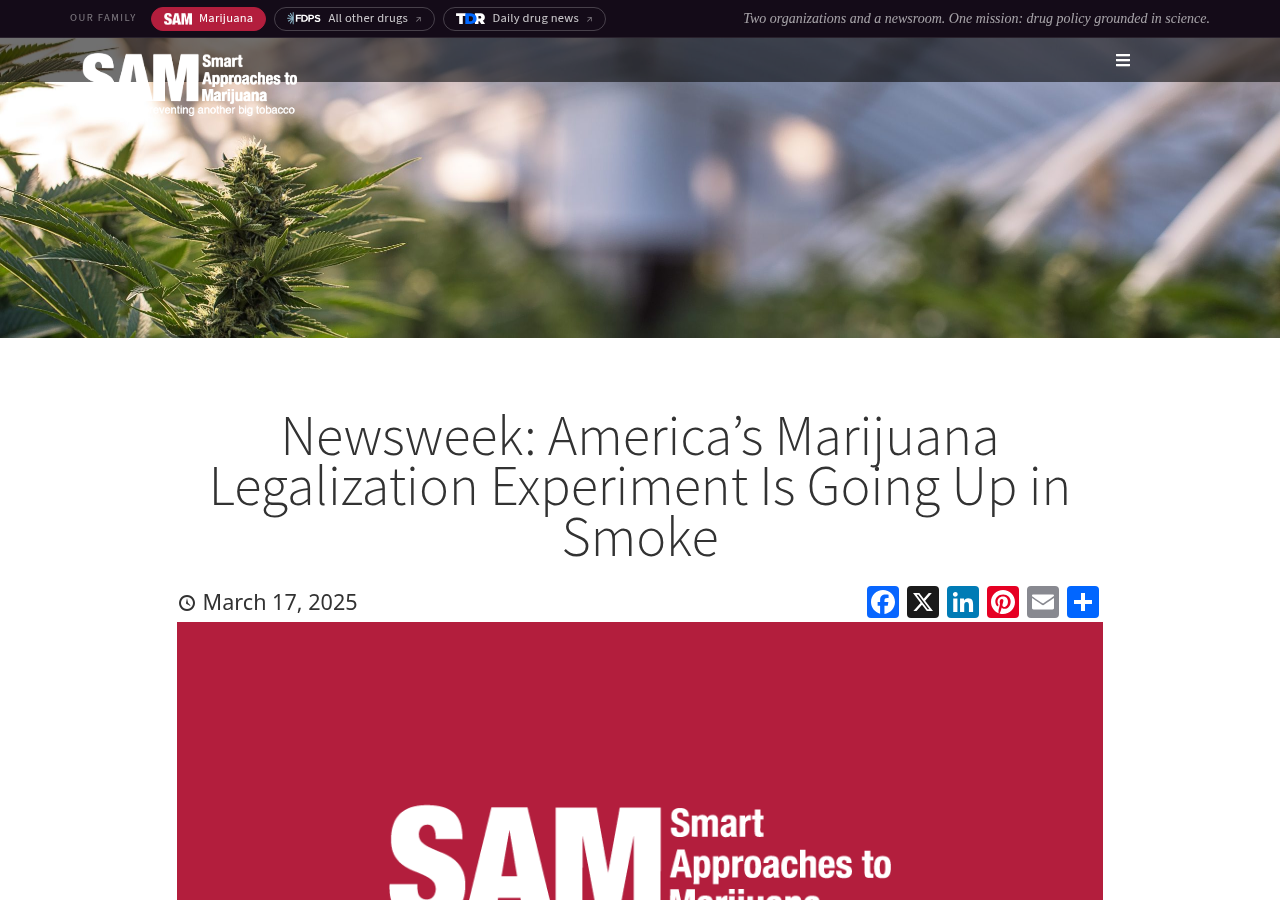
“@SenatorRicketts is absolutely right. The hemp loophole has left children exposed to dangerous, intoxicating THC products, with some being disguised and falsely marketed as everyday candy and snacks. Congress must put children’s safety first and close this loophole.”

Quote-post on X by @RepAndyHarrisMD of Sen. Ricketts’s Nov. 12 “deadly THC drugs” post. Text retrieved via the X API on Nov. 16, 2026.

Wayback Machine’s save service returned errors (HTTP 523) for this x.com URL on Nov. 16, 2026, and headless screenshots of x.com fail; image is a typographic card of the verbatim post text retrieved via the X API, with the original URL.

The evidence

Copycat packaging that mimics candy and snack brands is a real problem, and the CDC warns that children who eat THC edibles can become very sick and sometimes need emergency care. The fix for that is product rules: child-resistant packaging, no look-alike branding, 21+ sales, and clear dose labels. Closing the “loophole” as written does much more than that. It caps every finished hemp product at 0.4 milligrams of total THC per container, which removes adult products sold responsibly along with the knockoffs. THC also has a very wide safety margin compared with alcohol, which kills about 178,000 Americans a year.1 3 26 29 30

Back to index

Snapshot of the source for JB Pritzker
Public record
Official portrait of JB Pritzker
On record
November 4, 2026
Photo: Oscar Garza, CC BY-SA 4.0

JB Pritzker

Governor of Illinois (D) · November 4, 2026

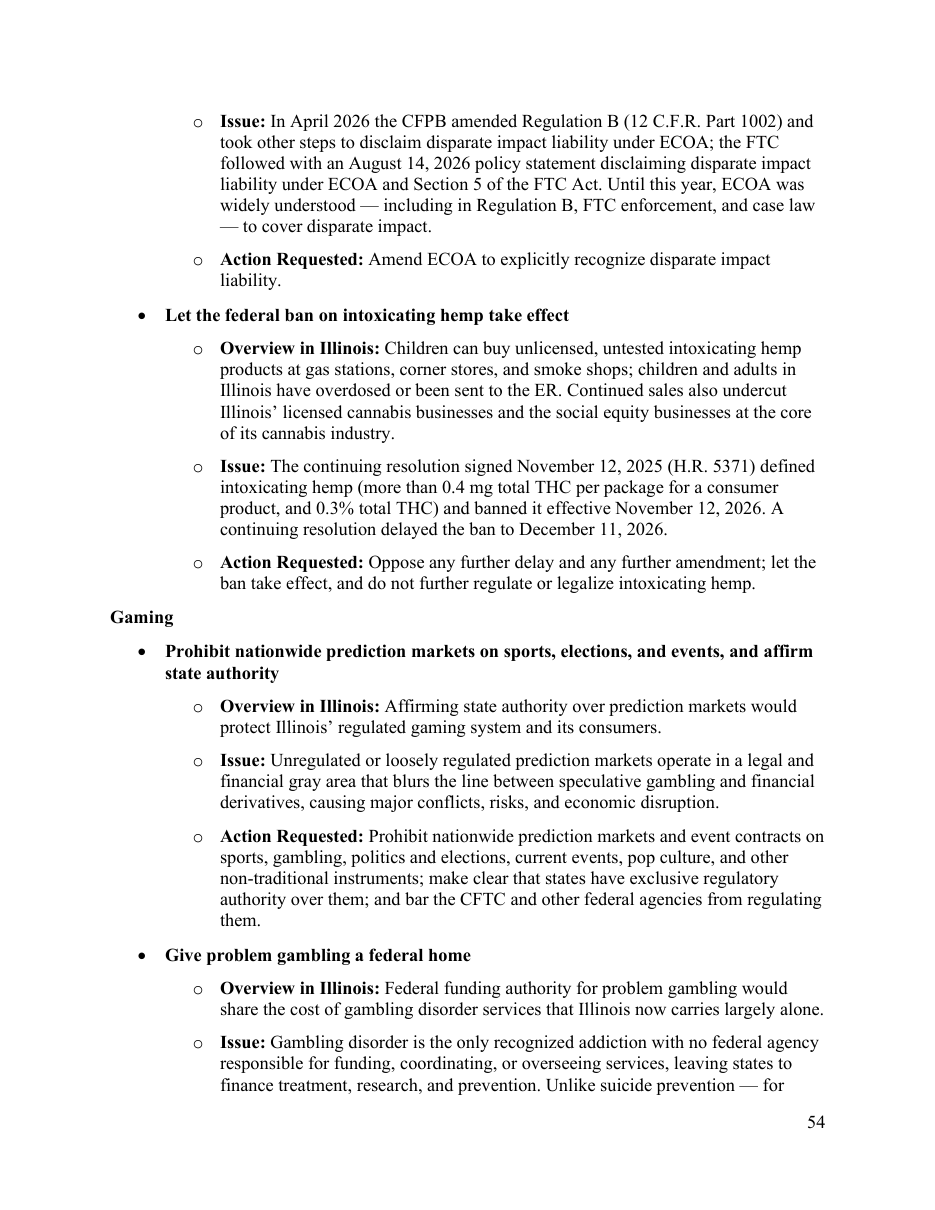
“Children can buy unlicensed, untested intoxicating hemp products at gas stations, corner stores, and smoke shops; children and adults in Illinois have overdosed or been sent to the ER. Continued sales also undercut Illinois’ licensed cannabis businesses and the social equity businesses at the core of its cannabis industry. … Oppose any further delay and any further amendment; let the ban take effect, and do not further regulate or legalize intoxicating hemp.”

From “Fighting for Illinois: The Day One Agenda” (p. 54), a policy document released by Gov. Pritzker’s office on Nov. 4, 2026, and announced with Lt. Gov. Juliana Stratton and Sen. Tammy Duckworth. The words are the document’s, not a spoken quote from any one of them. Linked from the governor’s official newsroom release.

Page 54 of the official PDF, rendered with pdftoppm. The governor’s newsroom release that links the PDF was also archived on Nov. 16, 2026.

The evidence

Kids getting into unlabeled, untested edibles is a fair concern; the CDC documents rising pediatric cannabis poisonings and ER visits. But “overdosed” here means over-intoxication, not the lethal overdoses that word suggests with opioids or alcohol. Cannabis has the widest safety margin of the drugs compared in a major risk assessment. The document also gives a second reason: hemp sales “undercut” Illinois’s licensed cannabis businesses. That is market protection, not a health finding. And it asks Congress to “not further regulate” hemp, while the ER problem it describes is the kind that testing, labeling, packaging, and age limits address. The federal cap it wants enforced is 0.4 milligrams of total THC per container, which reaches nearly every intoxicating hemp product, including tested and labeled ones.1 26 29 30

Back to index

Snapshot of the source for Asa Hutchinson
Public record
Official portrait of Asa Hutchinson
On record
November 4, 2026
Photo: U.S. Drug Enforcement Administration, Public domain

Asa Hutchinson

Former Governor of Arkansas (R); former DEA Administrator · November 4, 2026

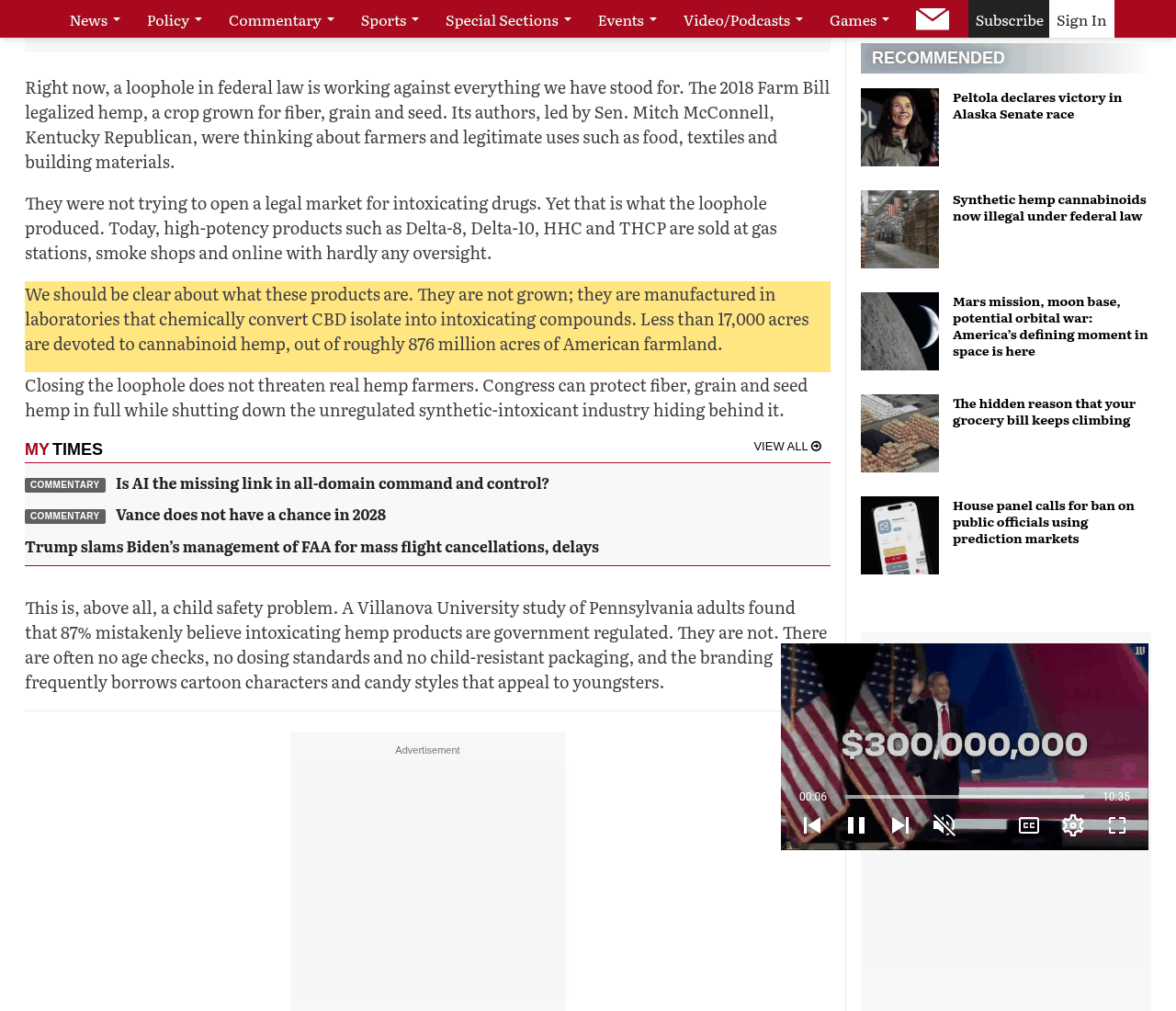
“We should be clear about what these products are. They are not grown; they are manufactured in laboratories that chemically convert CBD isolate into intoxicating compounds. … Intoxicating hemp products, marijuana in everything but name, are a major profit center.”

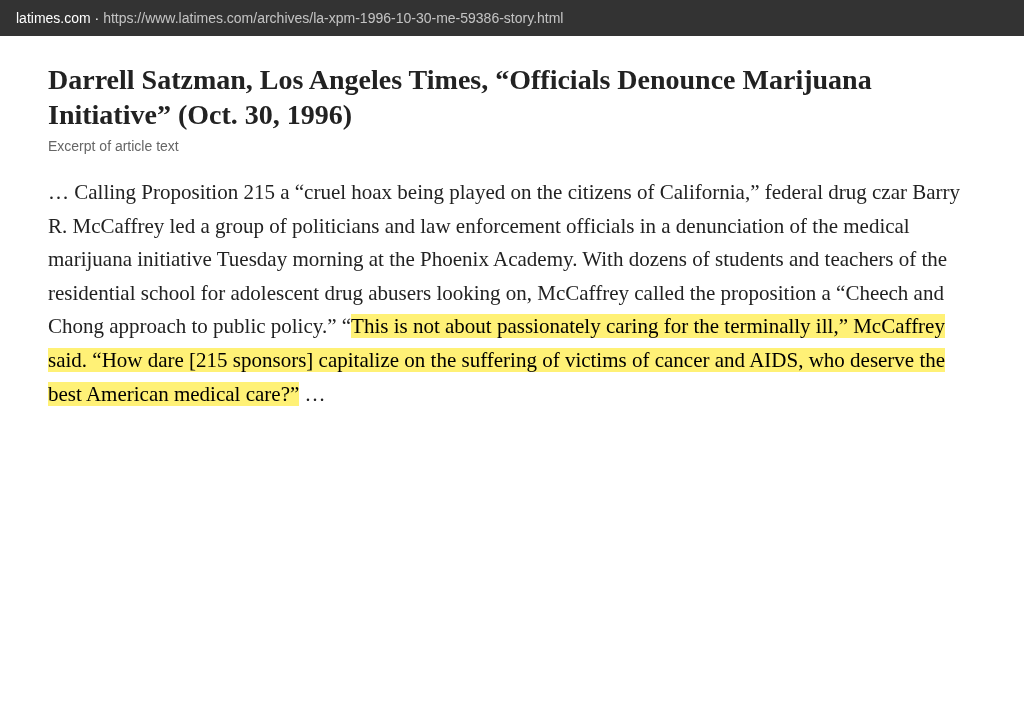
From an op-ed under Hutchinson’s own byline, “Reagan’s drug policy still matters,” The Washington Times (Nov. 4, 2026). He wrote it as a former official, not in office. The live page blocks plain HTTP fetches; it was opened with headless Chromium and in a Nov. 9, 2026, Wayback capture.

Headless Chromium screenshot of the live page with sticky overlays removed; the yellow highlight on the quoted paragraph was added by us.

The evidence

Some intoxicating hemp products, such as delta-8, delta-10, and HHC, are made by chemically converting CBD, and that is a fair target for testing rules. “They are not grown” is wrong as a description of the whole market. THCA flower and plant-derived delta-9 products come straight from the cannabis plant. THCA is the plant’s natural acid form of THC, and heat turns it into THC. The law Hutchinson wants enforced does not separate lab-converted products from grown ones. It caps every finished product at 0.4 milligrams of total THC per container, so the plant-grown products go too. Calling them “marijuana in everything but name” also concedes the point: these are cannabis products, and most Americans now live in a state where adults can buy cannabis legally under regulation.18 19 29 30 125

Back to index

Snapshot of the source for Tom Cotton
Public record
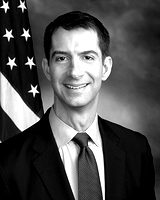
Official portrait of Tom Cotton
On record
September 30, 2026
Photo: U.S. Senate Photo Office, Public domain

Tom Cotton

U.S. Senator (R-AR) · September 30, 2026

“Leaving the loophole unaddressed would give these networks additional time to flood American commerce with synthetic products. This would also further entrench their operations on American soil, fund their enterprises with illicit revenue, and expose consumers to unregulated, dangerous synthetic products masquerading as legal hemp.”

From a letter to Attorney General Todd Blanche, signed by Sens. Tom Cotton, Susan Collins, Pete Ricketts, and Ted Budd, as published on Cotton’s official Senate site.

The evidence

Illegal grow operations, trafficking, and banned pesticides are law-enforcement problems, and they should be investigated as such. Using those crimes to justify closing a farm-bill definition on every licensed or shop-sold hemp cannabinoid product is a category error. THCA flower is not a “synthetic product masquerading as hemp”; it is the natural acidic form of THC in the plant. Some converted delta-8 is semi-synthetic; lumping all of it with Chinese criminal networks treats farmers and shopkeepers as a cartel. Crime should be prosecuted. Adult cannabinoid products can be tested, labeled, and age-gated without that smear.26 30

Back to index

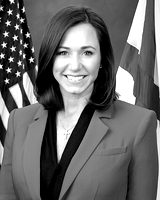
Snapshot of the source for Katie Britt
Public record
Official portrait of Katie Britt
On record
August 9, 2026
Photo: Office of Senator Katie Britt, Public domain

Katie Britt

U.S. Senator (R-AL) · August 9, 2026

“I proudly supported Senator Budd’s amendment to prevent an extension of the dangerous loophole that allows unregulated, intoxicating hemp-derived THC products to enter our homes and schools. I strongly opposed the Democrats’ motion to table this critical amendment because protecting our children cannot wait. It is unacceptable that these dangerous, intoxicating substances that pose a serious threat to the health and safety of our children can be purchased so easily in many retail stores with little or no age verification.”

The evidence

Weak or missing age verification in some retail settings is a real gap, and it is fair to say children should not be able to pick up intoxicating products at a checkout counter. “A serious threat to the health and safety of our children” still inflates THC’s lethality relative to alcohol and many household medicines, which account for far more pediatric and adult deaths. The public-health fix is mandatory 21+ sales, ID checks, child-resistant packaging, and a ban on look-alike branding — rules that can sit alongside a legal adult market.1 3 26

Back to index

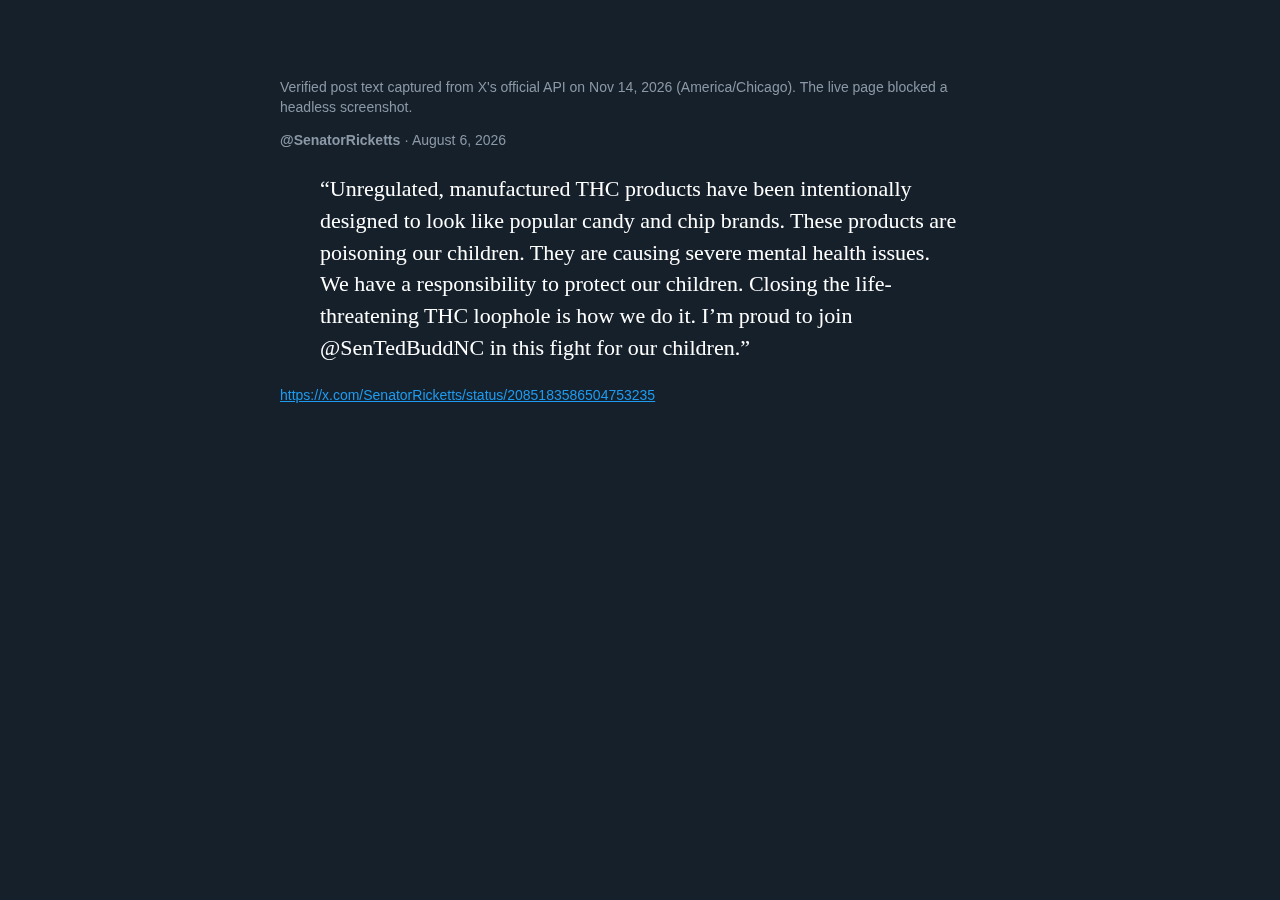
Snapshot of the source for Pete Ricketts
Public record
Official portrait of Pete Ricketts
On record
August 6, 2026
Photo: United States Congress, Public domain

Pete Ricketts

U.S. Senator (R-NE) · August 6, 2026

“Unregulated, manufactured THC products have been intentionally designed to look like popular candy and chip brands. These products are poisoning our children. They are causing severe mental health issues. We have a responsibility to protect our children. Closing the life-threatening THC loophole is how we do it. I’m proud to join @SenTedBuddNC in this fight for our children.”

Headless screenshot of x.com failed; image is a typographic card of the verbatim post text retrieved via the X API, with the original URL.

The evidence

Look-alike snack branding aimed at shelves where kids can reach it is a fair issue. “Poisoning our children” and a “life-threatening THC loophole” still oversell the toxicology. CDC documents a rise in pediatric edible exposures; most reported cases are not fatal. Cannabis has not been shown to cause fatal overdose at typical doses the way alcohol and opioids do, and its margin of exposure is the widest of drugs studied this way. “Life-threatening” is the language of a fentanyl crisis, not of THC.1 3 26

Back to index

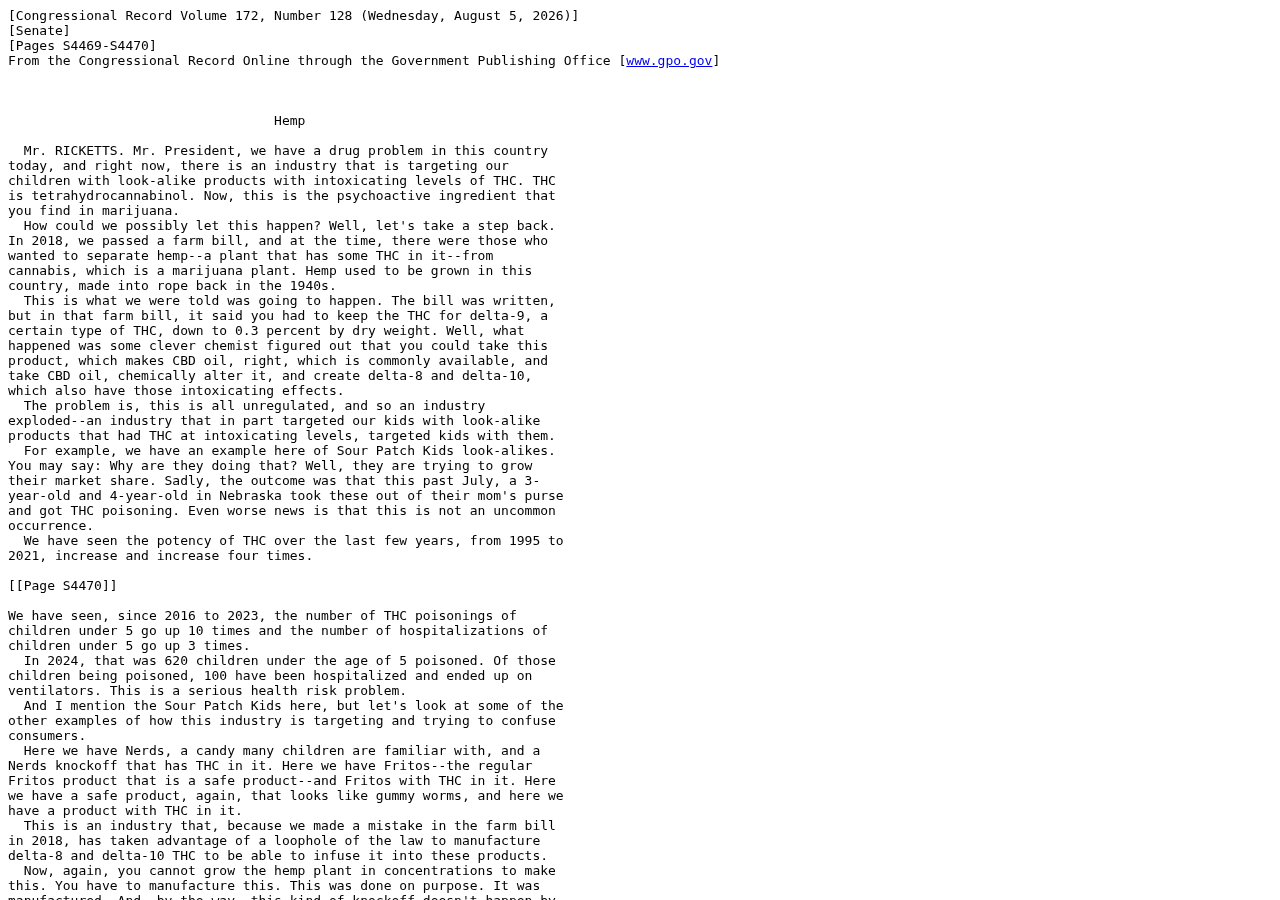
Snapshot of the source for Pete Ricketts
Public record
Official portrait of Pete Ricketts
On record
August 5, 2026
Photo: United States Congress, Public domain

Pete Ricketts

U.S. Senator (R-NE) · August 5, 2026

“Let's stop this right now because we know when THC gets into young people's minds, it can reduce their IQs, lead to mental health issues, such as suicidal ideation, anxiety, depression. This drug is bad for young people. So let's close this loophole and keep it closed.”

The evidence

Youth use is a real concern, which is why adult-use laws set a 21+ age limit, just as with alcohol. The IQ claim is often traced to studies of persistent, heavy adolescent use, including Meier et al. (2012); later work has questioned how much of that decline is causal versus confounded. NASEM (2017) found moderate evidence of impairment in learning, memory, and attention with cannabis use, and a statistical association with psychosis that is stronger for heavier, earlier use — not a finding that any youth exposure “reduces IQ” or reliably causes suicidal ideation. Most people who use cannabis never develop a psychotic disorder. These are arguments for age limits, honest labeling, and dose rules — not for describing THC as a mind-destroying poison.10 12 23

Back to index

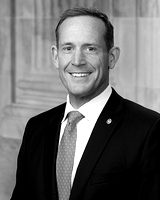
Snapshot of the source for Ted Budd
Public record
Official portrait of Ted Budd
On record
August 5, 2026
Photo: United States Senate, Public domain

Ted Budd

U.S. Senator (R-NC) · August 5, 2026

“This is a public health crisis that deserves this Senate’s immediate attention. Our children should never be the testing ground for an industry willing to exploit a loophole in federal law for profit. We must strip this amendment from the continuing resolution and regulate these harmful substances for what they are—not what the industry wants to call them. If a substance causes intoxication like marijuana, it should be regulated as such—not given a free pass as “hemp.” There is no loophole worth putting a child’s well-being at risk.”

Remarks as prepared for delivery, published by the senator’s official office. Key lines, including “testing ground” and “no loophole worth putting a child’s well-being at risk,” also appear in the Congressional Record PDF of the spoken remarks that day.

The evidence

Agreeing that kids should not be a “testing ground” does not settle the policy. Intoxicating products can be regulated as adult products — age 21, testing, serving sizes, and a ban on look-alike candy packaging — without a cap so low it wipes out most consumable hemp cannabinoids, including many non-candy adult products. That is the alternative congressional approach. CDC documents pediatric edible exposures; it does not show that THC is in the same lethal class as alcohol or opioids.1 3 26 30

Back to index

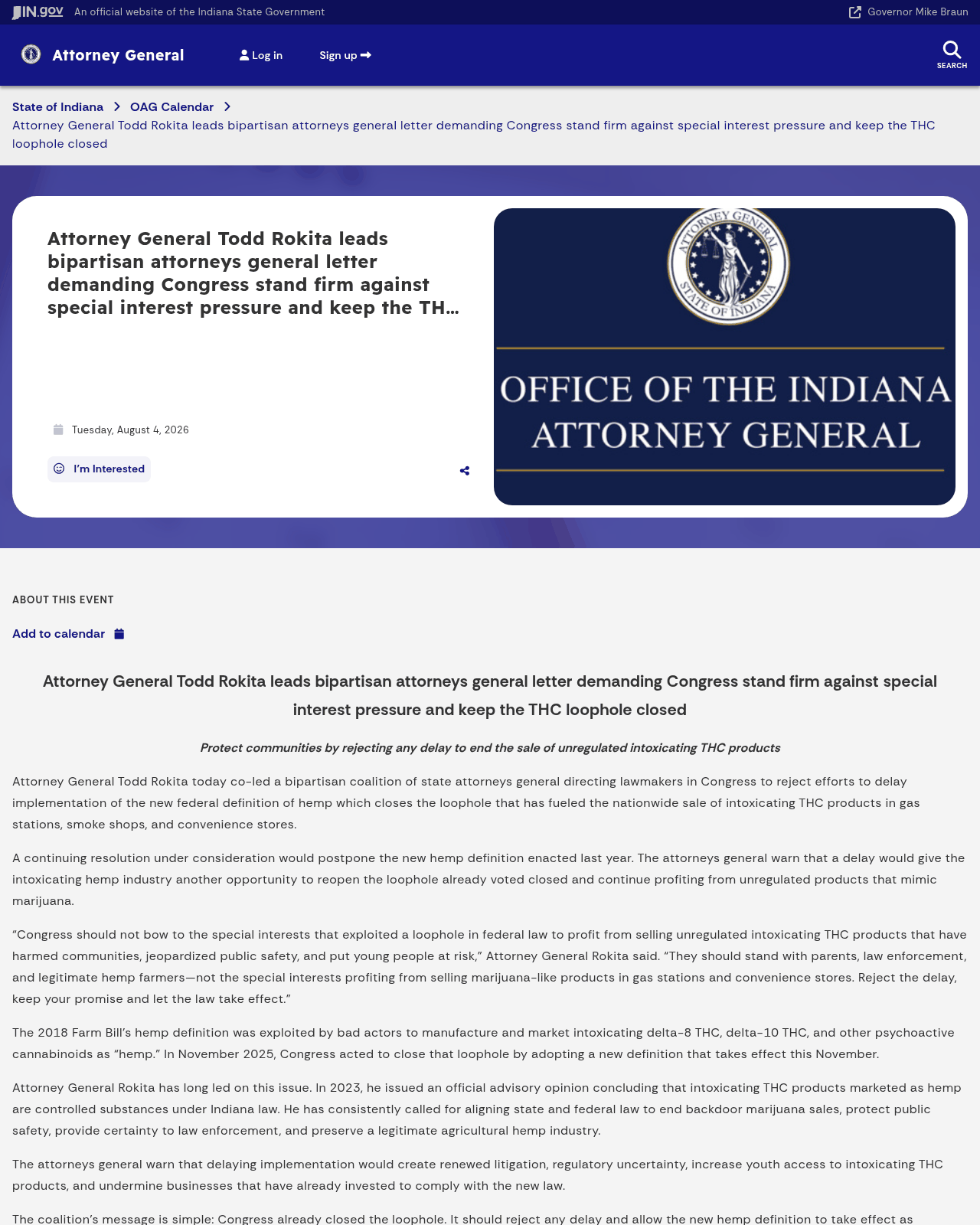
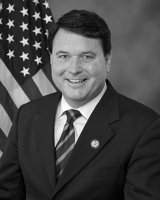
Snapshot of the source for Todd Rokita
Public record
Official portrait of Todd Rokita
On record
August 4, 2026
Photo: US House of Representatives, Public domain

Todd Rokita

Attorney General of Indiana (R) · August 4, 2026

“Congress should not bow to the special interests that exploited a loophole in federal law to profit from selling unregulated intoxicating THC products that have harmed communities, jeopardized public safety, and put young people at risk. They should stand with parents, law enforcement, and legitimate hemp farmers—not the special interests profiting from selling marijuana-like products in gas stations and convenience stores. Reject the delay, keep your promise and let the law take effect.”

Rokita’s attributed quotation in the Indiana Attorney General’s press release on the 35-attorney-general letter he co-led, as posted on the State of Indiana’s official events.in.gov site. The coalition letter overlaps the earlier NAAG card; this card is Rokita speaking in his own name.

The evidence

Edibles that look like candy and unlabeled doses are a real risk to children; the CDC documents rising pediatric poisonings. But Rokita frames the fight as parents versus “special interests.” Interest groups are lobbying on both sides: alcohol-industry groups have pushed Congress to ban intoxicating hemp products too. The harms he describes can be addressed with age limits, testing, labeling, and child-resistant packaging. What he asks Congress to enforce instead is a cap of 0.4 milligrams of total THC per container, which reaches nearly every intoxicating hemp product, including tested and labeled ones.26 29 30 141

Back to index

Snapshot of the source for Andy Harris
Public record
Official portrait of Andy Harris
On record
November 12, 2025
Photo: US House of Representatives, Public domain

Andy Harris

U.S. Representative (R-MD) · November 12, 2025

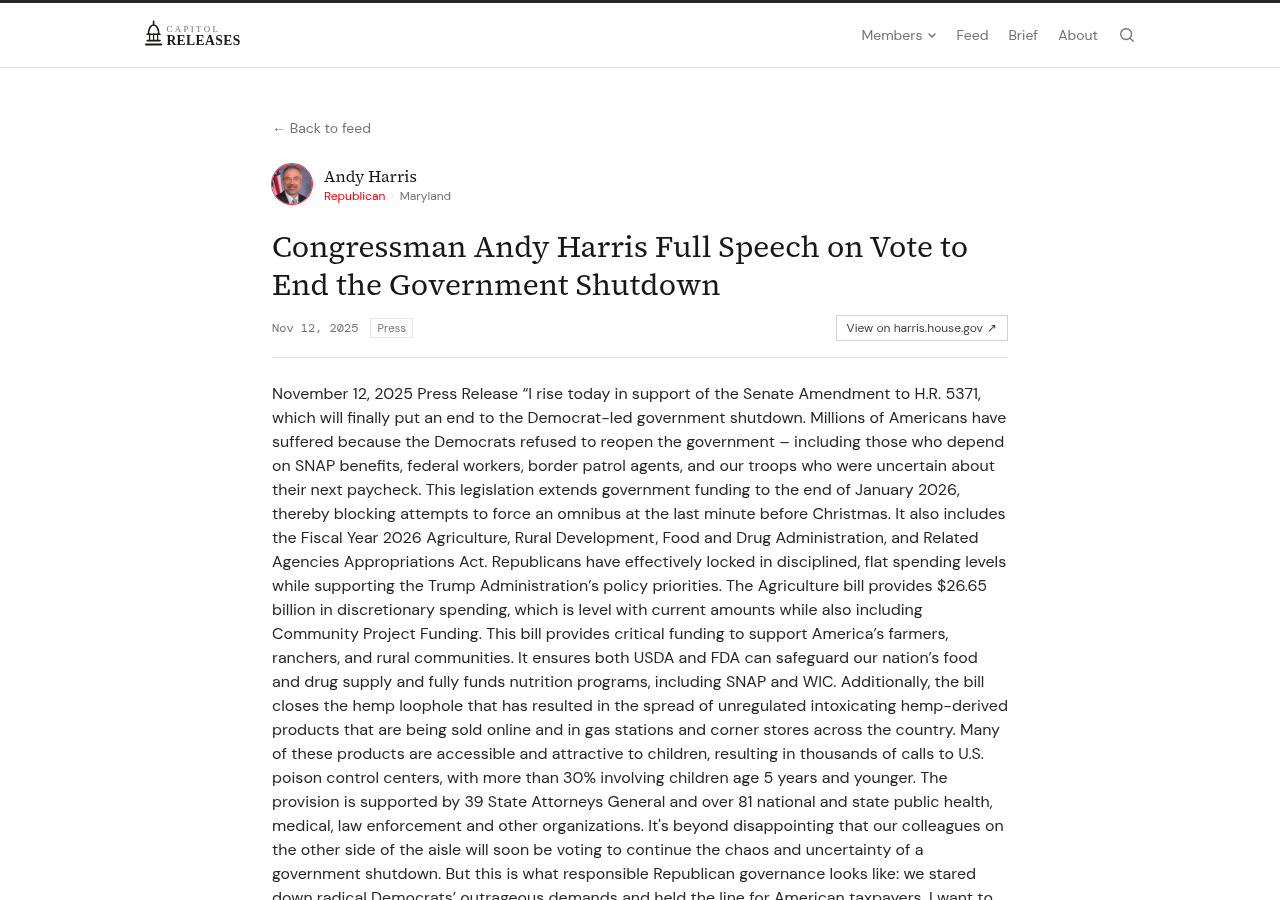
“Additionally, the bill closes the hemp loophole that has resulted in the spread of unregulated intoxicating hemp-derived products that are being sold online and in gas stations and corner stores across the country. Many of these products are accessible and attractive to children, resulting in thousands of calls to U.S. poison control centers, with more than 30% involving children age 5 years and younger. The provision is supported by 39 State Attorneys General and over 81 national and state public health, medical, law enforcement and other organizations.”

Floor remarks published as a November 12, 2025, press release (“I rise today in support of the Senate Amendment to H.R. 5371…”). Opened on Capitol Releases, which presents the text as a capture of the official harris.house.gov release. The house.gov press-release listing we opened did not still show this item on the first page.

The evidence

Pediatric edible ingestions and look-alike packaging are real, and poison-control data are a fair reason to require child-resistant packaging, 21+ sales, and a ban on candy mimicry. “Closes the hemp loophole” in the 2025 appropriations language goes much further, including a 0.4 mg THC cap per container that is far below a typical adult serving and would sweep in many full-spectrum CBD products, not only gas-station look-alikes. Support from attorneys general and advocacy groups does not settle the science or the policy design. Intoxicating hemp cannabinoids should be regulated; treating every adult product as contraband is not the only way to keep them away from five-year-olds.1 26 30

Back to index

Snapshot of the source for Mitch McConnell
Public record
Official portrait of Mitch McConnell
On record
November 10, 2025
Photo: U.S. Government, Public domain

Mitch McConnell

U.S. Senator (R-KY) · November 10, 2025

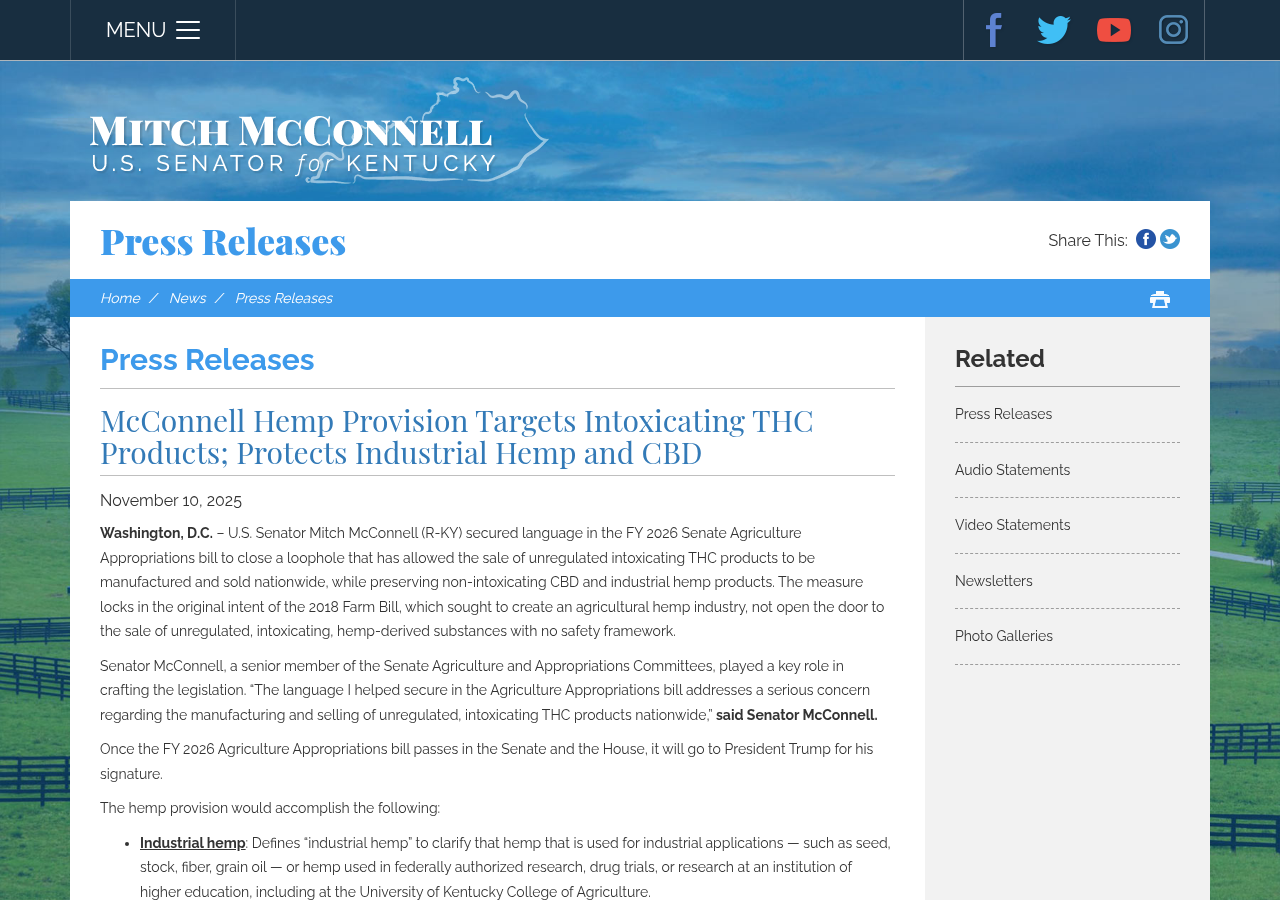
“The language included in today’s bill preserves the legitimate hemp industry while addressing the rise of intoxicating and synthetic THC products. Industrial hemp and CBD will remain legal for industrial applications — such as seed, stock, fiber, grain oil — or used in drug trials, federally authorized research, or research at an institution of higher education, such as the University of Kentucky College of Agriculture’s Industrial Hemp Research Program. I am proud to have championed this language that keeps these products out of the hands of children, secures the future of regulated hemp businesses, and keeps our promise to American farmers and law enforcement by clarifying the intention in the 2018 Farm Bill”

Official Senate press release. The second sentence in this excerpt was published without a closing period.

The evidence

The same announcement describes a cap of 0.4 milligrams of THC per package or container. That is far below a typical adult serving of about 5–10 mg and below the residual THC in many full-spectrum CBD products. Congressional Research Service analysis of the 2025 redefinition found it would sharply restrict consumable hemp cannabinoid products, not only look-alike candies. Keeping products away from children is a legitimate goal; a near-zero cap is not the only, or the most targeted, way to do it. Age gates, labeling, serving-size limits, and testing — the approach later pressed by Sens. Wyden and Merkley — address the packaging problem without treating every adult hemp cannabinoid product as contraband.26 30

Back to index

Snapshot of the source for Coalition of 39 state and territory attorneys general
Public record
On record
October 24, 2025
No freely licensed portrait

Coalition of 39 state and territory attorneys general

Bipartisan coalition of 39 state and territory attorneys general (co-sponsored by Tim Griffin of Arkansas, William Tong of Connecticut, Todd Rokita of Indiana, and Keith Ellison of Minnesota) · October 24, 2025

“Since the passage of the 2018 Farm Bill, hemp-derived THC products—often more potent than marijuana—have flooded the market due to a misinterpretation of the bill’s language. These synthetic cannabinoids, including delta-8, delta-10, THC-O, and others, are being sold in gas stations, convenience stores, and online retailers across the country, frequently in packaging purposefully designed to appeal to children.”

Language from the National Association of Attorneys General press release announcing the coalition letter. The letter PDF itself was blocked during this research pass; this wording is from the official NAAG release we opened via a Wayback Machine capture.

The evidence

Look-alike packaging and uneven age checks are real consumer-protection failures. The release still collapses distinct chemicals into one “synthetic cannabinoids” bucket. Delta-8 can be made by converting CBD; THC-O is a different, synthesized acetate; THCA flower — a major part of the hemp market the 2025 redefinition also hits — is not a synthetic cannabinoid at all. “Often more potent than marijuana” depends on the product, not on a law-of-nature about “hemp.” Potency and packaging are reasons to regulate like other adult intoxicants, not to treat every hemp-derived cannabinoid as a fake drug.26 30

Back to index

Snapshot of the source for Mike DeWine
Public record
Official portrait of Mike DeWine
On record
October 8, 2025
Photo: Unknown authorUnknown author, Public domain

Mike DeWine

Governor of Ohio (R) · October 8, 2025

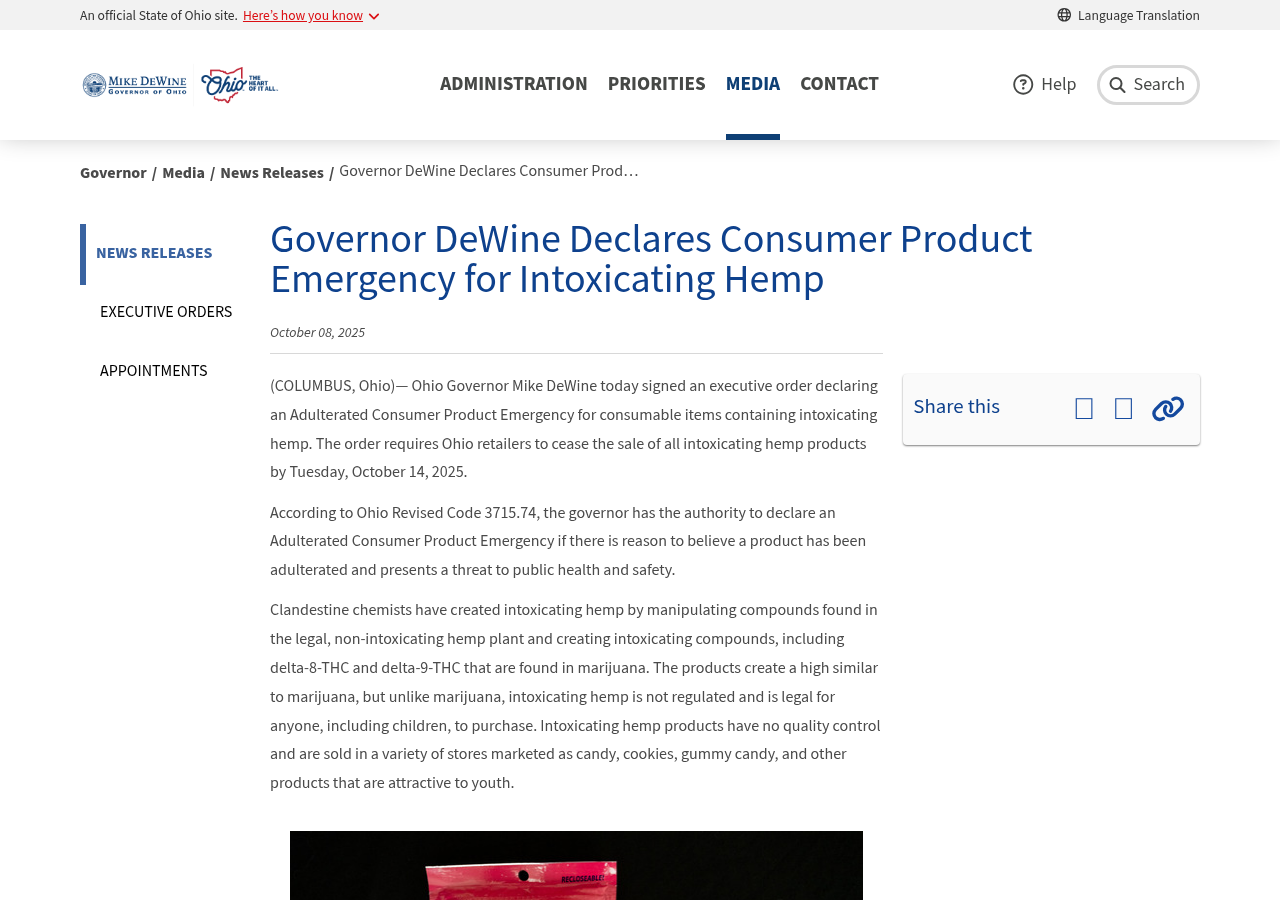
“Intoxicating hemp products are known to have significant impacts on young, developing brains, yet these products are legally marketed to kids, sold to kids, and ingested by kids in Ohio. When voters chose to legalize marijuana, they voted for a highly regulated market that only allows sales at licensed dispensaries to those 21 and older. Intoxicating hemp completely bypasses these laws, and we must do more to keep these products away from kids.”

From the press release announcing his executive order declaring an “Adulterated Consumer Product Emergency” and ordering stores to stop selling intoxicating hemp products.

The evidence

Kids eating look-alike gummies is a real problem, and CDC data on pediatric edible exposures back that up. But the fix DeWine names — 21+ sales, child-resistant packaging, no candy branding — is regulation, not an emergency ban that pulls adult products off every shelf. Hemp cannabinoids were legal under the 2018 Farm Bill until Congress changed the definition. Cannabis still has one of the widest safety margins of any drug studied, and alcohol, sold at the same Ohio gas stations, kills about 178,000 Americans a year.1 3 26 30

Back to index

Snapshot of the source for Mitch McConnell
Public record
Official portrait of Mitch McConnell
On record
August 1, 2025
Photo: U.S. Government, Public domain

Mitch McConnell

U.S. Senator (R-KY) · August 1, 2025

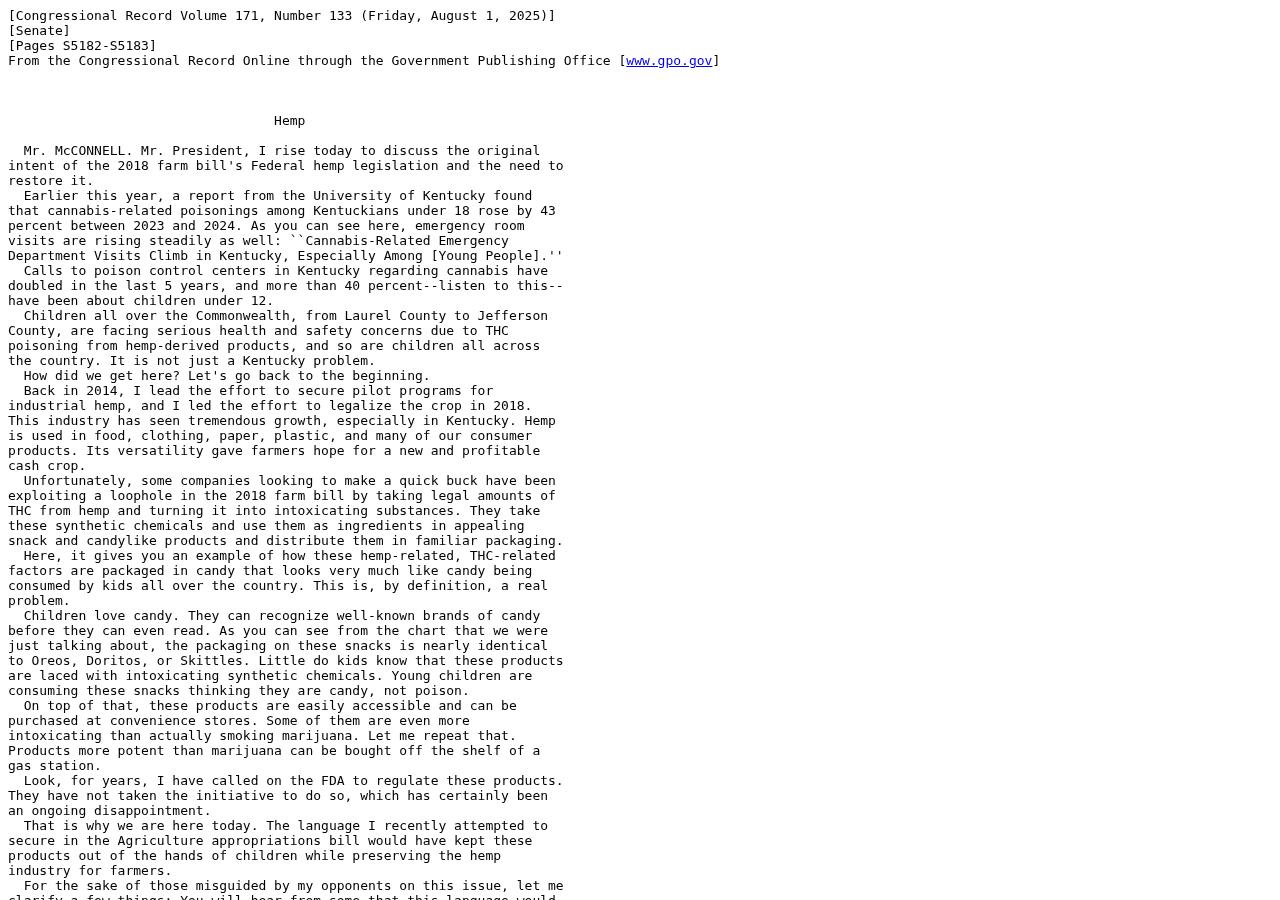
“Little do kids know that these products are laced with intoxicating synthetic chemicals. Young children are consuming these snacks thinking they are candy, not poison. On top of that, these products are easily accessible and can be purchased at convenience stores. Some of them are even more intoxicating than actually smoking marijuana. Let me repeat that. Products more potent than marijuana can be bought off the shelf of a gas station.”

The evidence

Accidental pediatric edible ingestions are a real, documented problem, and look-alike candy packaging is a fair consumer-protection issue. Calling those products “poison,” and calling hemp-derived cannabinoids “synthetic chemicals” as a class, still overstates the pharmacology. THCA is the natural precursor in the cannabis plant, not a lab-made poison; some delta-8 on the market is converted from CBD. Cannabis has the widest safety margin of drugs studied this way, with a population-level margin of exposure above 10,000, while excessive alcohol use causes about 178,000 U.S. deaths a year. Child-resistant packaging, 21+ sales, and a ban on look-alike branding are the tools used for other adult products — including alcohol, which remains far deadlier.1 2 3 26 30
Back to index

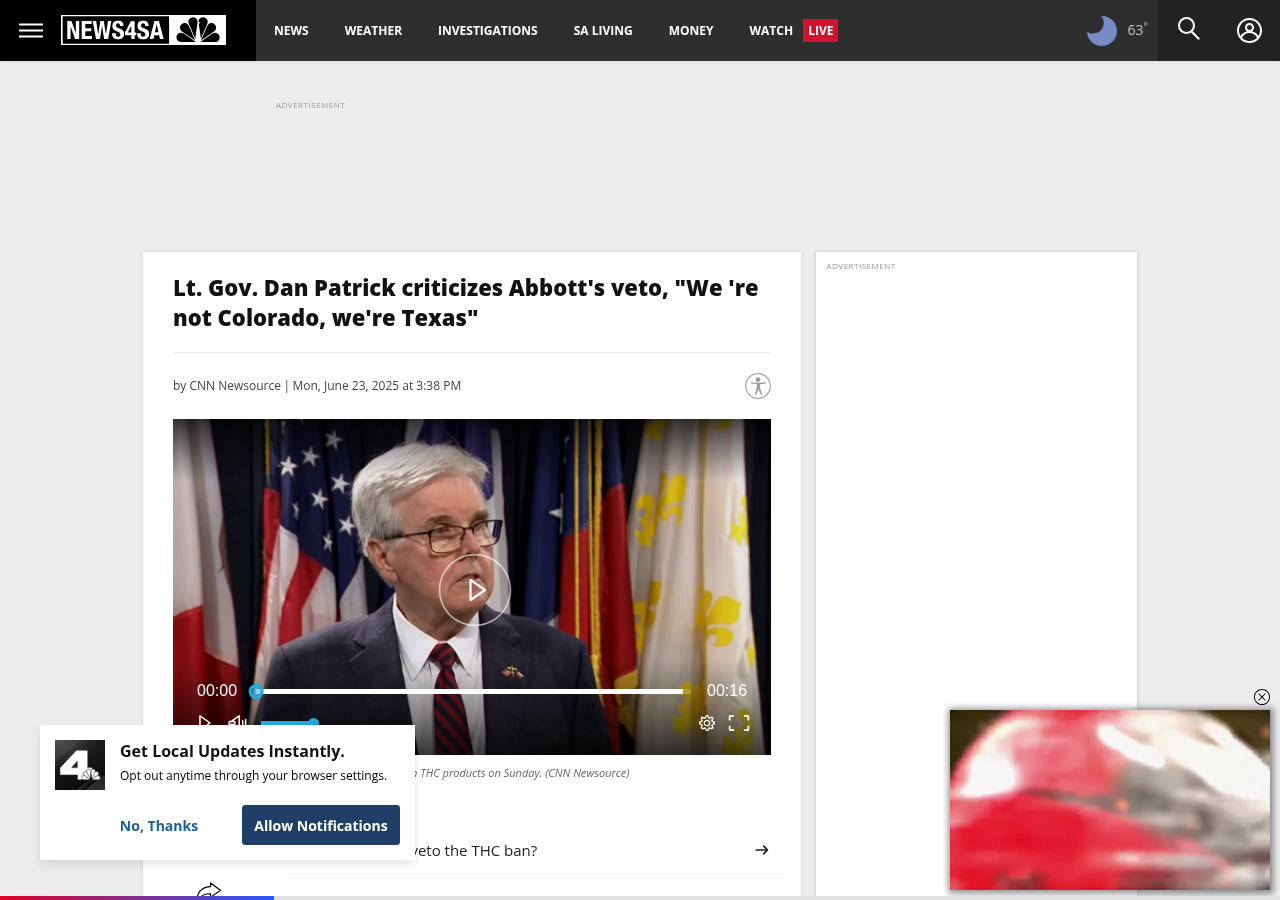
Snapshot of the source for Dan Patrick
Public record
Official portrait of Dan Patrick
On record
June 23, 2025
Photo: Maryland GovPics, CC BY 2.0

Dan Patrick

Lieutenant Governor of Texas (R) · June 23, 2025

Secondhand source — contemporaneous news report

“We're not Colorado, and we're not Oregon, and we're not Washington State — we're Texas. And I will not sign a bill that legalizes marijuana in Texas.”

SECONDHAND: News 4 San Antonio report dated Monday, June 23, 2025, of remarks after Gov. Greg Abbott vetoed a state ban on consumable hemp/THC products. The station presents this as a direct quotation; the page also links a post on X. We did not open Patrick’s official release or the X post itself.

The evidence

Patrick collapsed a fight over already-legal hemp-derived THC products into “a bill that legalizes marijuana in Texas.” Abbott had just vetoed a ban and asked for regulation instead. Whatever one thinks of Colorado, Oregon, or Washington, “we’re Texas” is not a finding about youth use, potency, or the illicit market. Those states have regulated adult-use markets for years; Texas already had intoxicating hemp products on shelves. Refusing to sign a regulatory bill because it might look like legalization leaves the very gas-station market critics say they want to control.10 26 30
Back to index

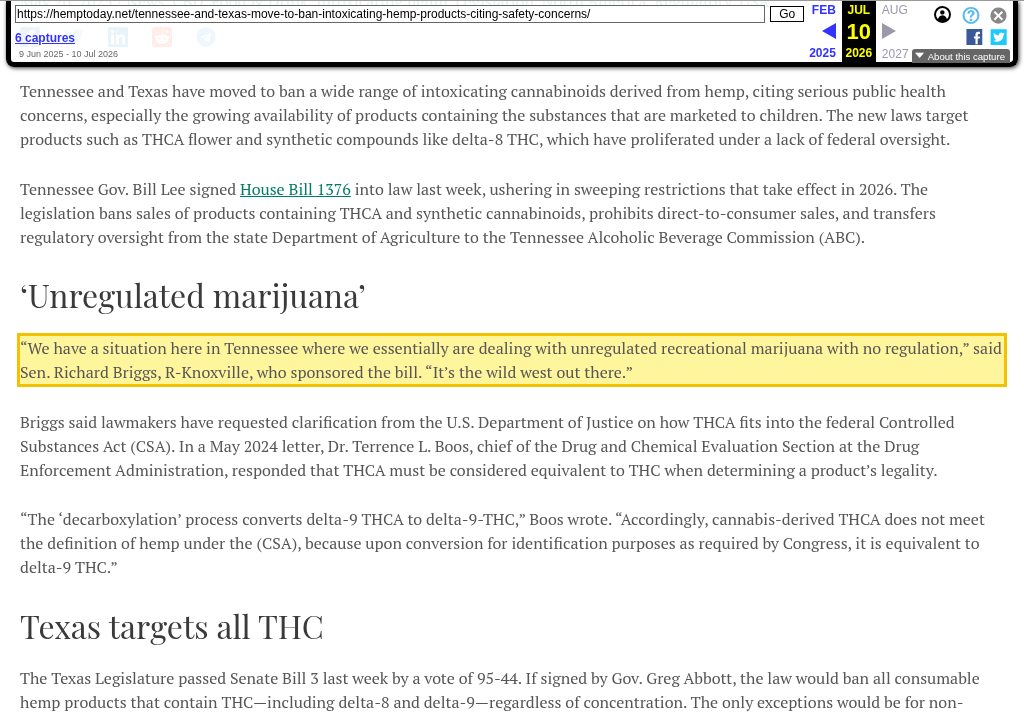
Snapshot of the source for Richard Briggs
Public record
On record
Reported May 26, 2025
No freely licensed portrait

Richard Briggs

Tennessee State Senator (R-Knoxville), sponsor of the 2025 THCA ban · Reported May 26, 2025

Secondhand source — contemporaneous news report

“We have a situation here in Tennessee where we essentially are dealing with unregulated recreational marijuana with no regulation. … It’s the wild west out there.”

SECONDHAND: HempToday report on Tennessee’s HB 1376 / SB 1413, which Gov. Bill Lee signed on May 21, 2025, banning THCA flower above 0.3% total THC. We opened the article through its Wayback Machine copy because the live site blocked automated access.

Snapshot of the Wayback Machine copy with the quote highlighted and pop-up overlays removed; taken 2026-11-14 06:56 PM America/Chicago.

The evidence

“No regulation” was not true. Tennessee’s 2023 hemp law (SB 378) already required buyers to be 21, required child-resistant packaging, banned kid-targeted packaging, and put the Department of Agriculture in charge. THCA is the natural, non-intoxicating acid form of THC that the plant grows; it becomes THC when heated, which is why Congress’s 2018 definition counted only delta-9. The answer to “wild west” was enforcing the 21+ rules already on the books, not banning the flower for adults.18 19 29 36 37

Back to index

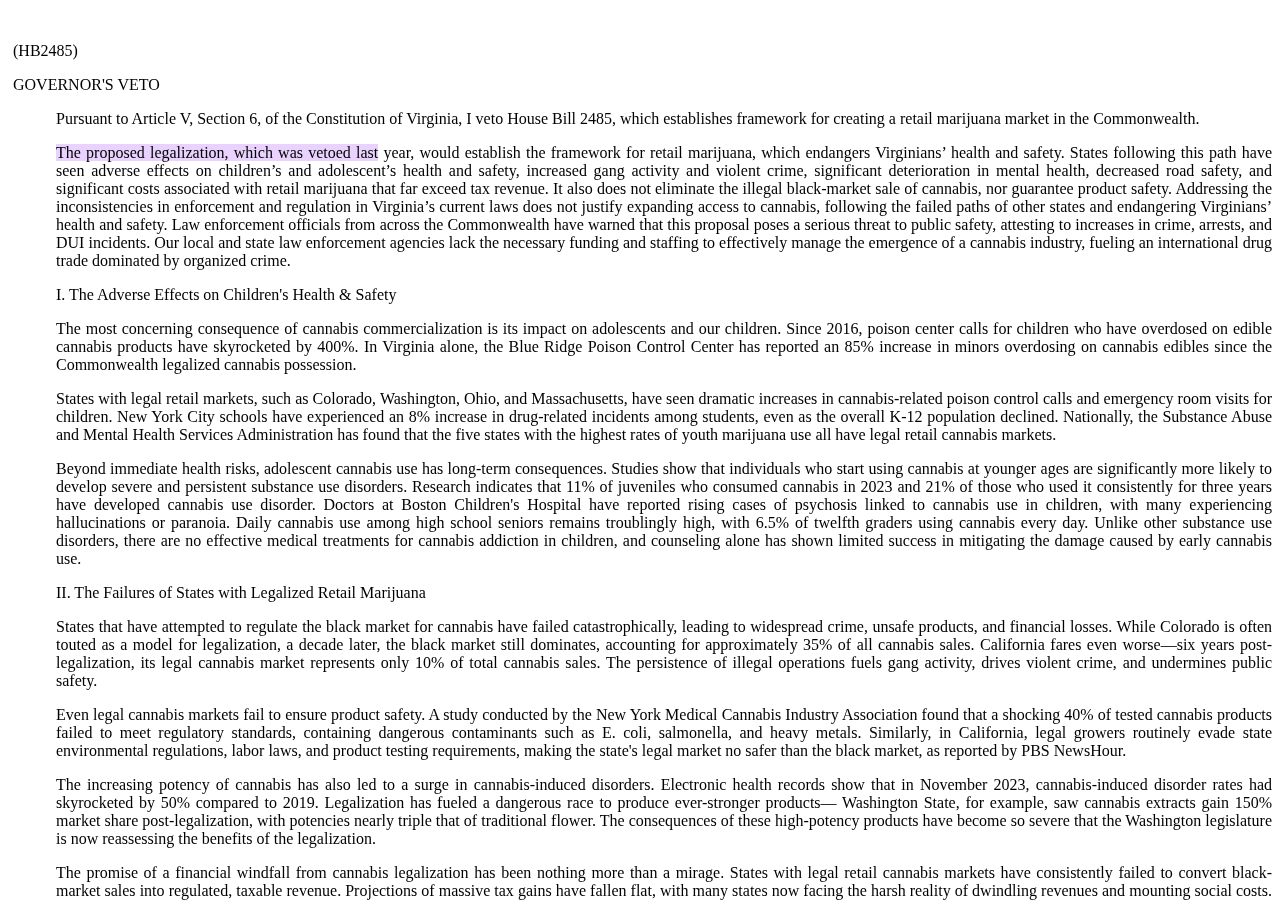
Snapshot of the source for Glenn Youngkin
Public record
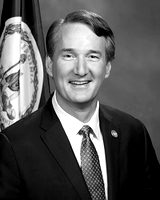
Official portrait of Glenn Youngkin
On record
March 24, 2025
Photo: Glenn Youngkin, Public domain

Glenn Youngkin

Governor of Virginia (R) · March 24, 2025

“The proposed legalization, which was vetoed last year, would establish the framework for retail marijuana, which endangers Virginians’ health and safety. States following this path have seen adverse effects on children’s and adolescent’s health and safety, increased gang activity and violent crime, significant deterioration in mental health, decreased road safety, and significant costs associated with retail marijuana that far exceed tax revenue.”

Governor’s veto message on HB 2485 (2025 session), which would have created a regulated retail market. Adult possession and home growing were already legal in Virginia under the 2021 law.

The evidence

The biggest youth study runs the other way: an analysis of national high-school surveys from 1993 to 2019 found recreational legalization was not associated with an increase in teen marijuana use. Vetoing licensed stores does not remove cannabis from Virginia — possession is already legal — it just leaves supply to the untested, untaxed market the veto claims to fear. Adult-use states have collected billions in cannabis tax revenue. And the comparative-harm research still ranks cannabis far below alcohol, which Virginia sells in state-run stores.1 2 53 57

Back to index

Snapshot of the source for Charles Perry
Public record
On record
March 19, 2025
No freely licensed portrait

Charles Perry

Texas State Senator (R-Lubbock) · March 19, 2025

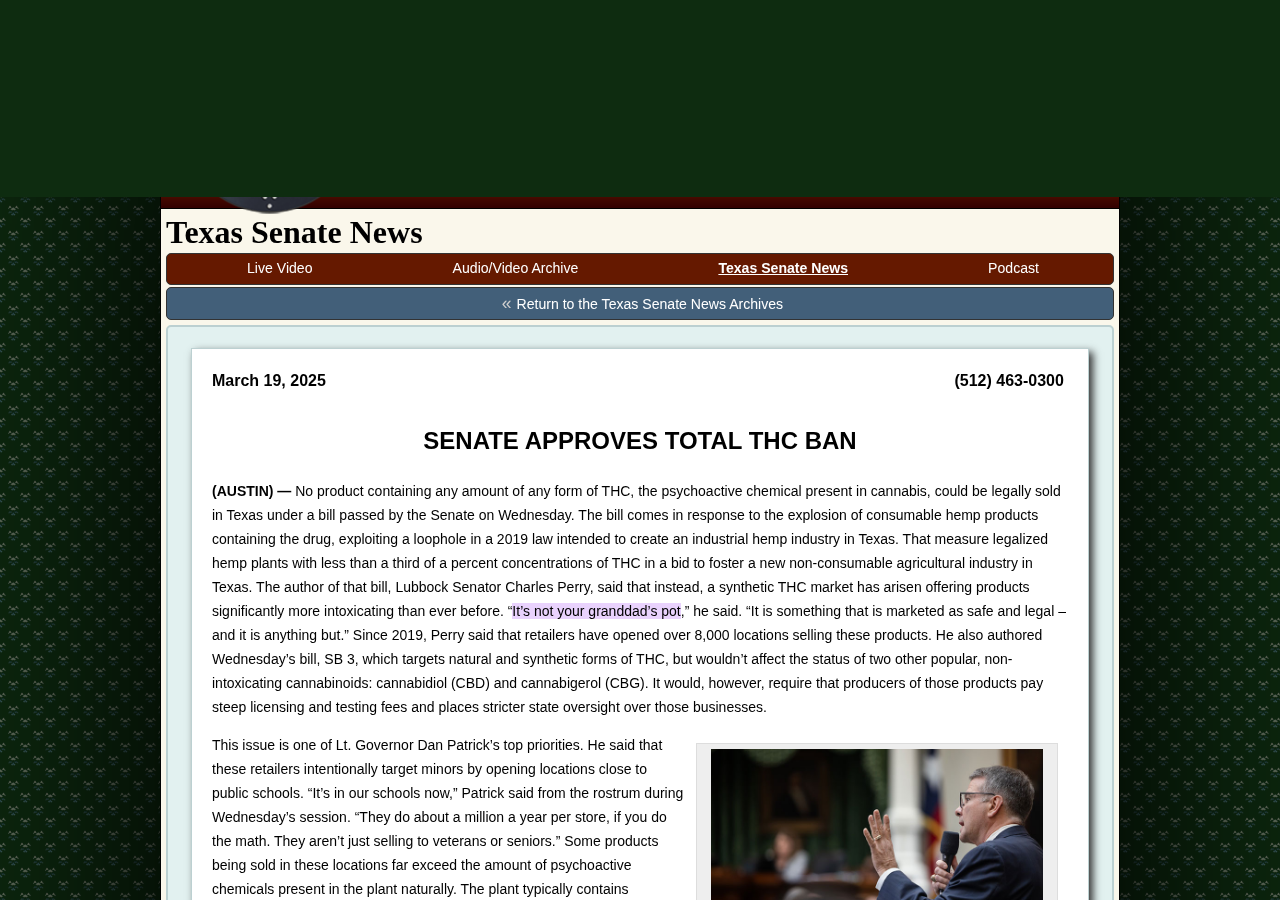
“It’s not your granddad’s pot … It is something that is marketed as safe and legal – and it is anything but.”

Two consecutive quoted sentences from the Texas Senate’s official release on SB 3, Perry’s bill to ban every product with any detectable THC. Gov. Greg Abbott later vetoed SB 3.

The evidence

Potency has risen: DEA-seized flower went from about 4% THC in 1995 to about 12% in 2014. That is an argument for labels and dose limits, not for banning every product with any THC. “Anything but safe” ignores the comparative evidence: cannabis has a margin of exposure above 10,000 at population level, the widest of the drugs Lachenmeier and Rehm studied, while alcohol kills about 178,000 Americans a year. His own governor vetoed the total ban.1 3 136

Back to index

Snapshot of the source for Kevin Sabet
Public record
Official portrait of Kevin Sabet
On record
Reported March 17, 2025
Photo: Elekes Andor, CC BY 4.0

Kevin Sabet

President of Smart Approaches to Marijuana; former senior drug-policy adviser, Office of National Drug Control Policy · Reported March 17, 2025

Secondhand source — contemporaneous news report

“Today’s marijuana is strengthened by very high-potency growing methods that have resulted in record levels of psychosis, schizophrenia, suicide, IQ loss, and other issues.”

SECONDHAND: Quoted in a Newsweek article that SAM republished on its own website, which is the copy we opened. Sabet is not an elected official; he is included as a former federal drug-policy official who now leads the main anti-legalization group.

The evidence

Potency has risen: seized flower went from about 4% THC in 1995 to about 12% in 2014. But “record levels” of psychosis, suicide, and IQ loss “resulted” from it is a causal claim the evidence does not support. The National Academies graded these as statistical associations, strongest with heavy and frequent use, not as proof that stronger weed “resulted in” record harms; for lasting effects on learning and memory after people quit, it found only limited evidence. National youth survey data found legalization was not associated with more teen use. Use honest labels and dose limits, and drop the doom.10 11 53 136

Back to index

Snapshot of the source for Pete Ricketts
Public record
Official portrait of Pete Ricketts
On record
February 10, 2025
Photo: United States Congress, Public domain

Pete Ricketts

U.S. Senator (R-NE) · February 10, 2025

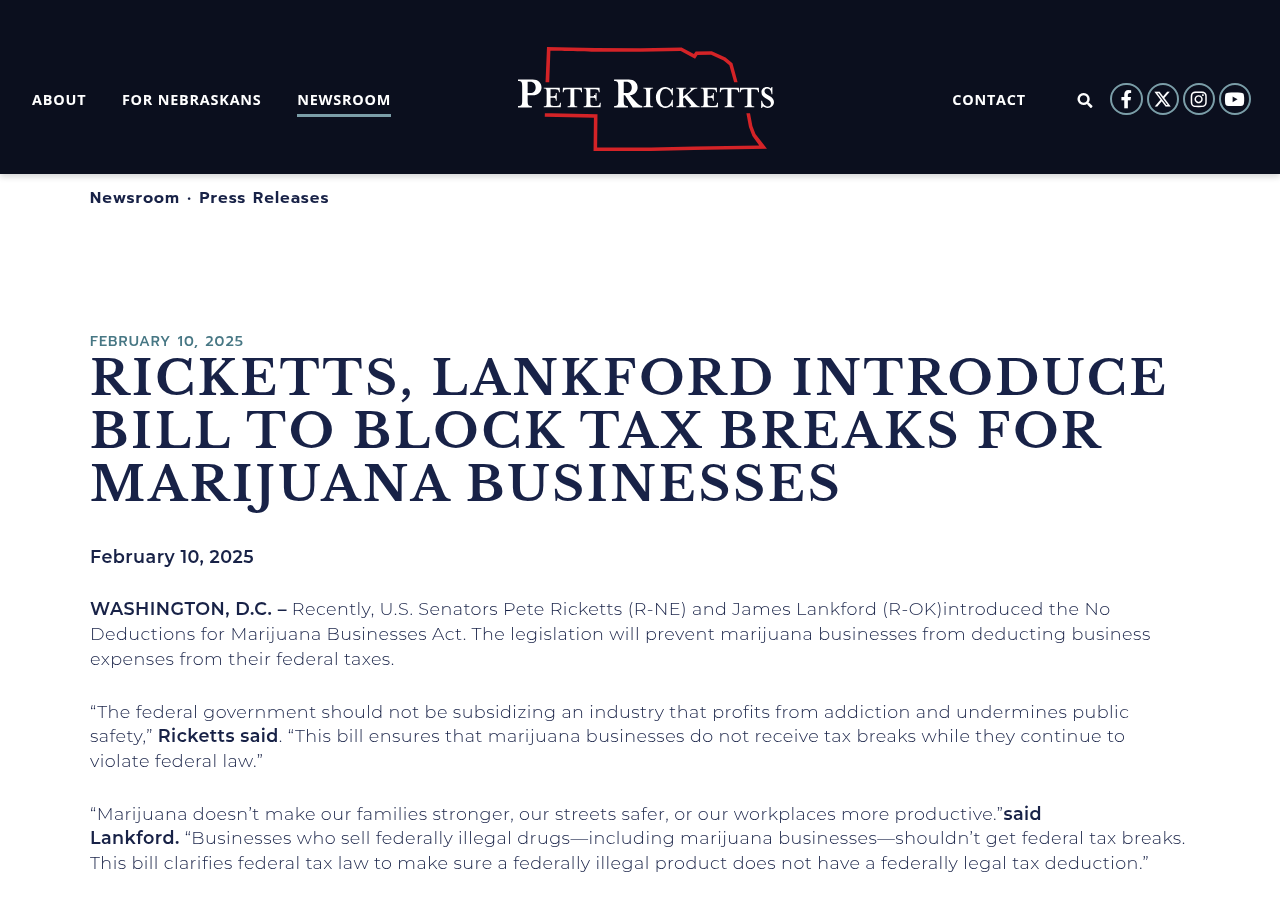
“The federal government should not be subsidizing an industry that profits from addiction and undermines public safety.”

The evidence

Ordinary business-expense deductions are not a “subsidy” unique to cannabis; they are how legal businesses are taxed. Alcohol, tobacco, and pharmaceutical companies deduct expenses while selling products with higher death tolls and, for alcohol and nicotine, higher or comparable dependence risk. NESARC data found the probability of transition from first use to dependence was substantially lower for cannabis than for nicotine. Public safety is a regulation problem (age, driving, packaging), not a reason to single cannabis out of the tax code after HHS found accepted medical use.2 3 8 55

Back to index

Snapshot of the source for James Lankford
Public record
Official portrait of James Lankford
On record
February 10, 2025
Photo: United States Senate, Public domain

James Lankford

U.S. Senator (R-OK) · February 10, 2025

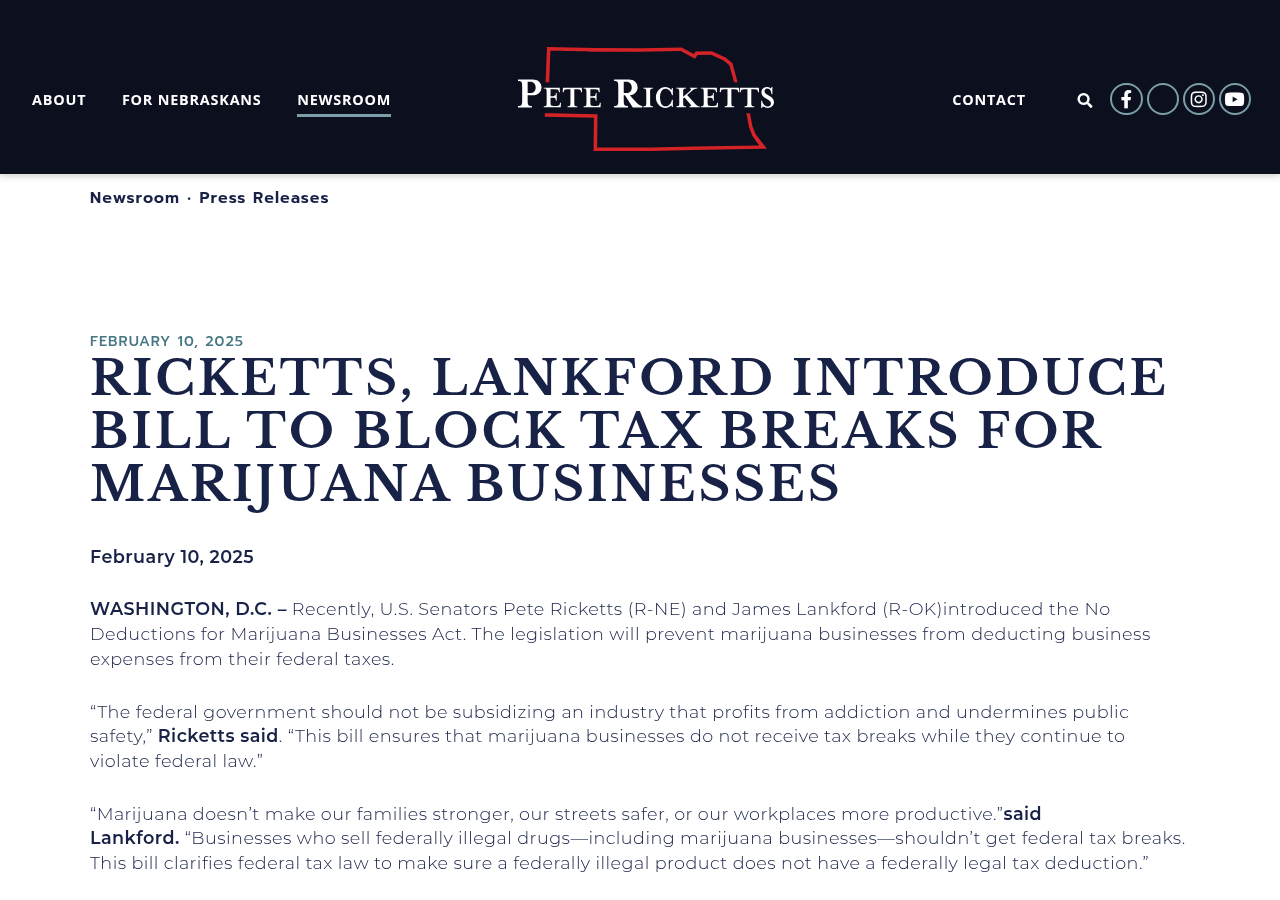
“Marijuana doesn’t make our families stronger, our streets safer, or our workplaces more productive. Businesses who sell federally illegal drugs—including marijuana businesses—shouldn’t get federal tax breaks.”

The evidence

This is a values claim dressed up as a tax argument. Alcohol is legal, deductible as a business, and far more strongly tied to family violence, impaired driving deaths, and lost productivity; expert harm rankings have placed alcohol above cannabis overall. HHS in 2023 found accepted medical use for marijuana, undercutting the idea that every cannabis sale is simply “federally illegal drugs” in the Schedule I sense of no medical use. Tax policy can be debated; the comparison to alcohol is the one this claim avoids.2 3 55

Back to index

Snapshot of the source for John Rutherford
Public record
Official portrait of John Rutherford
On record
September 20, 2024
Photo: House Creative Services, Public domain

John Rutherford

U.S. Representative (R-FL), former Jacksonville sheriff · September 20, 2024

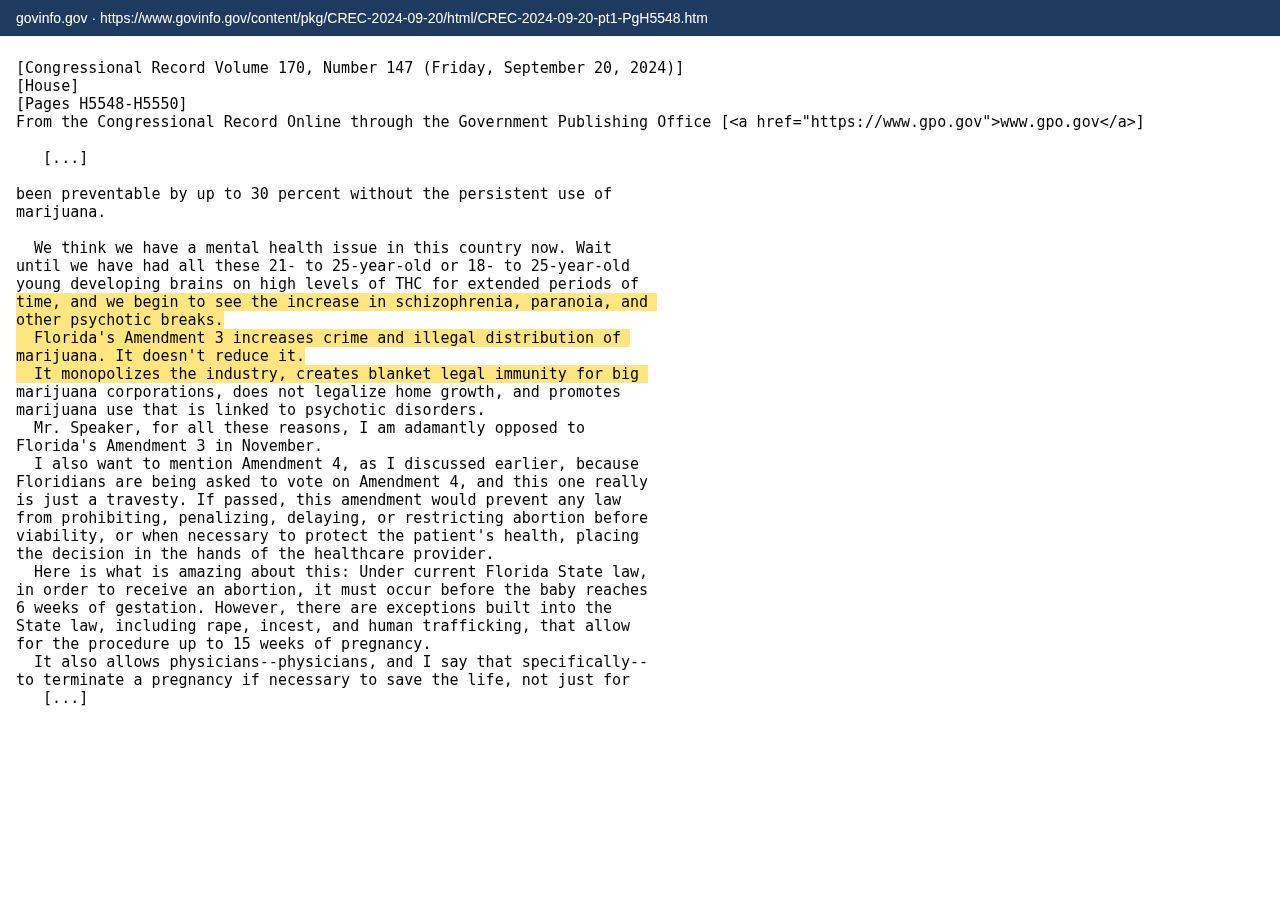
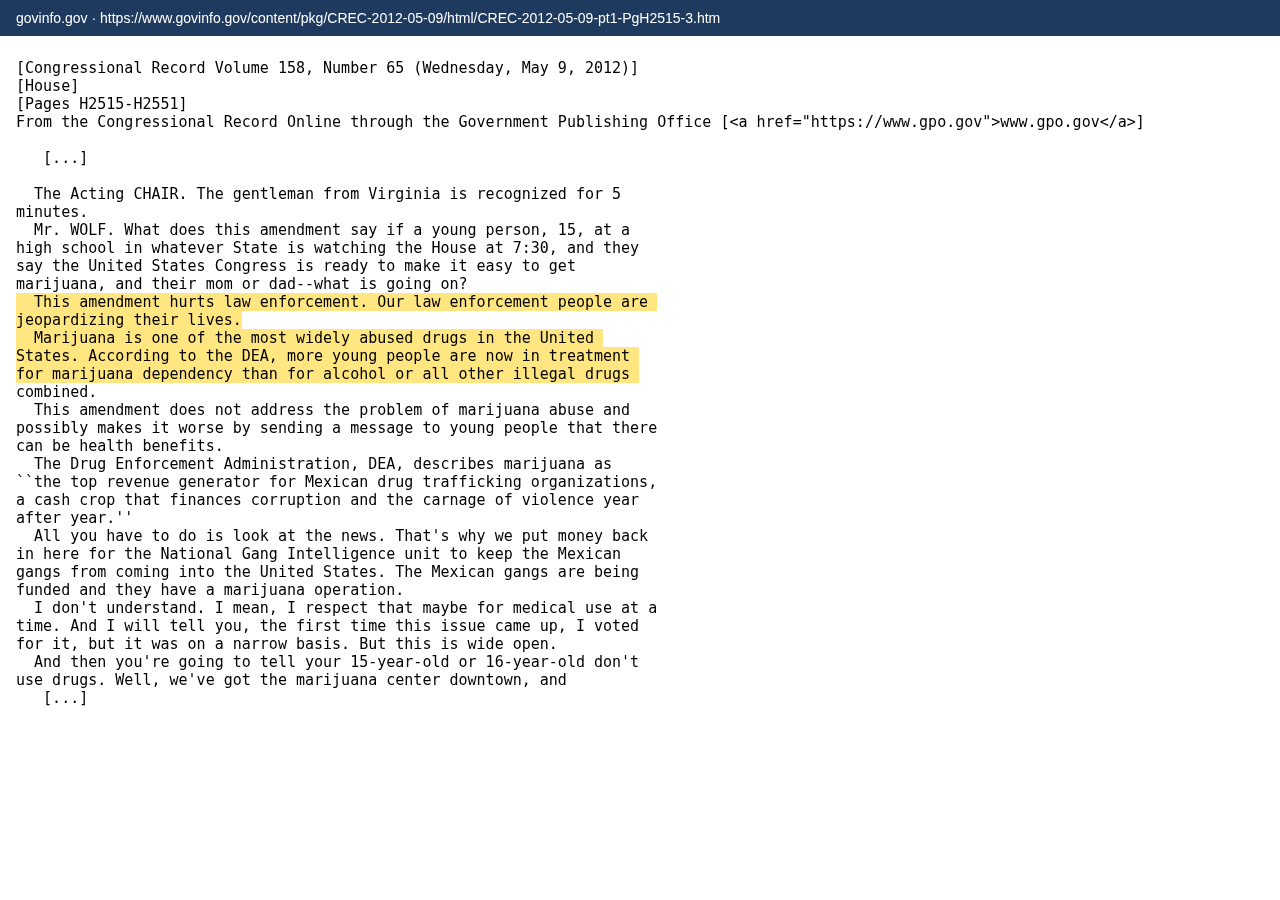
“Florida's Amendment 3 increases crime and illegal distribution of marijuana. It doesn't reduce it. It monopolizes the industry, creates blanket legal immunity for big marijuana corporations, does not legalize home growth, and promotes marijuana use that is linked to psychotic disorders.”

House floor remarks opposing Florida’s 2024 adult-use ballot measure. In the same speech he called claims that legal sales cut fentanyl-laced marijuana “another lie.”

Snapshot shows an excerpt of the govinfo.gov page text around the quote (highlighted), with the page’s own header lines; rendered from the official text on 2026-11-14 06:45 PM America/Chicago.

The evidence

Fair point, owned honestly: the National Academies found an association between cannabis and psychosis, highest among the most frequent users, which is why labeling and 21+ rules matter. But “increases crime” was asserted, not shown. Youth use did not rise with legalization in national survey data, and licensed markets test and label products the street never does. A majority of Florida voters (about 56%) backed Amendment 3 anyway; it fell short only of Florida’s 60% bar.10 53

Back to index

Snapshot of the source for Gavin Newsom
Public record
Official portrait of Gavin Newsom
On record
September 6, 2024
Photo: Charles Ommanney – Office of the Governor of California, Public domain

Gavin Newsom

Governor of California (D) · September 6, 2024

“We will not sit on our hands as drug peddlers target our children with dangerous and unregulated hemp products containing THC at our retail stores. We’re taking action to close loopholes and increase enforcement to prevent children from accessing these dangerous hemp and cannabis products.”

From the release announcing emergency rules requiring “no detectable THC” in hemp food and drink products — effectively a ban on intoxicating hemp, plus a 21+ age limit.

The evidence

A 21+ age limit and child-safe packaging are reasonable, and CDC data on pediatric edible exposures support them. “Drug peddlers,” though, describes licensed California retailers selling a product that was legal under the 2018 Farm Bill. A “no detectable THC” rule goes far past protecting children; it bans products for adults too. California already runs a legal adult-use cannabis market, so the honest framing is a market-share and regulation fight, not a war on peddlers. On the comparative-harm evidence, cannabis sits well below alcohol.2 26 30
Back to index

Snapshot of the source for Ron DeSantis
Public record
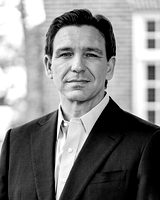
Official portrait of Ron DeSantis
On record
April 4, 2024
Photo: Government of Florida, Public domain

Ron DeSantis

Governor of Florida (R) · April 4, 2024

Secondhand source — contemporaneous news report

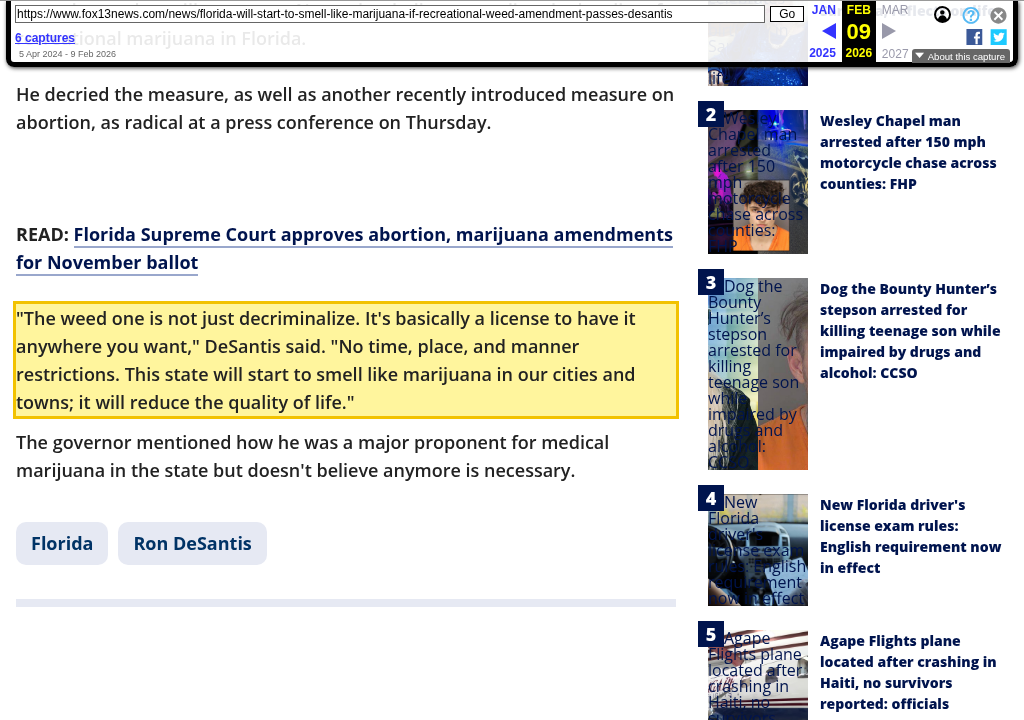
“The weed one is not just decriminalize. It's basically a license to have it anywhere you want. No time, place, and manner restrictions. This state will start to smell like marijuana in our cities and towns; it will reduce the quality of life.”

SECONDHAND: FOX 13 Tampa Bay report of a press conference about Amendment 3, Florida’s 2024 adult-use ballot measure.

Snapshot of the Wayback Machine copy with the quote highlighted and pop-up overlays removed; taken 2026-11-14 06:56 PM America/Chicago.

The evidence

“Smell” is a vibe, not a public-health finding. Most Americans already live in legal states, and national survey data found legalization was not associated with more teen use. Amendment 3 still won a majority of Florida voters; it fell short only of the state’s 60% threshold. Florida voters had already approved medical cannabis in 2016. If quality of life is the test, alcohol — legal in every Florida town — accounts for about 178,000 U.S. deaths a year.3 53 125

Back to index

Snapshot of the source for Pete Ricketts
Public record
Official portrait of Pete Ricketts
On record
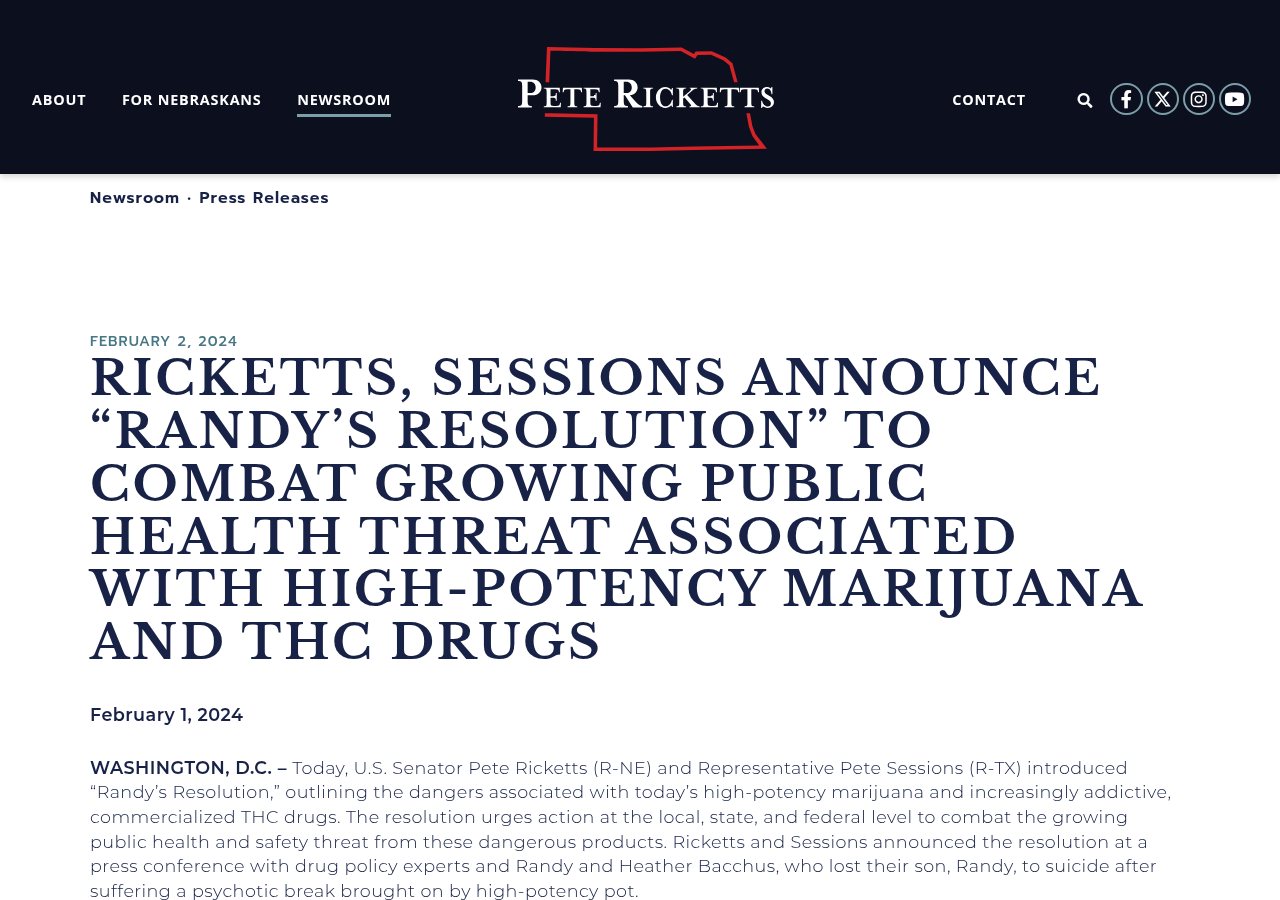
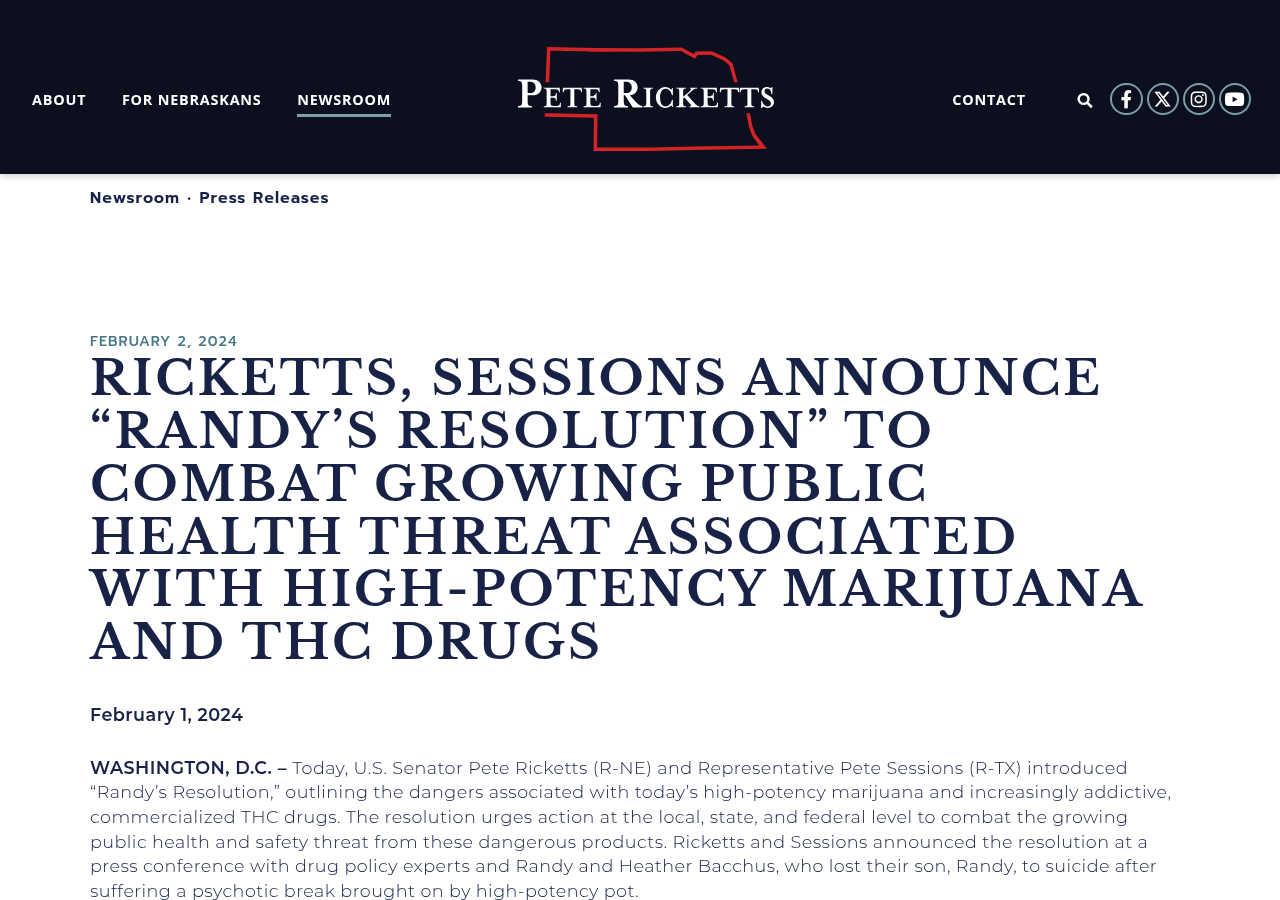
February 1, 2024
Photo: United States Congress, Public domain

Pete Ricketts

U.S. Senator (R-NE) · February 1, 2024

“The average THC potency in marijuana has more than tripled since 1995, and it’s killing young Americans like Randy Bacchus Jr. Randy’s Resolution is a call to arms for every level of government to do more to combat the dangerous, addictive high-potency marijuana products flooding the market today. We can’t stand by and do nothing while the big marijuana lobby gets the next generation addicted to a drug that causes mental health disorders and cognitive impairment.”

The evidence

A family’s loss is not something to dismiss, and potency of commercial cannabis has risen over recent decades. “It’s killing young Americans” still frames cannabis as a lethal toxin. NASEM (2017) found a statistical association between cannabis use and psychosis that is stronger with heavier and earlier use; it did not find that cannabis is a common cause of death. Dependence risk exists — NESARC data put the probability of transition from first use to dependence much lower for cannabis than for nicotine — and most people who use cannabis do not develop a psychotic disorder. Higher potency is an argument for dose labeling and serving-size rules, the way alcohol is sold by proof, not for treating the plant as a body count.1 8 10 12

Back to index

Snapshot of the source for Pete Sessions
Public record
Official portrait of Pete Sessions
On record
February 1, 2024
Photo: House Creative Services, Public domain

Pete Sessions

U.S. Representative (R-TX) · February 1, 2024

“The staggering increase in abuse of potent THC products, and the associated health risks, cannot be ignored. High levels of marijuana use pose a significant risk, particularly to our youth, increasing the incidence of psychosis fivefold.”

The evidence

A fivefold figure is sometimes drawn from observational studies of daily high-potency use in specific populations. It is not a finding that typical youth cannabis use multiplies psychosis five times in the general population. NASEM (2017) found a statistical association with schizophrenia and other psychoses, greater with heavier and earlier use, and also that people with psychotic symptoms are more likely to use cannabis — a two-way problem that makes a simple “fivefold” slogan misleading. Most people who use cannabis never develop a psychotic disorder. Youth protection still points to 21+ age limits and honest risk labeling, not to a blanket claim about “incidence.”10 12

Back to index

Snapshot of the source for Ken Paxton
Public record
Official portrait of Ken Paxton
On record
January 31, 2024
Photo: Gage Skidmore, CC BY-SA 4.0

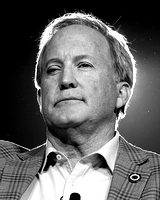
Ken Paxton

Attorney General of Texas (R) · January 31, 2024

“The five municipalities adopted ordinances or policies instructing police not to enforce Texas drug laws concerning possession and distribution of marijuana—an illicit substance that psychologists have increasingly linked to psychosis and other negative consequences. “I will not stand idly by as cities run by pro-crime extremists deliberately violate Texas law and promote the use of illicit drugs that harm our communities,” said Attorney General Paxton.”

Official Texas Attorney General press release. The first sentence is the office’s characterization of marijuana; the second is Paxton’s attributed quotation.

The evidence

NASEM and other reviews have found an association between cannabis use and psychosis or schizophrenia, with the evidence stronger for heavy use and for people who already have other risk factors. Most people who use cannabis never develop psychosis. The press release treats that association as a reason cities must keep arresting people for possession, and Paxton calls local non-enforcement policies the work of “pro-crime extremists” who “promote the use of illicit drugs.” Declining to arrest adults for possession is not the same thing as promoting use, and it is not a finding about psychosis. A public-health response can warn honestly about psychiatric risk without treating every city that deprioritizes low-level possession as a crime faction.10 72

Back to index

Snapshot of the source for Mike Flood
Public record
Official portrait of Mike Flood
On record
November 7, 2023
Photo: Ike Hayman, Public domain

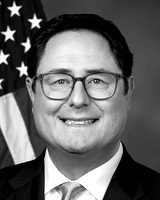
Mike Flood

U.S. Representative (R-NE) · November 7, 2023

“Today, retailers across Nebraska are selling THC-laced products aimed at kids. For example, a retailer in Madison County has allegedly been selling gummies containing 200 times the level of THC needed to send a kid to the hospital. Delta 8 products are made to look like common types of candy or snacks to appeal to children.”

House floor remarks titled “Delta 8.”

The evidence

Copycat candy packaging is a fair target, and CDC data on pediatric edible exposures are real. But “200 times the level needed to send a kid to the hospital” was offered as an allegation (his word: “allegedly”), with no dose science behind it. The tools that work are the ones adult-use states already require: 21+ sales, child-resistant packaging, dose limits, and no cartoon branding. Hemp-derived cannabinoids were legal under the 2018 Farm Bill, and cannabis has a far wider safety margin than alcohol.1 26 30
Back to index

Snapshot of the source for Pete Ricketts, John Cornyn, Ted Budd, and James Lankford
Public record
On record
September 26, 2023
No freely licensed portrait

Pete Ricketts, John Cornyn, Ted Budd, and James Lankford

U.S. Senators (R-NE, R-TX, R-NC, R-OK) · September 26, 2023

“The growth of the marijuana industry has already caused THC potency to skyrocket from 2-5% in the 1970s to 99% in many concentrates sold today. The significant mental health damage to youth caused by these products will only worsen with the passage of the SAFER Banking Act, as the industry will use new investments to increase potency further and bring in new users, including children. Marijuana use is associated with psychosis, motor vehicle accidents, respiratory problems, and low birth weight. … Allowing banking access to a Schedule I drug sets a dangerous legal precedent and will help facilitate money laundering for drug cartels.”

Joint letter to Senate leaders, as published in Sen. Ricketts’s official press release. Ellipsis marks an omitted passage between two consecutive quoted paragraphs.

The evidence

Flower potency has risen from the low single digits of mid-century street samples toward much stronger commercial flower, and concentrates can test at very high THC percentages. Collapsing that into “marijuana … 99%” makes distillate sound like the ordinary product. Associations with psychosis (heavier use), impaired driving, smoke-related respiratory effects, and low birth weight appear in the evidence base and are reasons for 21+ laws, impaired-driving rules, and pregnancy guidance — not a proof that giving state-licensed shops bank accounts will hook children or launder cartel money. Bringing licensed businesses into the regulated banking system is the opposite of an unregulated cash market. HHS in 2023 found accepted medical use, the scientific premise of the Schedule I claim the letter relies on.10 12 25 28 55

Back to index

Snapshot of the source for Ron DeSantis
Public record
Official portrait of Ron DeSantis
On record
August 26, 2023
Photo: Government of Florida, Public domain

Ron DeSantis

Governor of Florida (R) · August 26, 2023

Secondhand source — contemporaneous news report

“I think what’s happened is this stuff is very potent now. I think when young people get it, I think it’s a real, real problem, and I think it’s a lot different than stuff that people were using 30, 40 years ago. I think when kids get on that, I think it causes a lot of problems and then, of course, you know, they can throw fentanyl in any of this stuff now. … But what’s happened in Colorado, the black market for marijuana is bigger and more lucrative than it was before they did the legalization. So the legalization I don’t think has worked.”

SECONDHAND: Marijuana Moment report, published August 28, 2023, of remarks at an Iowa campaign event on Saturday, August 26, 2023. The outlet presents these as direct quotations. We did not open a video or official transcript of the event.

The evidence

Potency has risen, and adolescent use is a real risk window. “They can throw fentanyl in any of this stuff now” is a scare line, not a description of how legal cannabis markets work; fentanyl contamination is a feature of the illicit opioid supply, not of regulated cannabis. DeSantis also claimed Colorado’s black market is “bigger and more lucrative” than before legalization and cited no data in the remarks as reported. An illicit market can persist after legalization, especially where taxes are high or interstate commerce remains illegal, but that is an argument for better regulation and federal reform, not proof that legalization “hasn’t worked.”10 12 72

Back to index

Snapshot of the source for Asa Hutchinson
Public record
Official portrait of Asa Hutchinson
On record
August 3, 2022
Photo: U.S. Drug Enforcement Administration, Public domain

Asa Hutchinson

Governor of Arkansas (R) · August 3, 2022

Secondhand source — contemporaneous news report

“And so, once again, they’re selling a harmful drug to the citizens of Arkansas based upon promises that looks good. … It’s going to take a lot of education in order to change that climate and to be able to show voters that this would be, in fact, harmful.”

SECONDHAND: Marijuana Moment report, published August 4, 2022, of remarks at the Arkansas Municipal Police Association Convention on Wednesday, August 3, 2022. The outlet presents these as direct quotations (one line is also attributed there to The Sentinel-Record). We did not open a video or official transcript. A widely repeated longer line, “I believe that marijuana is a harmful drug,” was not in the article we opened, so it is not used here.

The evidence

Hutchinson, a former DEA administrator, told police to “stand firm” and described a legalization initiative as selling “a harmful drug.” Cannabis can be harmful, especially for adolescents and heavy users, and it can be dependence-forming. Calling adult-use legalization the sale of a harmful drug, and asking law enforcement to campaign against a ballot measure on that basis, still treats a substance with a very wide safety margin as if the only honest education is opposition. The public-health tools used for alcohol — age limits, licensing, and warnings — were not the education he was asking officers to deliver.1 2 3 10 72

Back to index

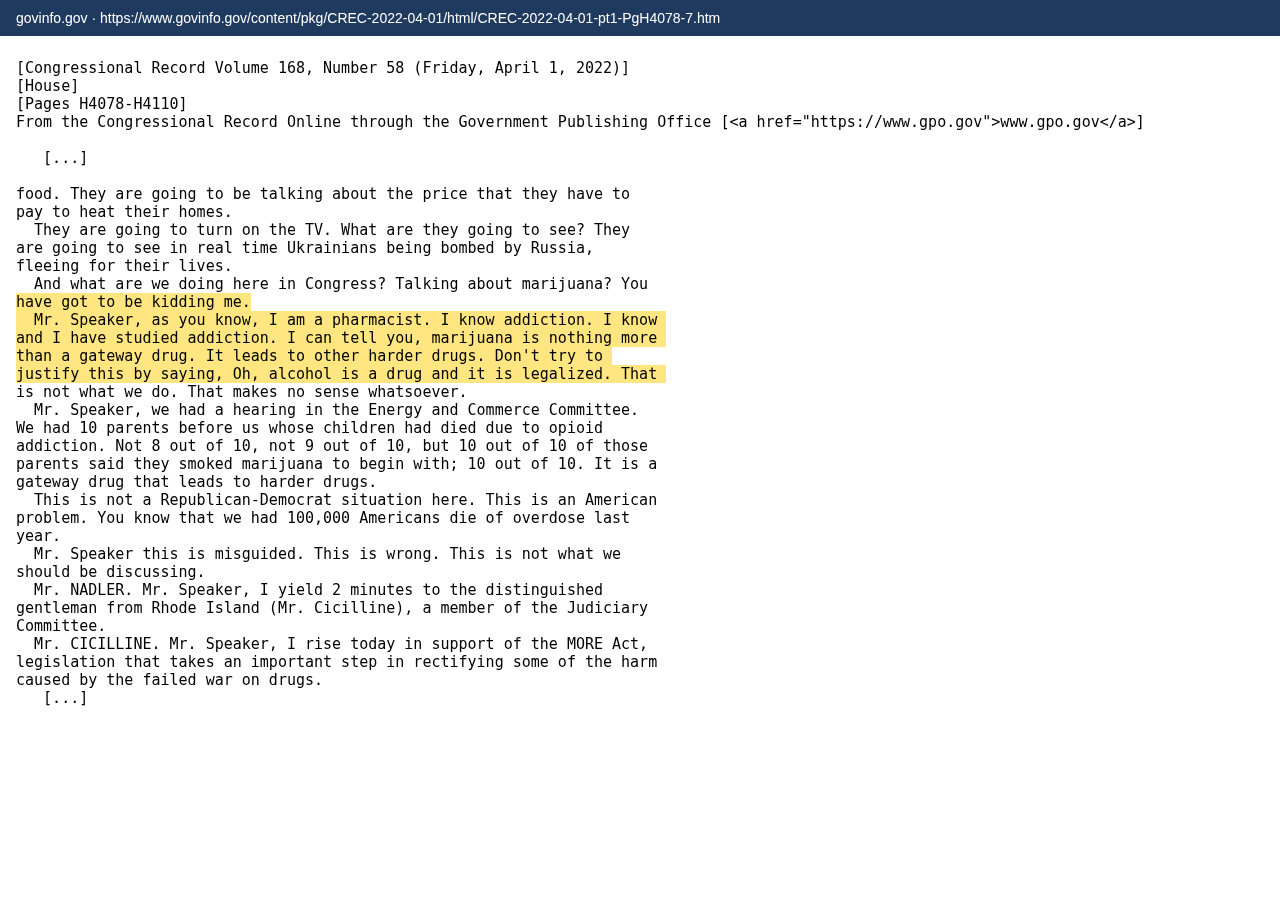
Snapshot of the source for Earl L. “Buddy” Carter
Public record
Official portrait of Earl L. “Buddy” Carter
On record
April 1, 2022
Photo: House Creative Services, Public domain

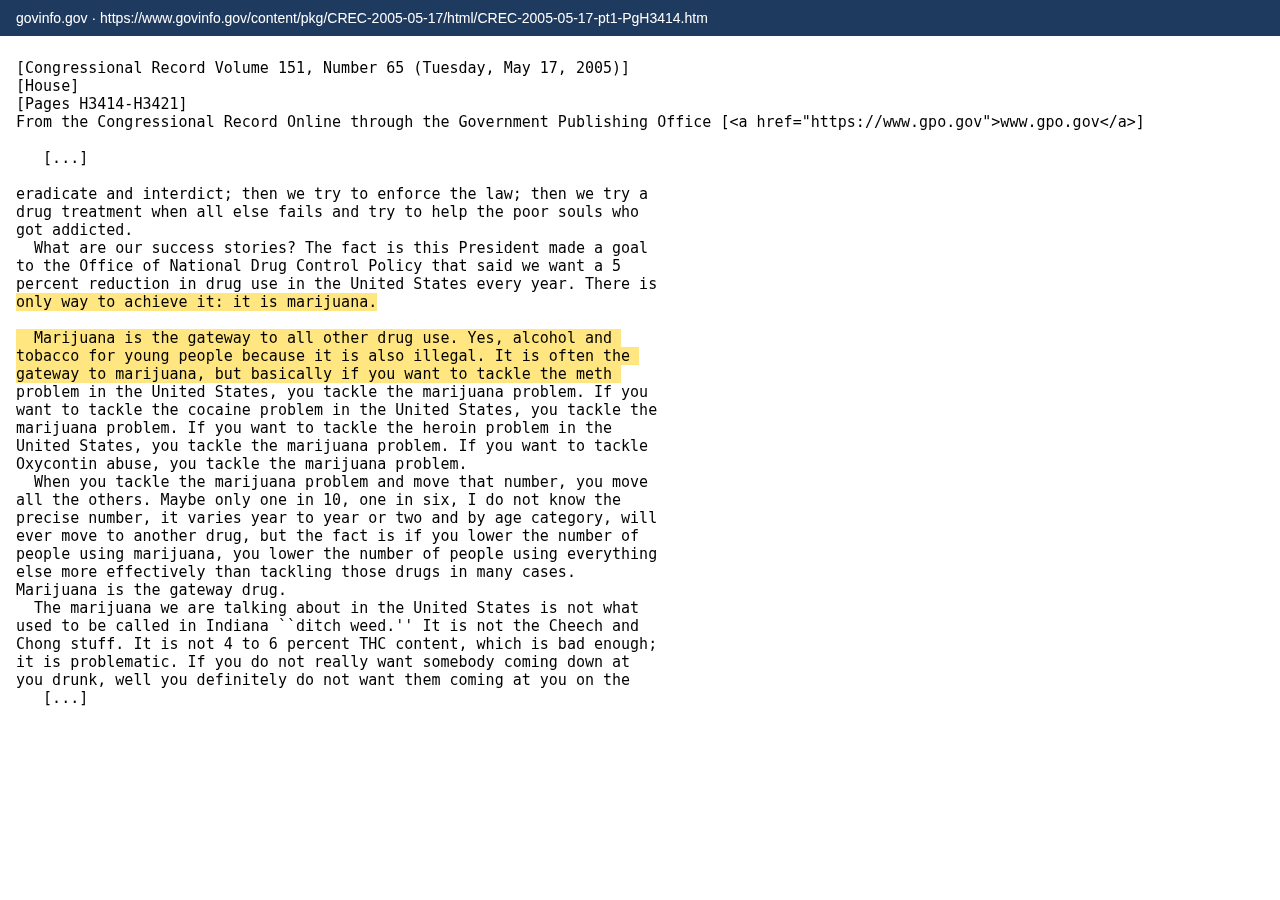
Earl L. “Buddy” Carter

U.S. Representative (R-GA) · April 1, 2022

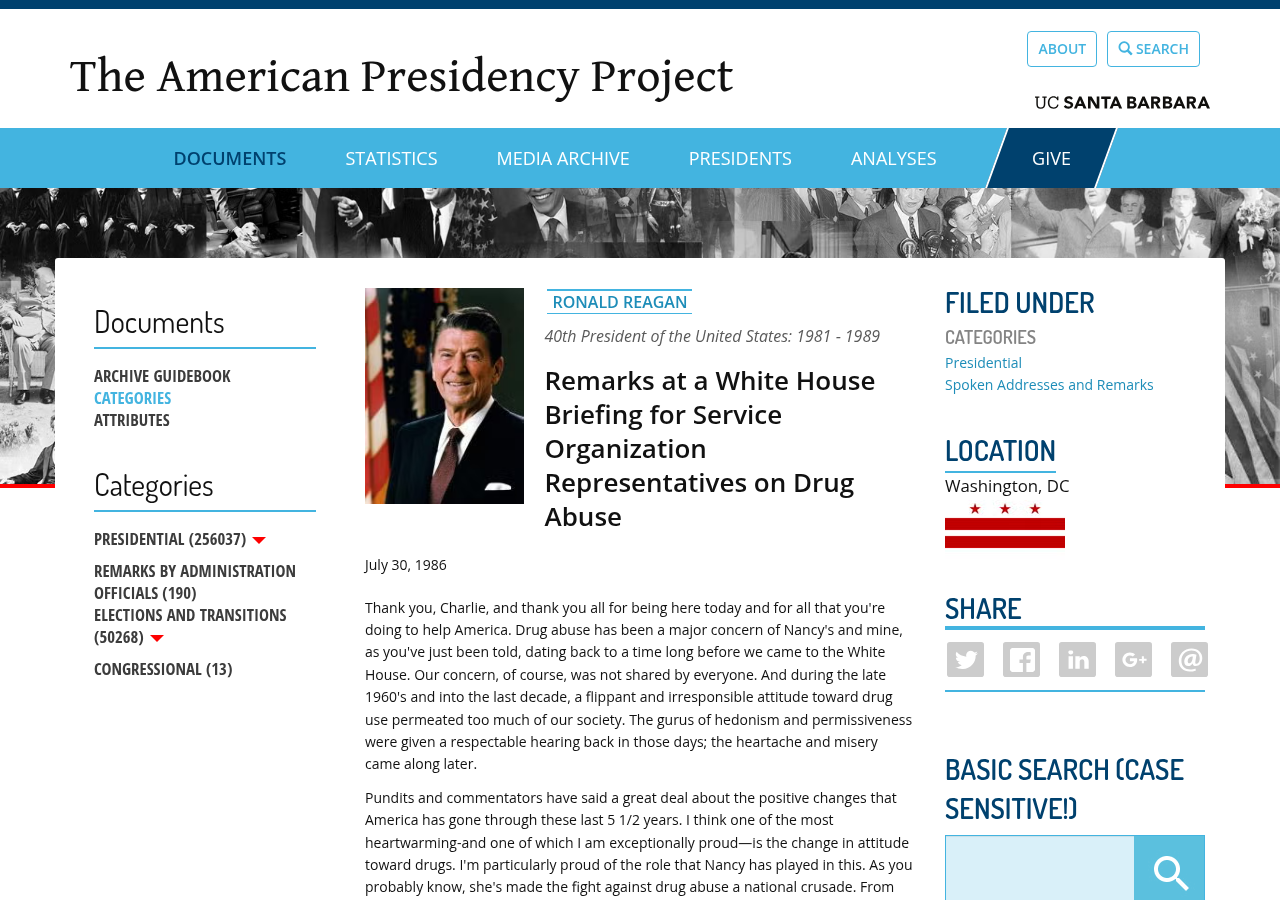
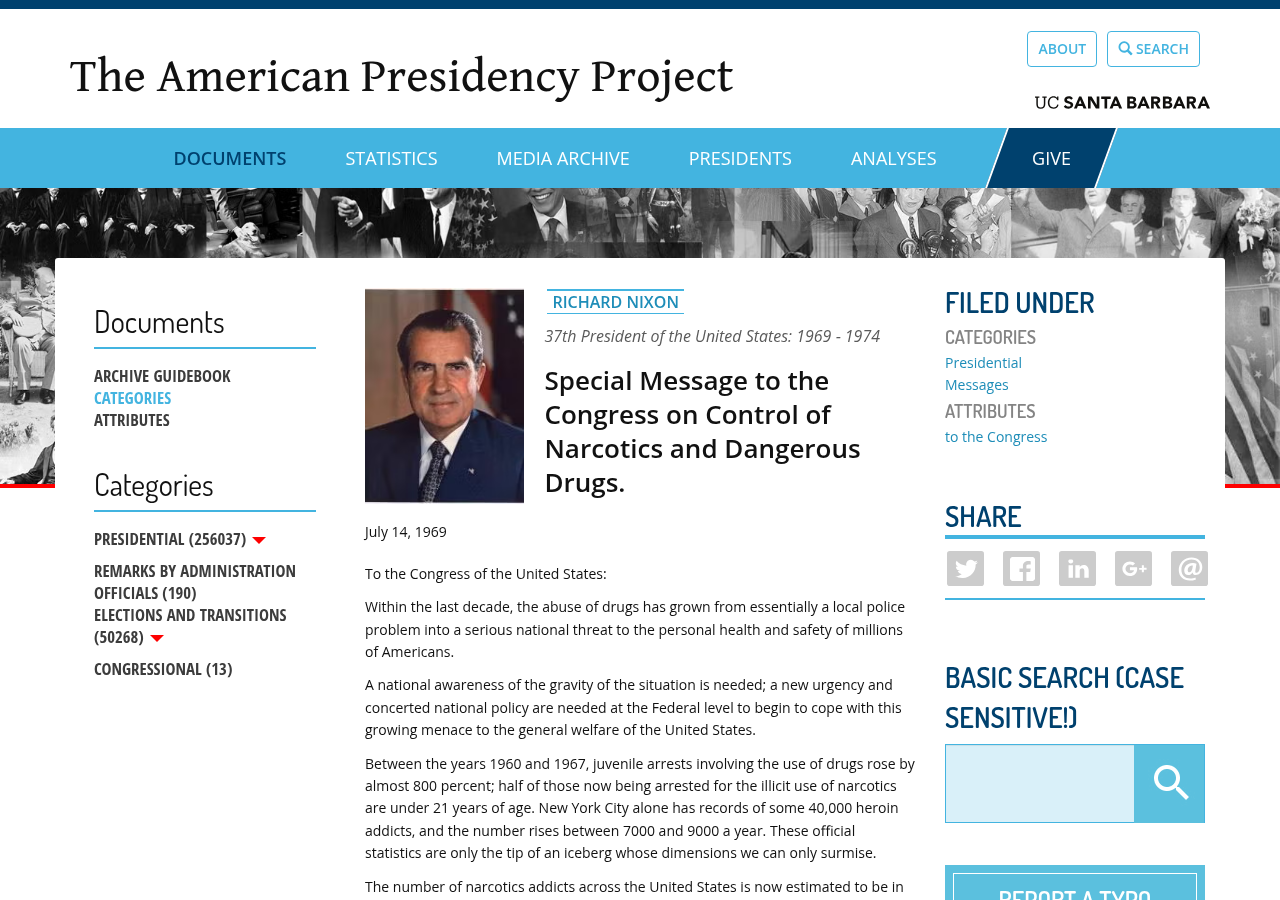
“I can tell you, marijuana is nothing more than a gateway drug. It leads to other harder drugs. Don't try to justify this by saying, Oh, alcohol is a drug and it is legalized. That is not what we do. That makes no sense whatsoever.”

House floor debate on the MORE Act (H.R. 3617), which passed the House that day.

Snapshot shows an excerpt of the govinfo.gov page text around the quote (highlighted), with the page’s own header lines; rendered from the official text on 2026-11-14 06:45 PM America/Chicago.

The evidence

NIDA says the opposite of “nothing more than a gateway”: most people who use cannabis never go on to other drugs. His floor anecdote — 10 grieving parents who all said their children started with marijuana — is a selection effect; NIDA notes alcohol and tobacco are also usually among the first substances people try. And the alcohol comparison he waves off is the one that matters: cannabis has a far lower dependence risk, and alcohol kills about 178,000 Americans a year.3 8 72

Back to index

Snapshot of the source for Andy Biggs
Public record
Official portrait of Andy Biggs
On record
April 1, 2022
Photo: U.S. Congress, Public domain

Andy Biggs

U.S. Representative (R-AZ) · April 1, 2022

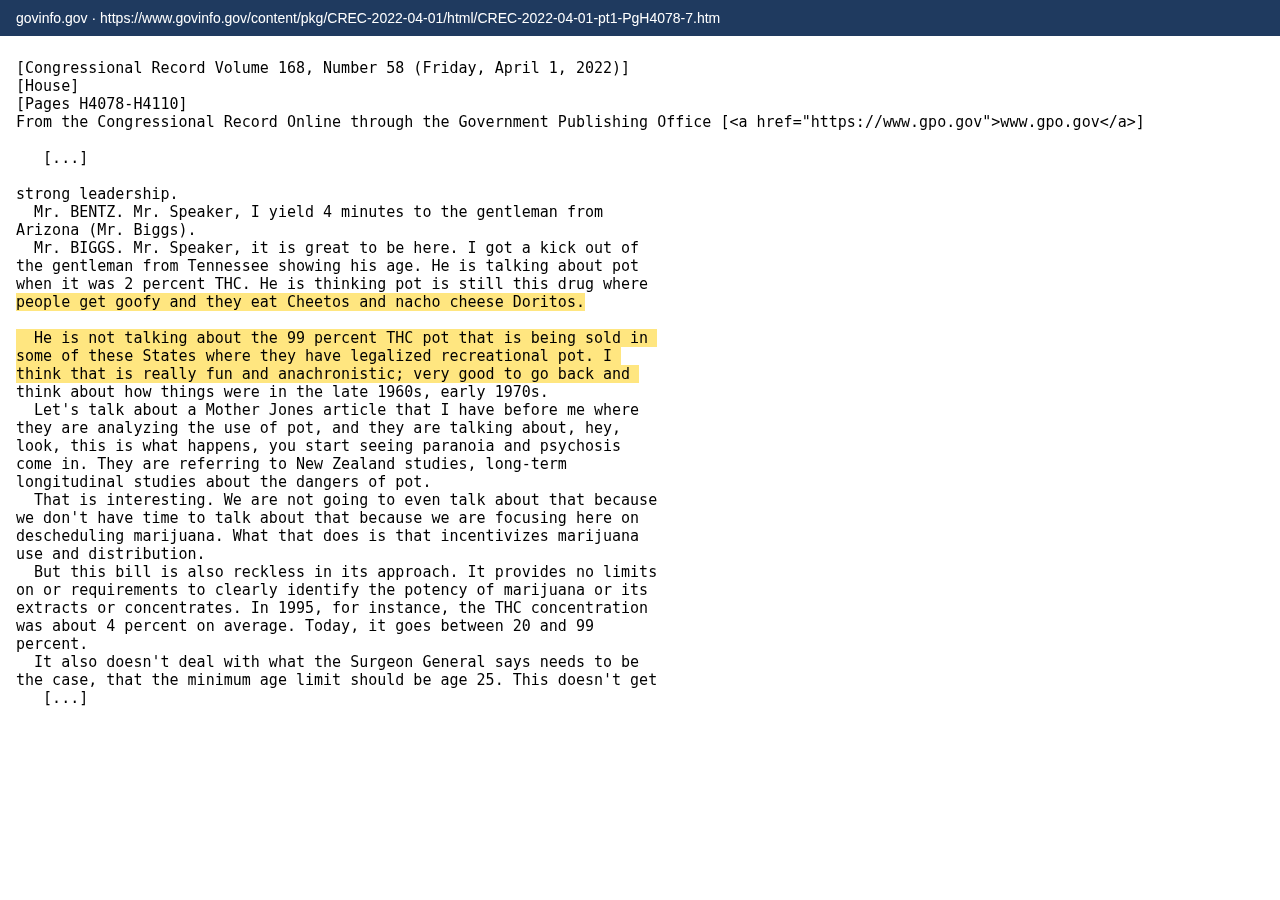
“He is not talking about the 99 percent THC pot that is being sold in some of these States where they have legalized recreational pot. … In 1995, for instance, the THC concentration was about 4 percent on average. Today, it goes between 20 and 99 percent. It also doesn't deal with what the Surgeon General says needs to be the case, that the minimum age limit should be age 25.”

House floor debate on the MORE Act (H.R. 3617).

Snapshot shows an excerpt of the govinfo.gov page text around the quote (highlighted), with the page’s own header lines; rendered from the official text on 2026-11-14 06:45 PM America/Chicago.

The evidence

No cannabis flower is 99% THC. The DEA-sample potency study he is echoing found seized flower rose from about 4% in 1995 to about 12% in 2014; near-pure figures describe refined concentrates, a different product. The 2019 Surgeon General’s advisory notes the brain keeps developing into the mid-20s, but it sets no “minimum age limit” of 25 — we read it. Potency labels and 21+ laws are what the MORE Act debate was about.10 136

Back to index

Snapshot of the source for Steven Palazzo
Public record
Official portrait of Steven Palazzo
On record
April 1, 2022
Photo: House Creative Services, Public domain

Steven Palazzo

U.S. Representative (R-MS) · April 1, 2022

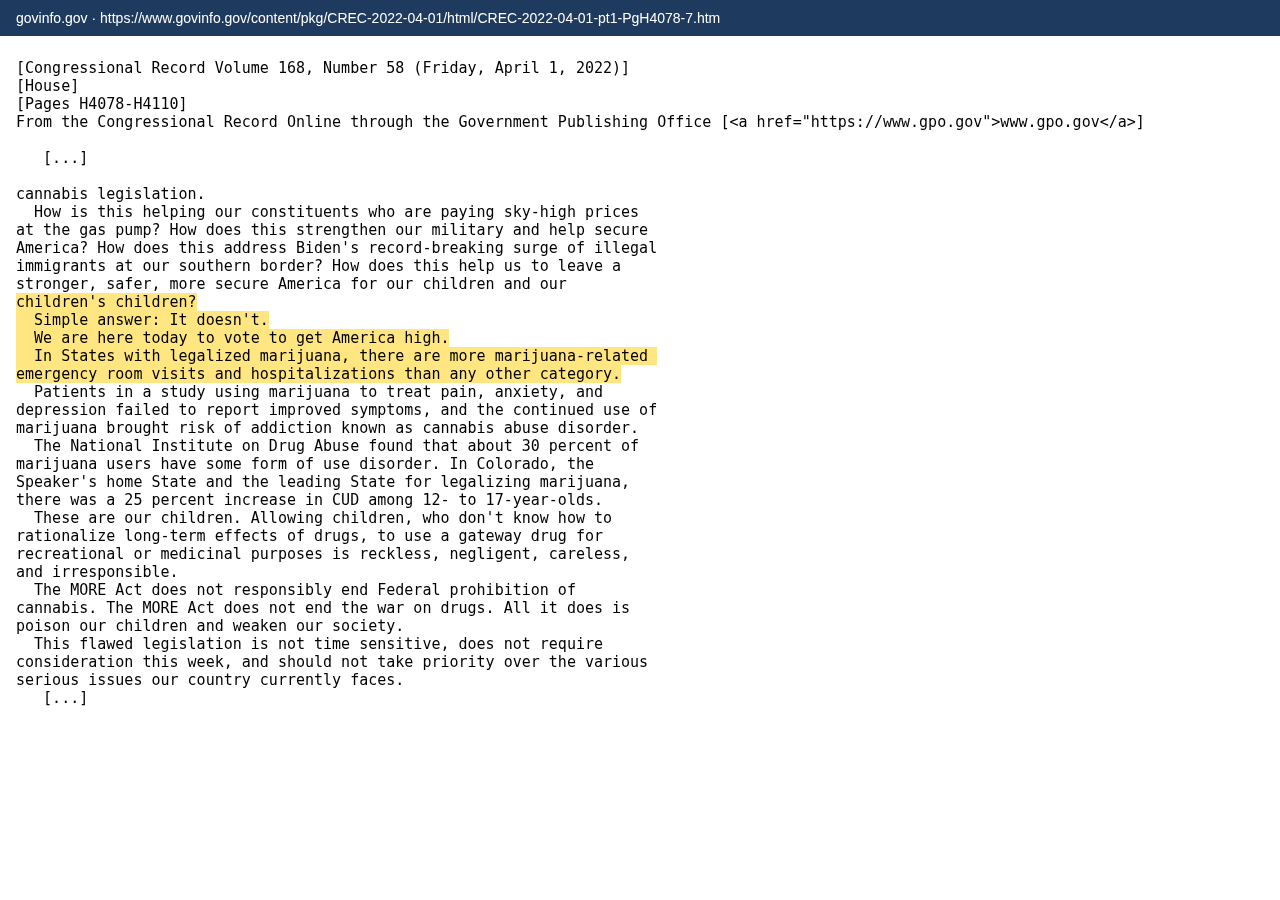
“We are here today to vote to get America high. In States with legalized marijuana, there are more marijuana-related emergency room visits and hospitalizations than any other category.”

House floor debate on the MORE Act (H.R. 3617).

Snapshot shows an excerpt of the govinfo.gov page text around the quote (highlighted), with the page’s own header lines; rendered from the official text on 2026-11-14 06:45 PM America/Chicago.

The evidence

He cited no source for “more than any other category,” and national data point the other way: alcohol alone accounts for about 178,000 U.S. deaths a year, and comparative-risk research puts cannabis’s population margin of exposure far beyond alcohol’s. The MORE Act decriminalized and expunged; it did not require anyone to get high. Most Americans favor legal marijuana, and the House passed the bill that day.1 3 126

Back to index

Snapshot of the source for Bob Good
Public record
Official portrait of Bob Good
On record
April 1, 2022
Photo: House Creative Committee, Public domain

Bob Good

U.S. Representative (R-VA) · April 1, 2022

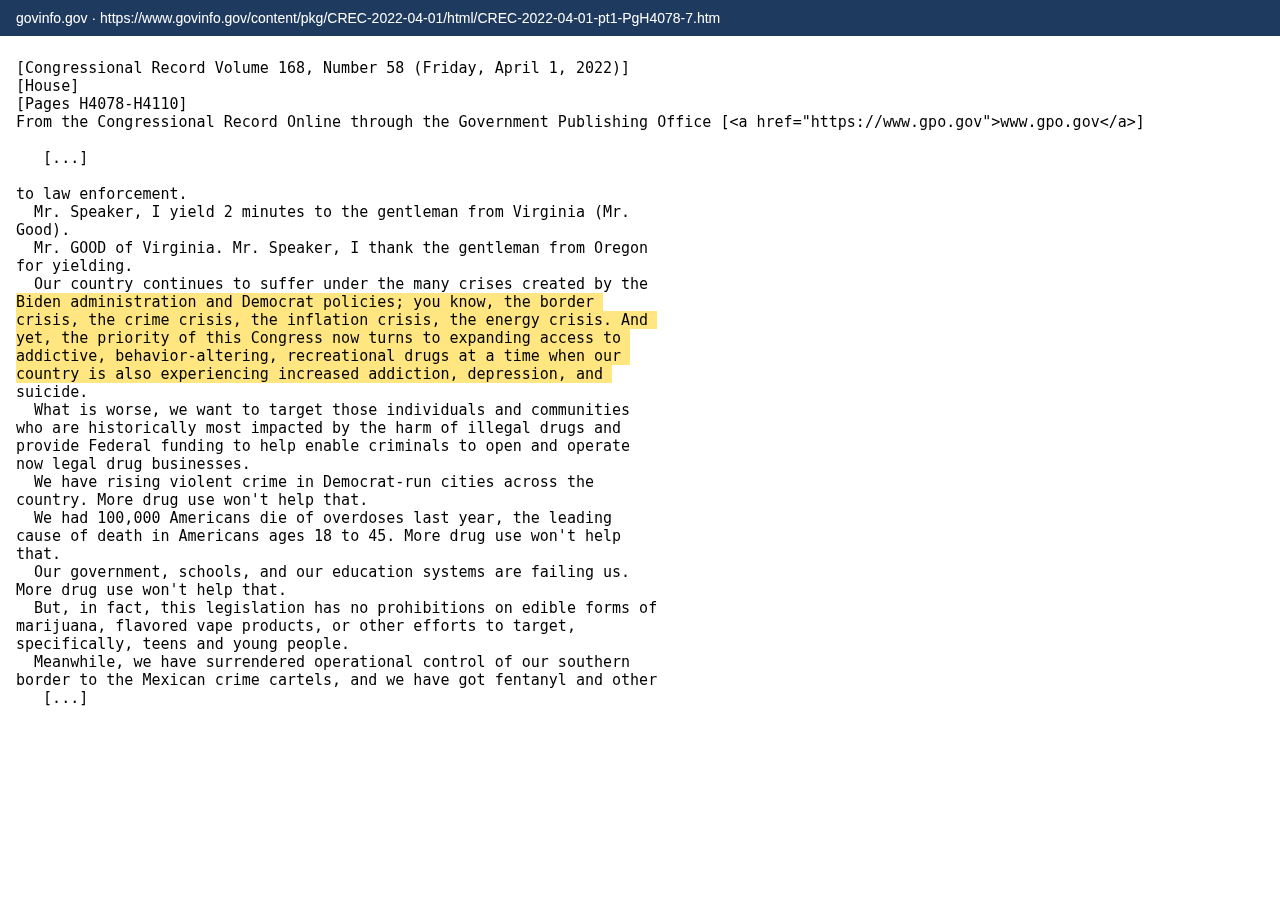
“And yet, the priority of this Congress now turns to expanding access to addictive, behavior-altering, recreational drugs at a time when our country is also experiencing increased addiction, depression, and suicide.”

House floor debate on the MORE Act (H.R. 3617).

Snapshot shows an excerpt of the govinfo.gov page text around the quote (highlighted), with the page’s own header lines; rendered from the official text on 2026-11-14 06:45 PM America/Chicago.

The evidence

By this definition alcohol is an “addictive, behavior-altering, recreational drug,” and it is legal and advertised. It is also far more addictive: about 22.7% of drinkers develop dependence over a lifetime, compared with 8.9% of cannabis users. It kills about 178,000 Americans a year. The MORE Act decriminalized cannabis and cleared records. Expert harm rankings put alcohol well above cannabis.2 3 8

Back to index

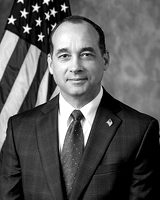
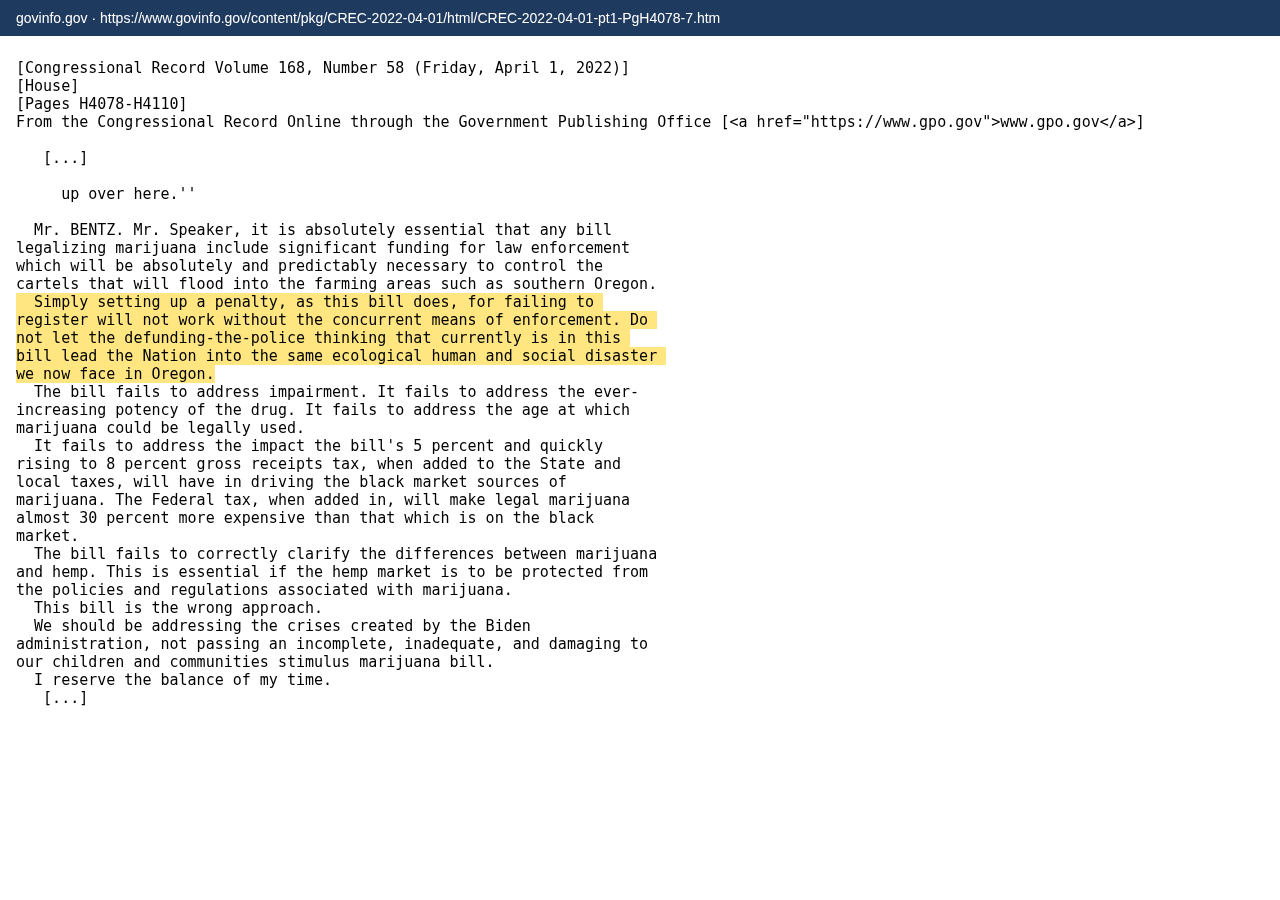
Snapshot of the source for Cliff Bentz
Public record
Official portrait of Cliff Bentz
On record
April 1, 2022
Photo: House Creative Committee, Public domain

Cliff Bentz

U.S. Representative (R-OR) · April 1, 2022

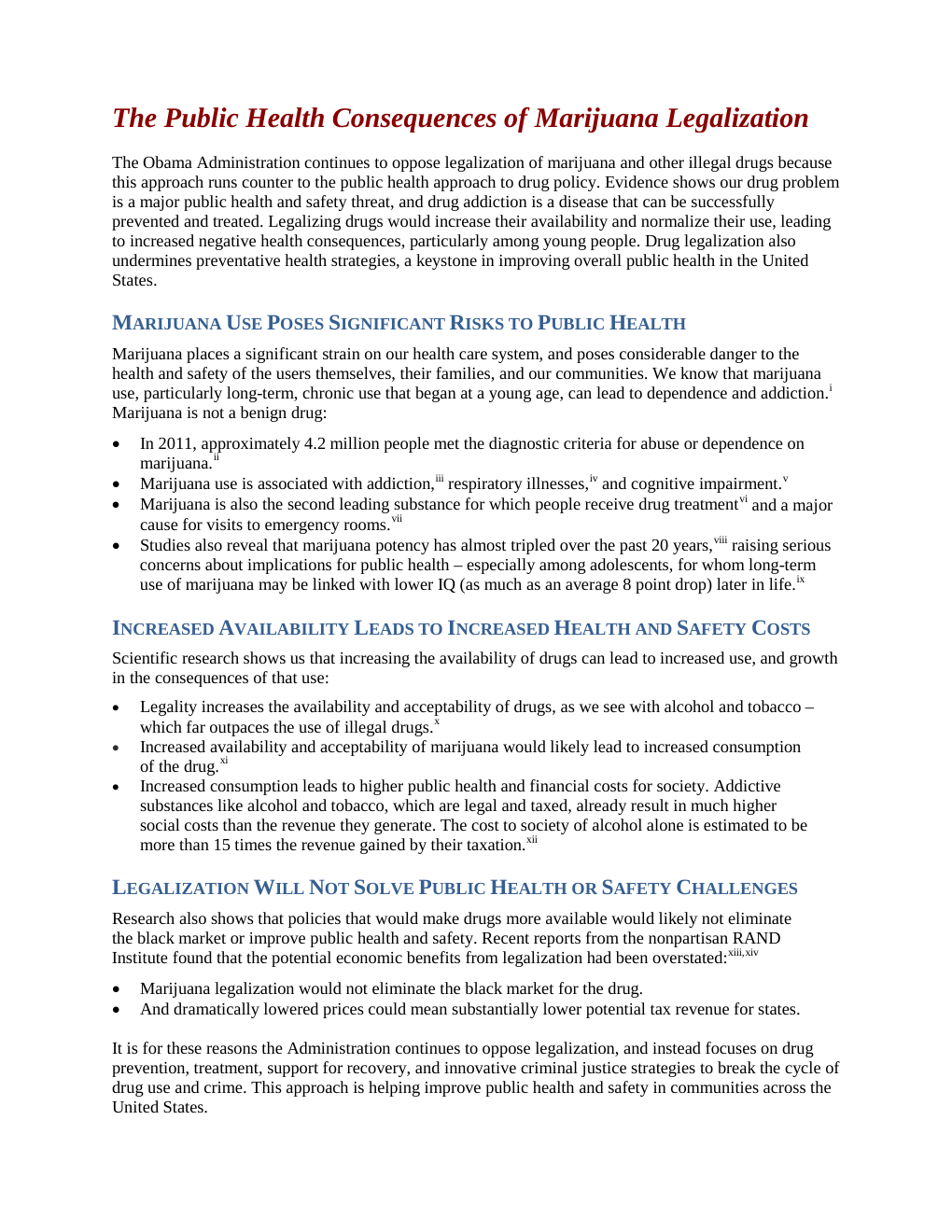
“Do not let the defunding-the-police thinking that currently is in this bill lead the Nation into the same ecological human and social disaster we now face in Oregon. The bill fails to address impairment. It fails to address the ever- increasing potency of the drug.”

House floor debate on the MORE Act (H.R. 3617). Bentz’s concern was illegal grows in southern Oregon.

Snapshot shows an excerpt of the govinfo.gov page text around the quote (highlighted), with the page’s own header lines; rendered from the official text on 2026-11-14 06:45 PM America/Chicago.

The evidence

Illegal grows are a real enforcement problem. They are also what prohibition-era price gaps produce, not a feature of licensed, taxed markets. Federal decriminalization does not defund police; adult-use states have raised billions in cannabis taxes that can pay for enforcement. Potency has risen, from about 4% THC in seized flower in 1995 to about 12% in 2014, and that is an argument for labeling, which only a legal market can require.57 136
Back to index

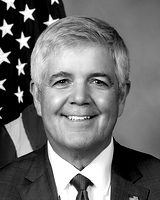
Snapshot of the source for Greg Murphy
Public record
Official portrait of Greg Murphy
On record
December 4, 2020
Photo: U.S. Congress, Public domain

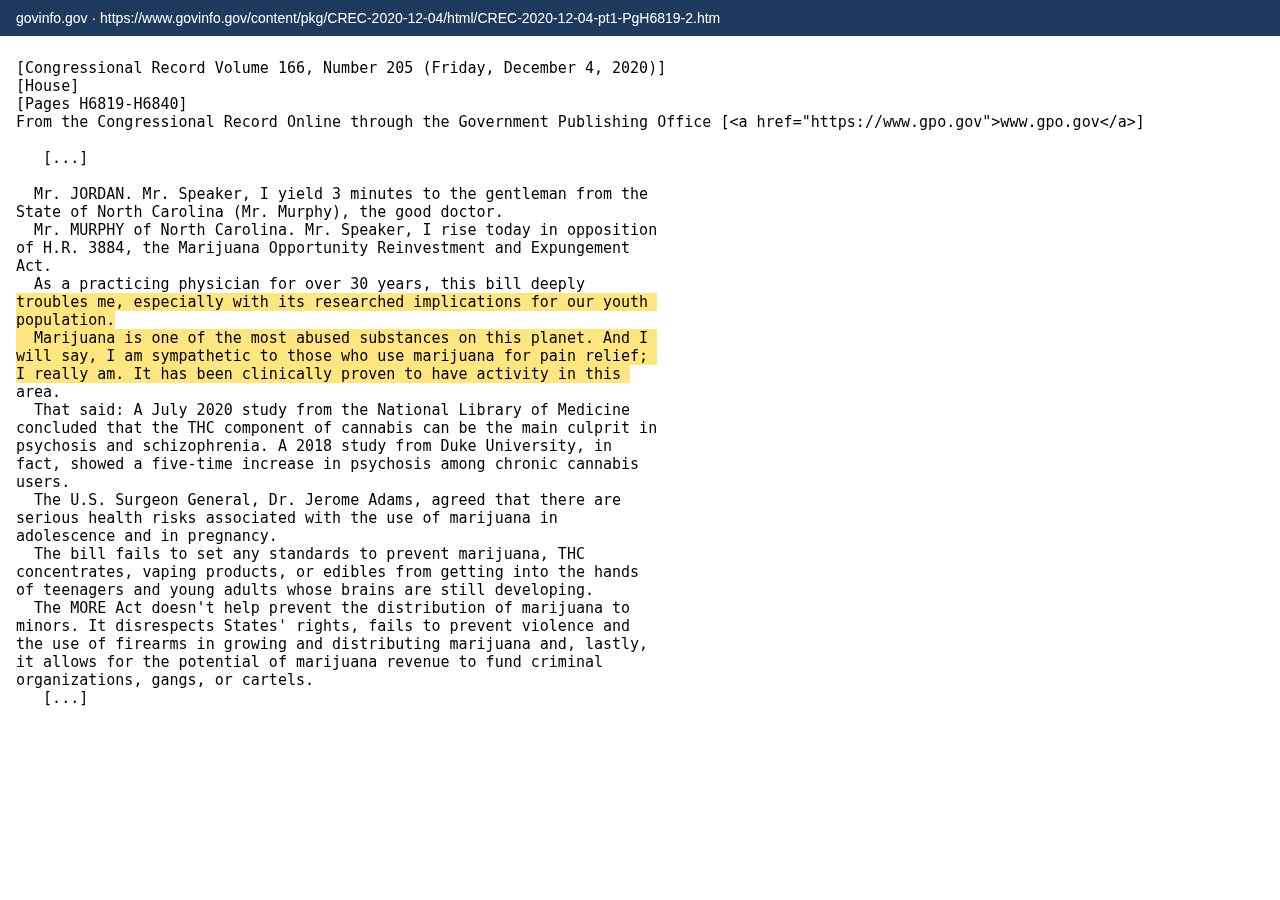
Greg Murphy

U.S. Representative (R-NC) · December 4, 2020

“Marijuana is one of the most abused substances on this planet. … Marijuana is a gateway drug; make no mistake about that. It undoubtedly leads to further and much more dangerous drug use.”

House floor debate on the MORE Act of 2019 (H.R. 3884). In the same speech he said cannabis “has been clinically proven to have activity” for pain relief.

Snapshot shows an excerpt of the govinfo.gov page text around the quote (highlighted), with the page’s own header lines; rendered from the official text on 2026-11-14 06:45 PM America/Chicago.

The evidence

“Undoubtedly” is the problem word. NIDA: “most people who use or have used cannabis do not go on to use other substances later in life.” Lifetime dependence risk is about 8.9% for cannabis versus 22.7% for alcohol and 67.5% for nicotine. He was right in the same speech about pain relief — the National Academies found conclusive or substantial evidence for chronic pain.8 10 72

Back to index

Snapshot of the source for Vicky Hartzler
Public record
Official portrait of Vicky Hartzler
On record
December 4, 2020
Photo: US House Office of Photography/House Creative Services, Public domain

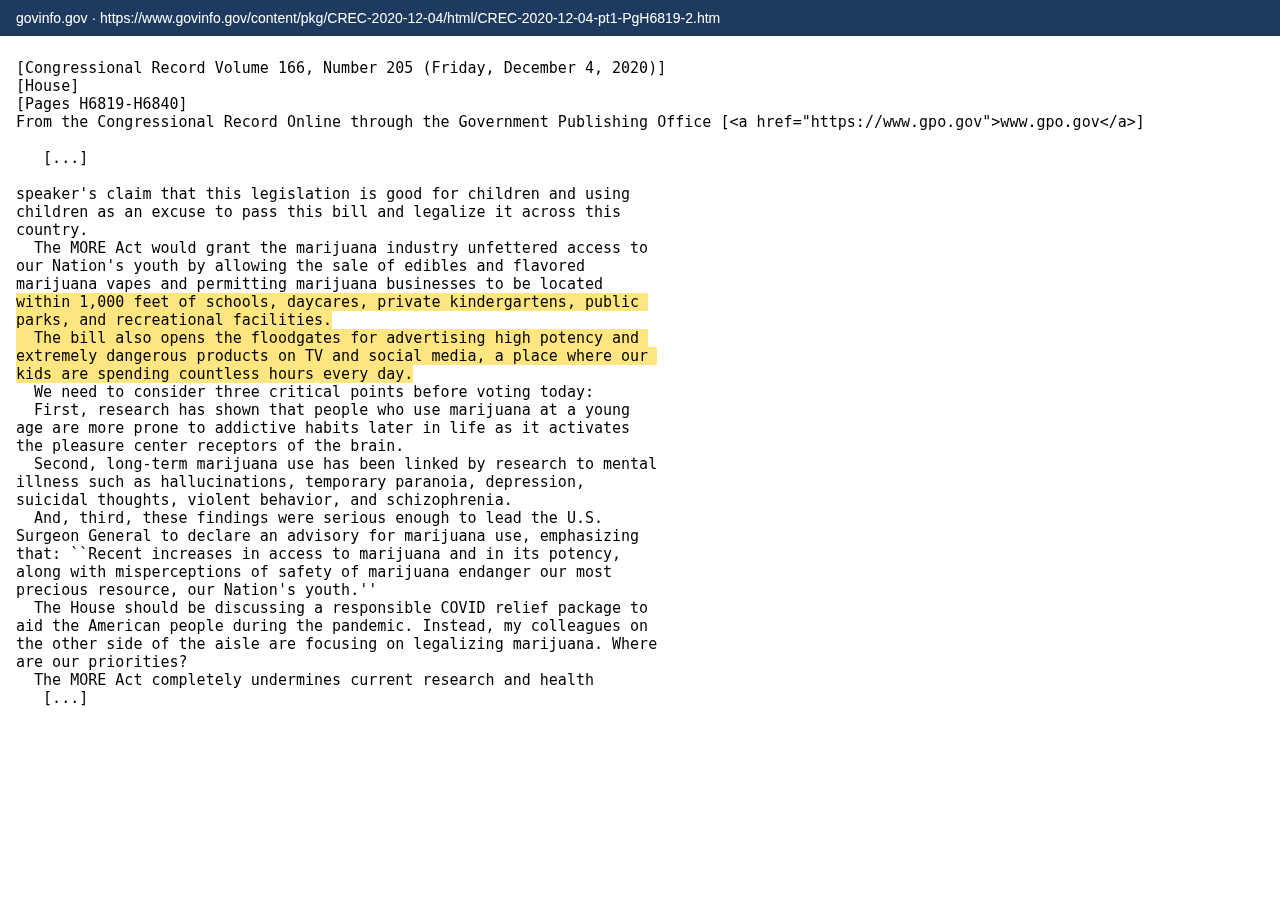
Vicky Hartzler

U.S. Representative (R-MO) · December 4, 2020

“The bill also opens the floodgates for advertising high potency and extremely dangerous products on TV and social media, a place where our kids are spending countless hours every day. … Second, long-term marijuana use has been linked by research to mental illness such as hallucinations, temporary paranoia, depression, suicidal thoughts, violent behavior, and schizophrenia.”

House floor debate on the MORE Act of 2019 (H.R. 3884). Missouri voters legalized adult use two years later.

Snapshot shows an excerpt of the govinfo.gov page text around the quote (highlighted), with the page’s own header lines; rendered from the official text on 2026-11-14 06:45 PM America/Chicago.

The evidence

Honest part: the National Academies found substantial evidence of an association between cannabis use and psychosis, highest among the most frequent users, which is why potency labels and 21+ rules matter. Stringing “violent behavior” onto that list goes beyond the evidence, and “extremely dangerous” ignores comparative risk. Cannabis has a population margin of exposure above 10,000, while alcohol, advertised on TV every weekend, is tied to about 178,000 U.S. deaths a year. Youth use did not rise with legalization.1 3 10 53

Back to index

Snapshot of the source for Dan Bishop
Public record
Official portrait of Dan Bishop
On record
December 4, 2020
Photo: The White House, Public domain

Dan Bishop

U.S. Representative (R-NC) · December 4, 2020

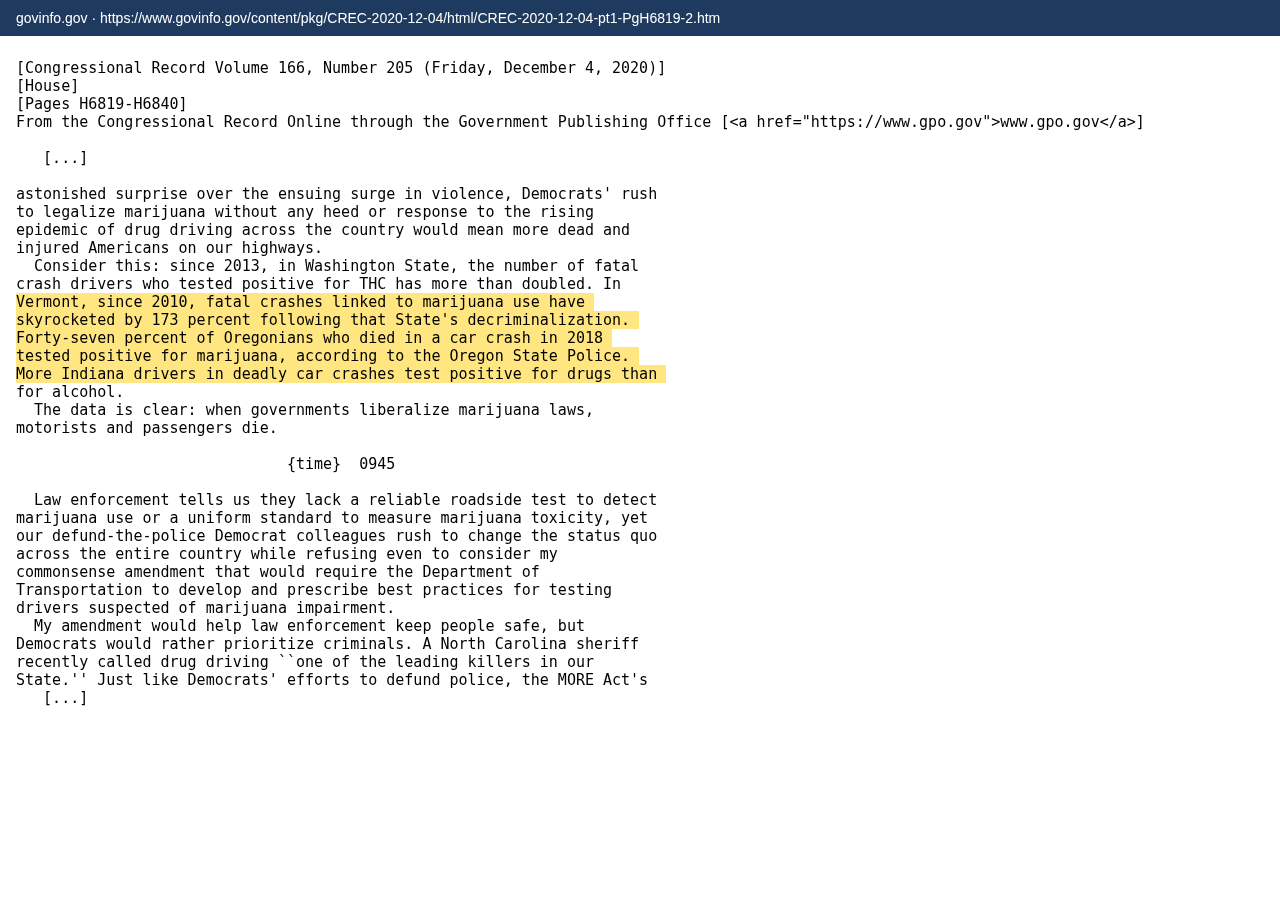
“Forty-seven percent of Oregonians who died in a car crash in 2018 tested positive for marijuana, according to the Oregon State Police. More Indiana drivers in deadly car crashes test positive for drugs than for alcohol. The data is clear: when governments liberalize marijuana laws, motorists and passengers die.”

House floor debate on the MORE Act of 2019 (H.R. 3884).

Snapshot shows an excerpt of the govinfo.gov page text around the quote (highlighted), with the page’s own header lines; rendered from the official text on 2026-11-14 06:45 PM America/Chicago.

The evidence

“Tested positive” is the catch. THC can stay detectable in blood or urine long after impairment ends, so a positive test does not show a driver was high at the time of a crash. The research review he needed says the epidemiology is mixed: some studies find no link with crash risk, and the association shrinks once bias and confounding are controlled, though recent use clearly impairs driving. Don’t drive high, and fund real impairment testing. “The data is clear” is the one thing the data is not.10 25

Back to index

Snapshot of the source for Jerome Adams
Public record
Official portrait of Jerome Adams
On record
August 29, 2019
Photo: United States Department of Health and Human Services, Public domain

Jerome Adams

U.S. Surgeon General · August 29, 2019

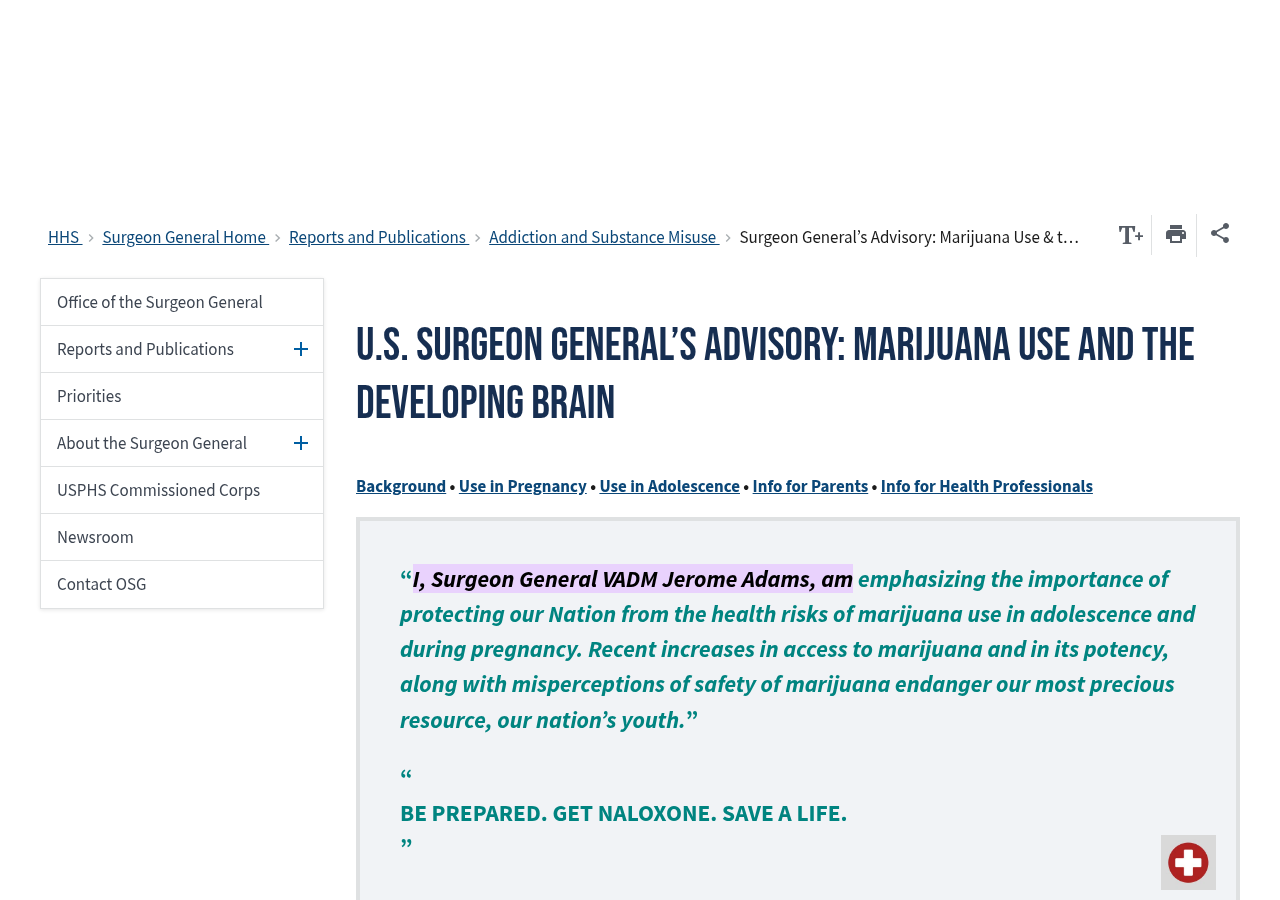
“I, Surgeon General VADM Jerome Adams, am emphasizing the importance of protecting our Nation from the health risks of marijuana use in adolescence and during pregnancy. Recent increases in access to marijuana and in its potency, along with misperceptions of safety of marijuana endanger our most precious resource, our nation’s youth.”

The evidence

Fair part first: we agree that pregnancy and adolescence are times to skip cannabis, and CDC guidance says the same. The overreach is the claim that wider adult access “endangers” youth. A national study of high-school surveys from 1993 to 2019 found recreational legalization was not associated with more teen use. Licensed stores check ID; the street market does not. Treating adult access as the threat — rather than age limits, honest labeling, and pregnancy counseling — is the old prohibition reflex with a public-health label.10 28 53

Back to index

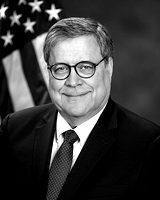
Snapshot of the source for William P. Barr
Public record
Official portrait of William P. Barr
On record
April 10, 2019
Photo: The United States Department of Justice, Public domain

William P. Barr

U.S. Attorney General · April 10, 2019

Secondhand source — contemporaneous news report

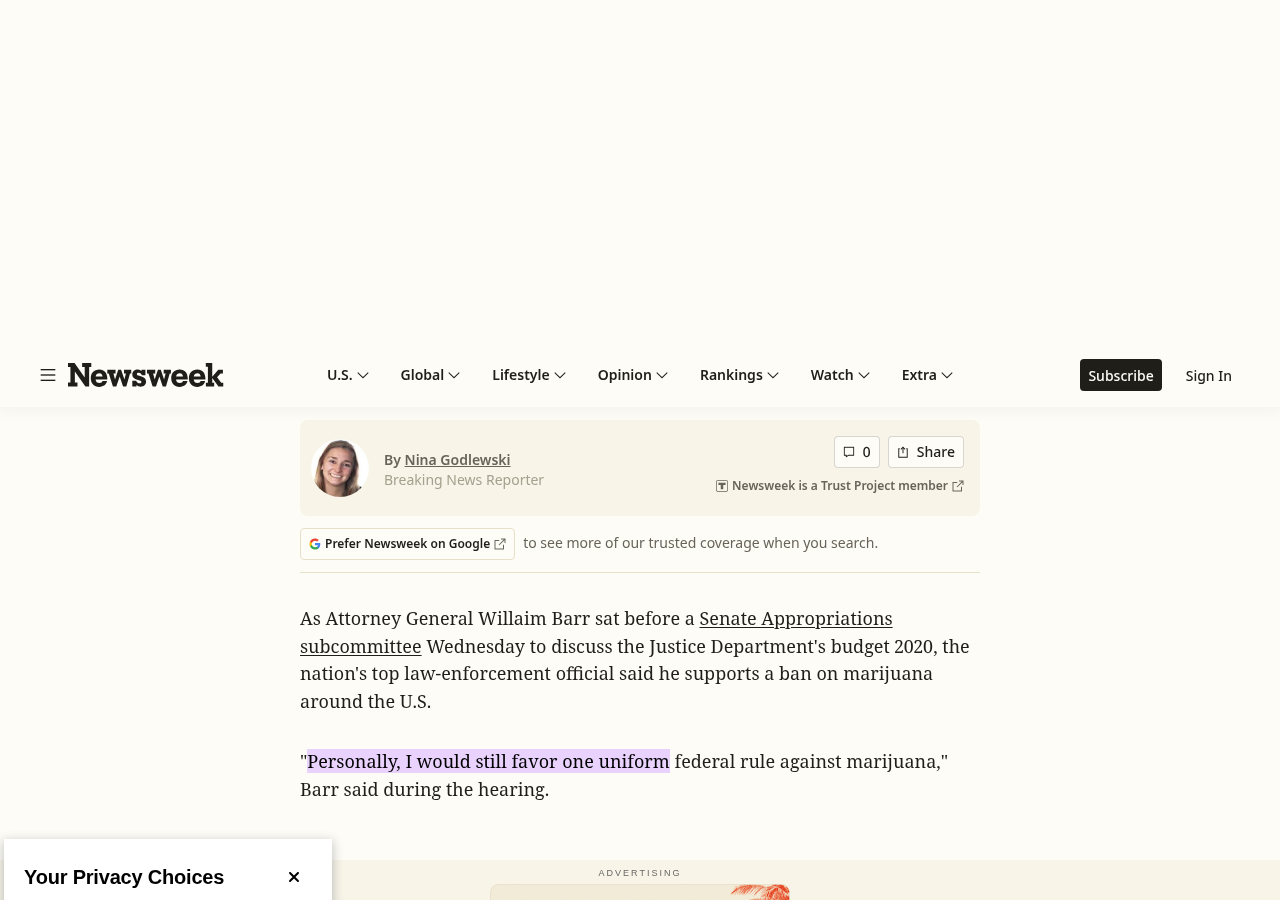
“Personally, I would still favor one uniform federal rule against marijuana … But if there is not sufficient consensus to obtain that then I think the way to go is to permit a more federal approach so states can, you know, make their own decisions within the framework of the federal law.”

SECONDHAND: Newsweek report of Barr’s testimony to a Senate Appropriations subcommittee, answering Sen. Lisa Murkowski. We did not open an official hearing transcript.

The evidence

A “uniform federal rule against marijuana” would override voters in dozens of states. Pew polling finds most Americans favor legal marijuana for medical or recreational use, and most now live in a legal state. Within four years, HHS’s own review found accepted medical use and recommended moving marijuana out of Schedule I. To his credit, Barr preferred letting states decide over the status quo; the national ban he “personally” wanted is the policy the evidence left behind.55 125 126

Back to index

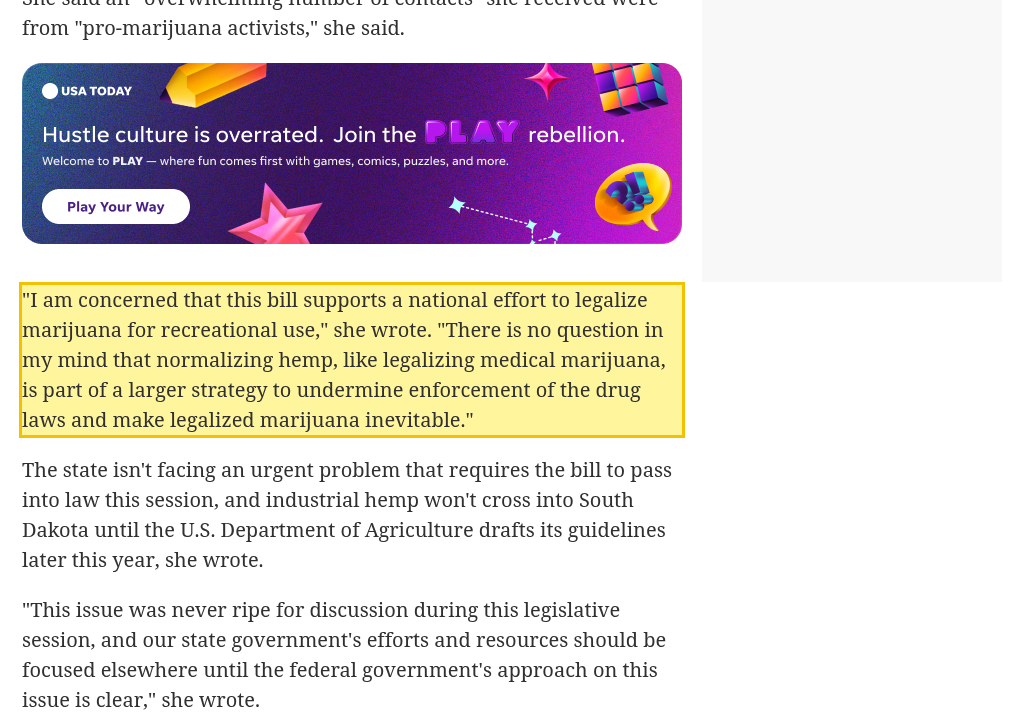
Snapshot of the source for Kristi Noem
Public record
Official portrait of Kristi Noem
On record
March 11, 2019
Photo: U.S. Department of Homeland Security, Public domain

Kristi Noem

Governor of South Dakota (R), later U.S. Secretary of Homeland Security · March 11, 2019

Secondhand source — contemporaneous news report

“I am concerned that this bill supports a national effort to legalize marijuana for recreational use. There is no question in my mind that normalizing hemp, like legalizing medical marijuana, is part of a larger strategy to undermine enforcement of the drug laws and make legalized marijuana inevitable.”

SECONDHAND: Argus Leader report quoting Noem’s veto letter on HB 1191, the industrial hemp bill. We did not open the letter itself. As a congresswoman, Noem had voted for the 2018 Farm Bill that legalized hemp nationally.

Snapshot of the live page with the quote highlighted and pop-up overlays removed; taken 2026-11-14 06:56 PM America/Chicago.

The evidence

Hemp is legally defined by its low THC content (0.3% delta-9 THC or less on a dry-weight basis in the 2018 law); farm hemp does not get anyone high. Congress — with Noem’s vote — had already legalized it nationally. Treating a fiber-and-grain crop as a secret marijuana plot is the same fear that kept American farmers from a crop George Washington grew.29 30 118

Back to index

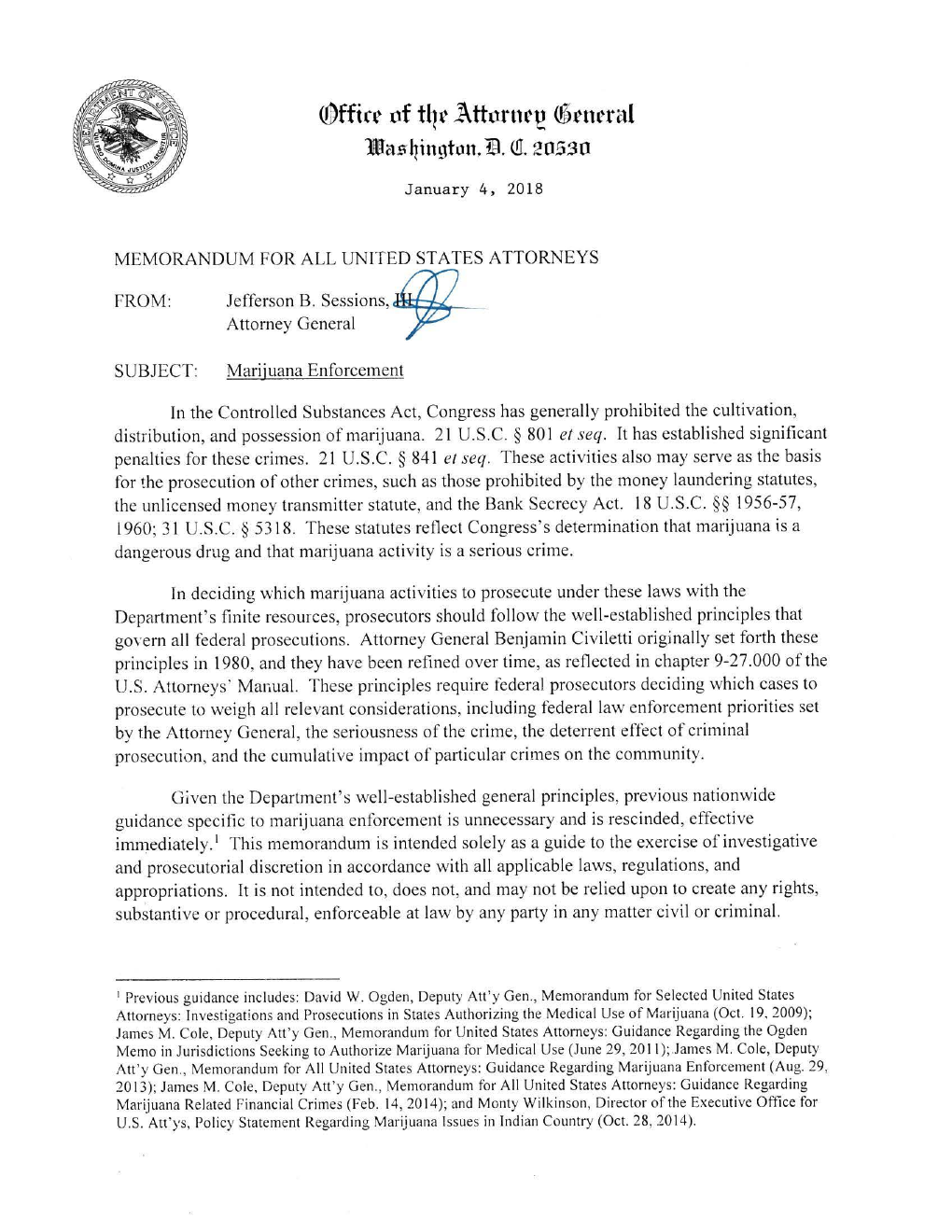
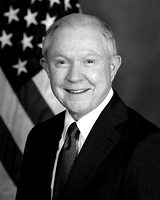
Snapshot of the source for Jeff Sessions
Public record
Official portrait of Jeff Sessions
On record
January 4, 2018
Photo: United States Department of Justice, Public domain

Jeff Sessions

U.S. Attorney General; former U.S. Senator (R-AL) · January 4, 2018

“These statutes reflect Congress's determination that marijuana is a dangerous drug and that marijuana activity is a serious crime.”

Official Justice Department memorandum rescinding prior nationwide marijuana-enforcement guidance (the Cole memo and related guidance). Line breaks and spacing artifacts from the PDF have been cleaned; wording is from the memo we opened on justice.gov.

The evidence

Congress’s 1970 scheduling decision is not a scientific last word. In 2023 HHS recommended Schedule III after finding accepted medical use. The FDA has approved THC- and cannabis-derived medicines. Comparative-risk research ranks cannabis well below alcohol on overdose and overall harm. Reciting a statute does not make the danger claim true.1 2 21 55

Back to index

Snapshot of the source for John F. Kelly
Public record
Official portrait of John F. Kelly
On record
April 18, 2017
Photo: Department of Homeland Security, Public domain

John F. Kelly

U.S. Secretary of Homeland Security · April 18, 2017

“And let me be clear about marijuana. It is a potentially dangerous gateway drug that frequently leads to the use of harder drugs. Additionally, science tells us that it is not only psychologically addictive but can also have profound negative impact on the still developing brains of teens and up through the early 20s.”

From Secretary Kelly’s prepared remarks, “Home and Away: DHS and the Threats to America,” delivered at George Washington University and published by DHS. The same passage says ICE would use marijuana possession convictions in deportation cases.

The evidence

NIDA’s own answer to the gateway question: cannabis is often among the first substances people encounter, “still, most people who use or have used cannabis do not go on to use other substances later in life.” Shared risk factors — not the plant — explain most of the overlap. On addiction, national NESARC data put the lifetime chance of moving from first use to dependence at about 8.9% for cannabis versus 22.7% for alcohol and 67.5% for nicotine. Protecting developing brains is why 21+ laws exist; it is not evidence for treating adult use as a deportation trigger.8 10 72

Back to index

Snapshot of the source for Andrew Cuomo
Public record
Official portrait of Andrew Cuomo
On record
February 8, 2017
Photo: Wikimedia Commons, Public domain

Andrew Cuomo

Governor of New York (D) · February 8, 2017

Secondhand source — contemporaneous news report

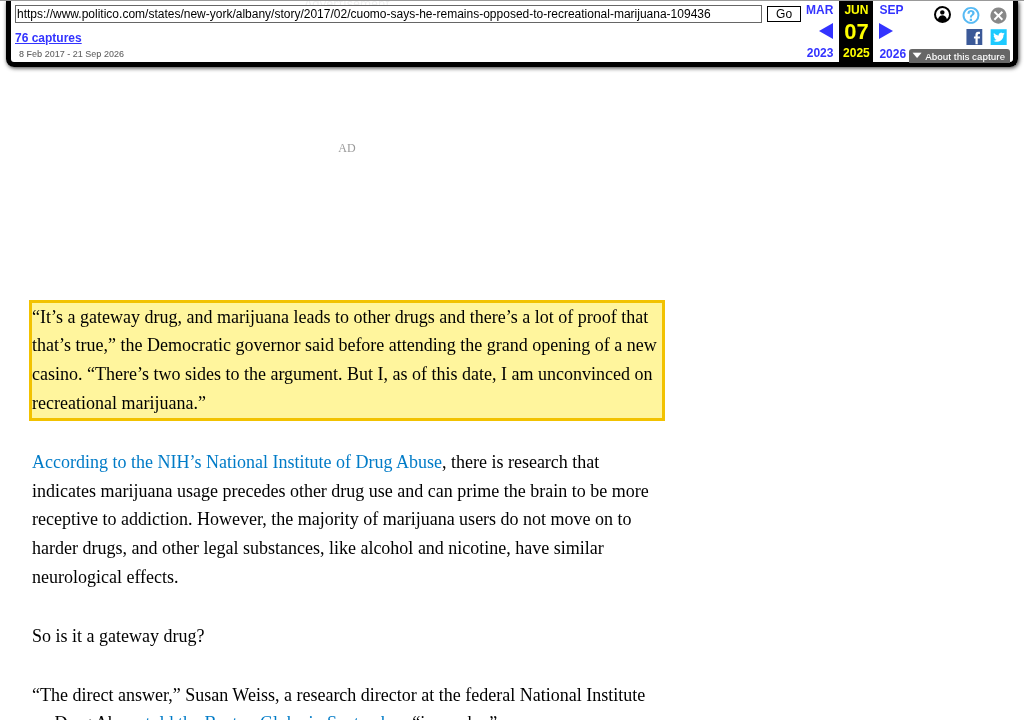
“It’s a gateway drug, and marijuana leads to other drugs and there’s a lot of proof that that’s true. … There’s two sides to the argument. But I, as of this date, I am unconvinced on recreational marijuana.”

SECONDHAND: Politico New York report of Cuomo’s remarks to reporters in Schenectady. In March 2021, Cuomo signed New York’s adult-use legalization law.

Snapshot of the Wayback Machine copy with the quote highlighted and pop-up overlays removed; taken 2026-11-14 06:56 PM America/Chicago.

The evidence

“A lot of proof” is not what NIDA says: “most people who use or have used cannabis do not go on to use other substances later in life,” and the overlap is better explained by shared risk factors. Cannabis also carries a much lower lifetime risk of dependence than alcohol or nicotine. Four years later, Cuomo signed the law legalizing adult use in New York.8 72

Back to index

Snapshot of the source for Chuck Grassley
Public record
Official portrait of Chuck Grassley
On record
April 5, 2016
Photo: United States Congress, Public domain

Chuck Grassley

U.S. Senator (R-IA) · April 5, 2016

“In 2013, the Department of Justice decided to all but abandon the enforcement of federal law relating to the possession, cultivation, and distribution of marijuana in states that were in the process of becoming the only jurisdictions in the world to legalize and regulate all these activities for recreational use. … Legitimate enforcement discretion doesn’t tolerate and incentivize ongoing, widespread, and unlawful conduct.”

Prepared statement for the Senate Caucus on International Narcotics Control hearing that day. Ellipsis marks an omitted passage.

The evidence

Grassley treats state-legal cannabis as “unlawful conduct” the Justice Department should not tolerate. That is a legal-positivist argument, not a scientific one. By 2023, HHS had found accepted medical use, and the FDA had already approved THC- and CBD-based medicines. Countries and U.S. states that legalized and regulated adult use did so as a harm-reduction alternative to prohibition, not as a DOJ “abandonment.” The harm comparisons that matter — overdose, violence, total social harm — still favor cannabis over alcohol.1 2 21 55

Back to index

Snapshot of the source for Jeff Sessions
Public record
Official portrait of Jeff Sessions
On record
April 5, 2016
Photo: United States Department of Justice, Public domain

Jeff Sessions

U.S. Senator (R-AL), later U.S. Attorney General · April 5, 2016

Secondhand source — contemporaneous news report

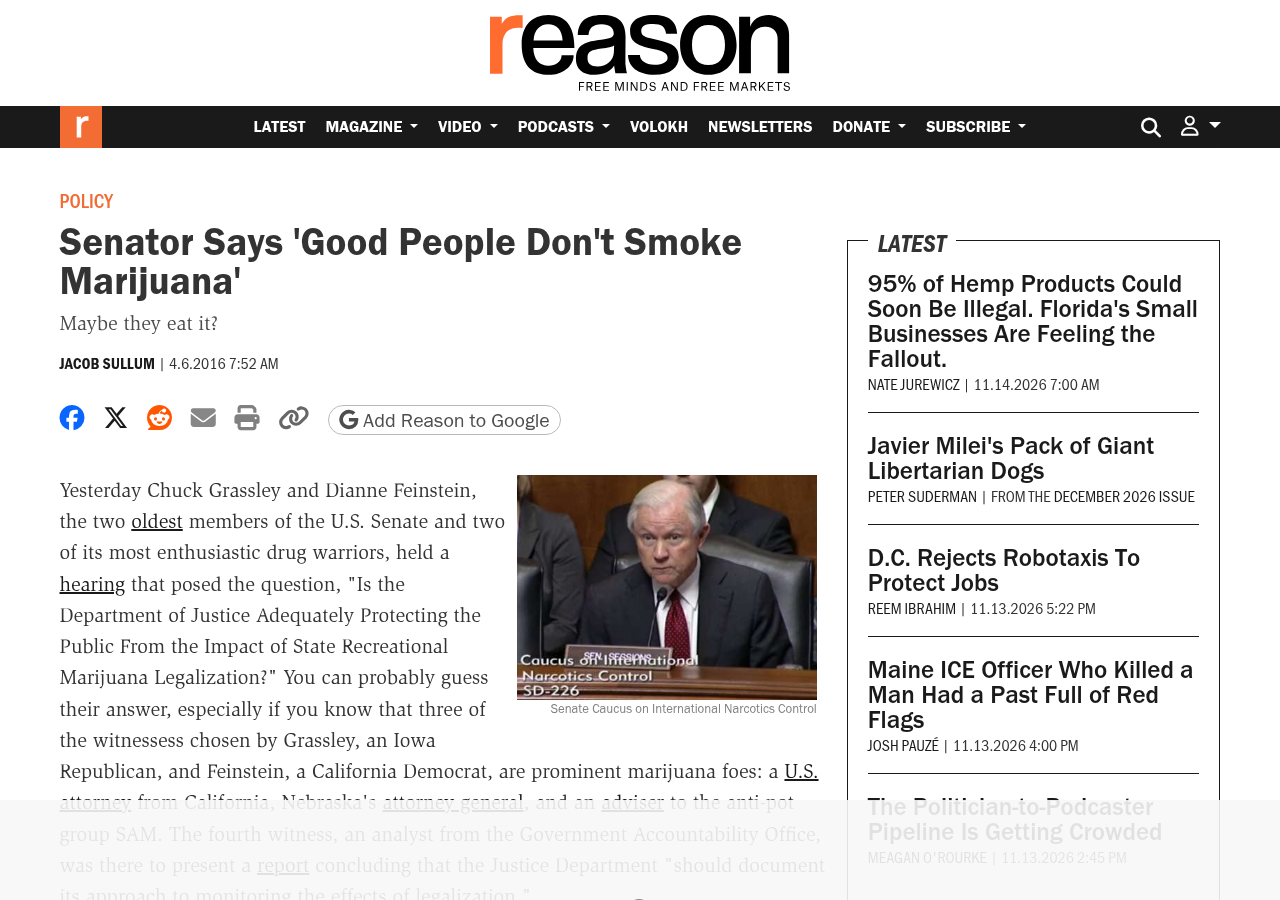
“The creating of knowledge that this drug is dangerous, it cannot be played with, it is not funny, it's not something to laugh about, and trying to send that message with clarity, that good people don't smoke marijuana.”

SECONDHAND: contemporaneous news report of remarks at the April 5, 2016, Senate Caucus on International Narcotics Control hearing. We opened Reason’s April 6, 2016 article, which presents this as a direct quotation. We did not independently open an official hearing transcript.

The evidence

This is a moral slogan, not a finding. Tens of millions of American adults have used cannabis, including patients using FDA-approved THC medicines and, later, state-licensed medical cannabis after HHS found accepted medical use in 2023. NIDA’s own guidance on the “gateway” question and national survey data do not sort the country into “good people” and cannabis users. The claim is Reefer Madness in a suit: stigma in place of evidence.21 55 72

Back to index

Snapshot of the source for Chuck Rosenberg
Public record
Official portrait of Chuck Rosenberg
On record
November 4, 2015
Photo: Drug Enforcement Administration, Public domain

Chuck Rosenberg

Acting Administrator, U.S. Drug Enforcement Administration · November 4, 2015

Secondhand source — contemporaneous news report

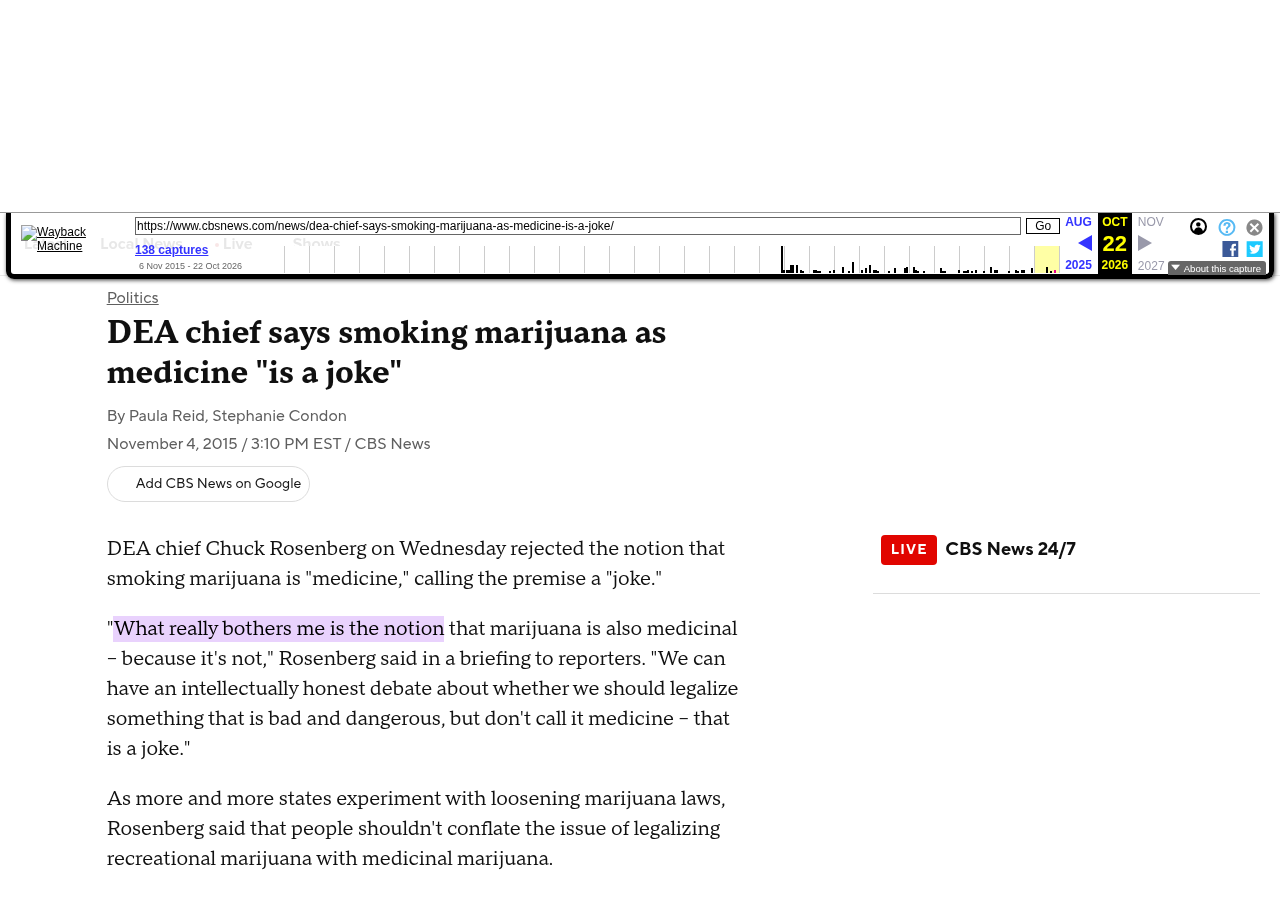
“What really bothers me is the notion that marijuana is also medicinal -- because it's not … We can have an intellectually honest debate about whether we should legalize something that is bad and dangerous, but don't call it medicine -- that is a joke.”

SECONDHAND: CBS News report of remarks at a briefing with reporters. We did not open a transcript of the briefing.

The evidence

The FDA had already approved THC-based medicines decades earlier, and approved a cannabis-derived CBD drug in 2018 after randomized trials in severe childhood epilepsy. The National Academies found conclusive or substantial evidence that cannabis or cannabinoids treat chronic pain in adults, chemotherapy nausea, and MS spasticity. In 2023, HHS — the government’s own scientists — found accepted medical use and recommended Schedule III. The DEA then proposed rescheduling in 2024. The joke aged badly.10 21 22 54 55

Back to index

Snapshot of the source for Bob Goodlatte
Public record
Official portrait of Bob Goodlatte
On record
June 2, 2015
Photo: United States Congress, Public domain

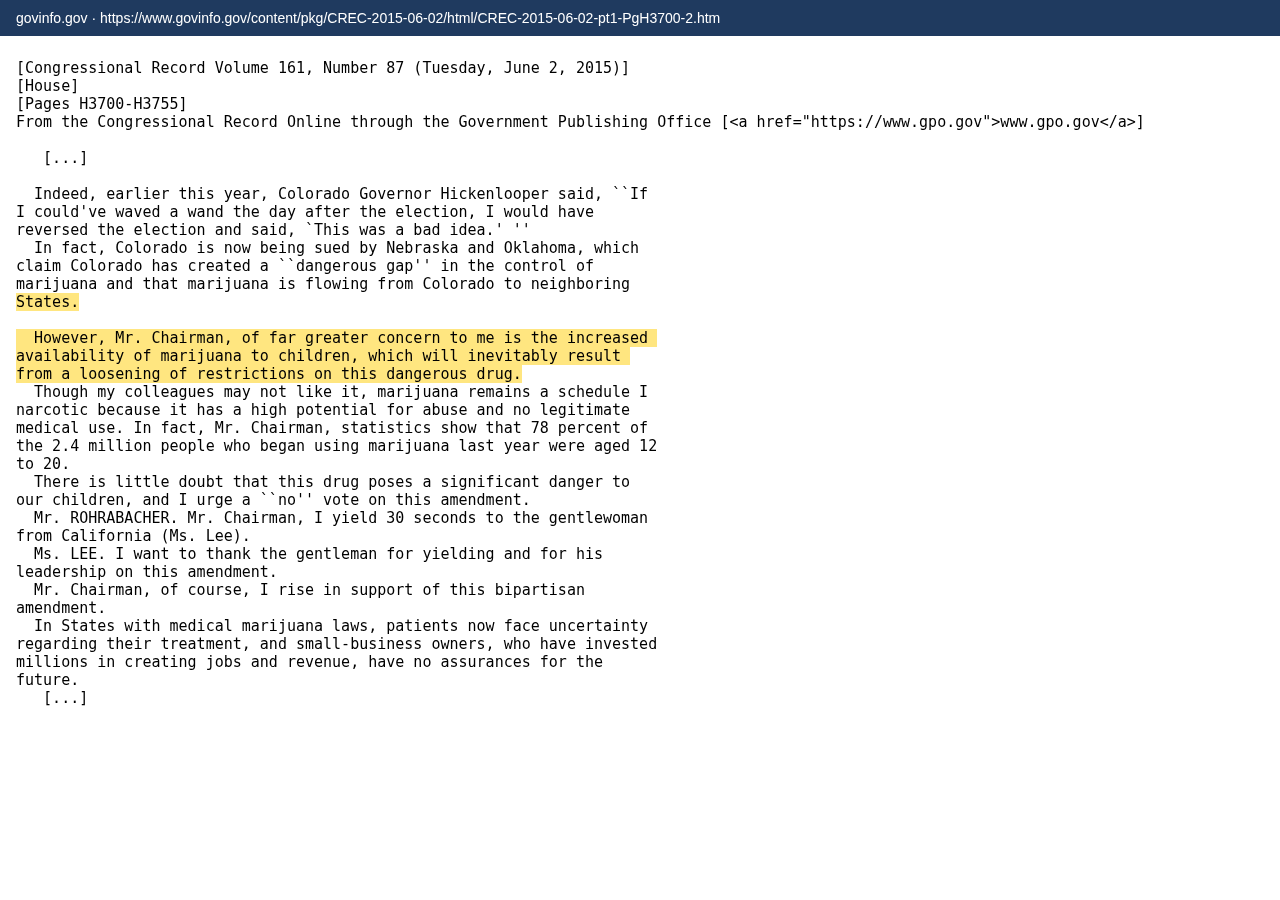
Bob Goodlatte

U.S. Representative (R-VA), chair of the House Judiciary Committee · June 2, 2015

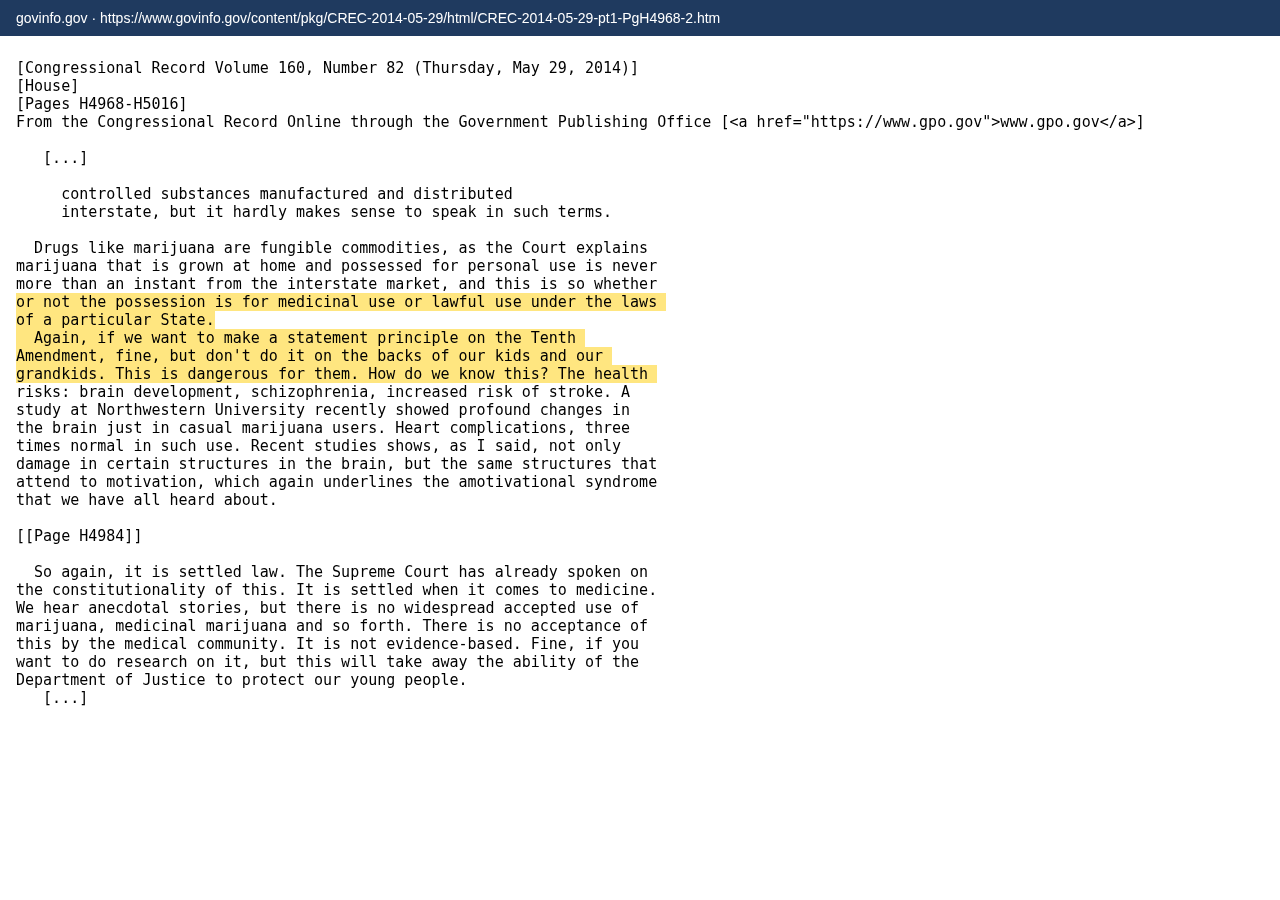
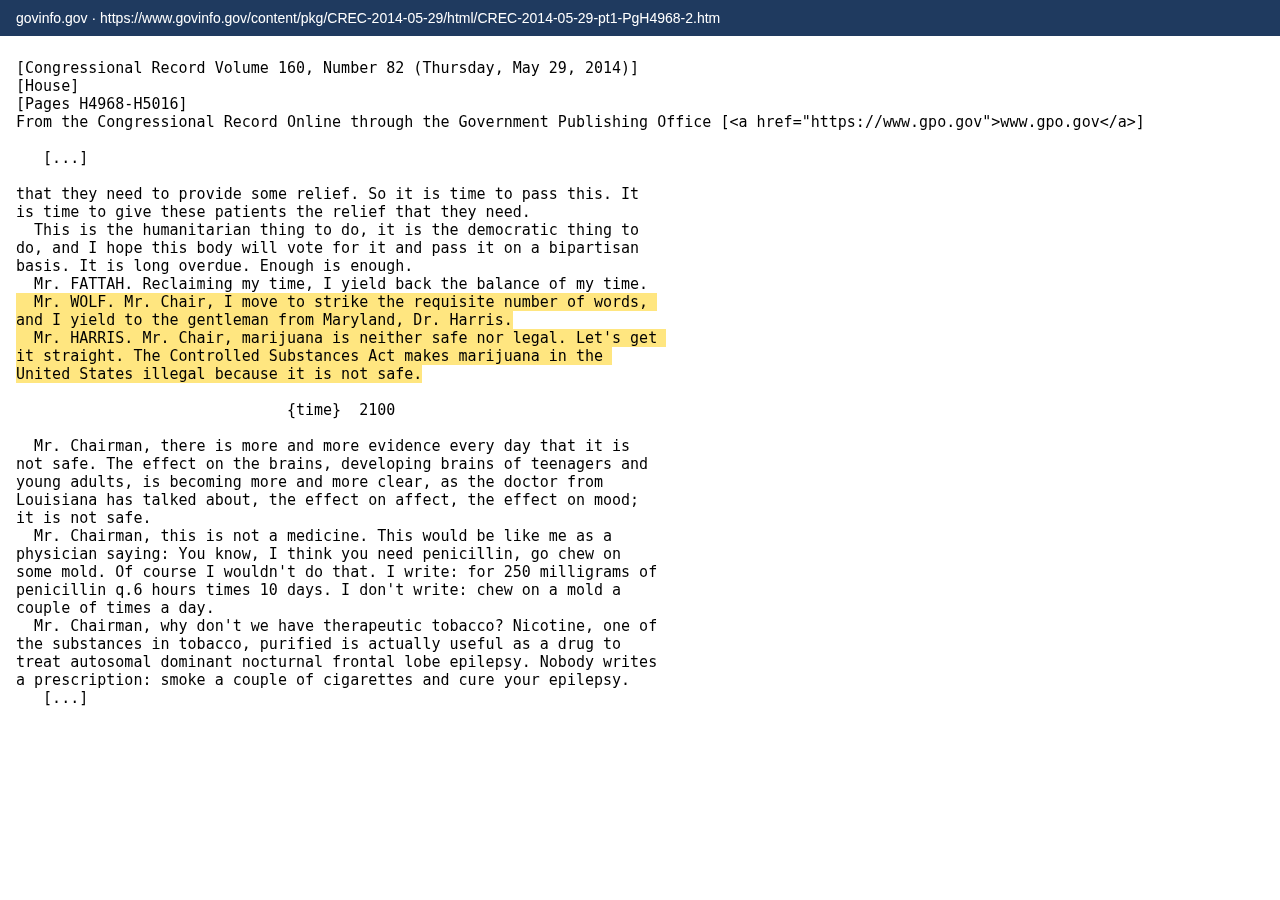
“However, Mr. Chairman, of far greater concern to me is the increased availability of marijuana to children, which will inevitably result from a loosening of restrictions on this dangerous drug. Though my colleagues may not like it, marijuana remains a schedule I narcotic because it has a high potential for abuse and no legitimate medical use.”

House floor debate opposing the 2015 Rohrabacher–Farr medical marijuana amendment, which passed.

Snapshot shows an excerpt of the govinfo.gov page text around the quote (highlighted), with the page’s own header lines; rendered from the official text on 2026-11-14 06:45 PM America/Chicago.

The evidence

Marijuana is not a “narcotic” pharmacologically; that label is a legal leftover. “No legitimate medical use” was already contradicted by FDA-approved THC medicines and by randomized trials of cannabis for neuropathic pain. In 2023, HHS formally found accepted medical use and recommended Schedule III. As for children, a study of high-school surveys from 1993 to 2019 found legalization was not associated with more teen use; “inevitably” did not happen.21 53 55 96

Back to index

Snapshot of the source for Pete Ricketts
Public record
Official portrait of Pete Ricketts
On record
April 29, 2015
Photo: United States Congress, Public domain

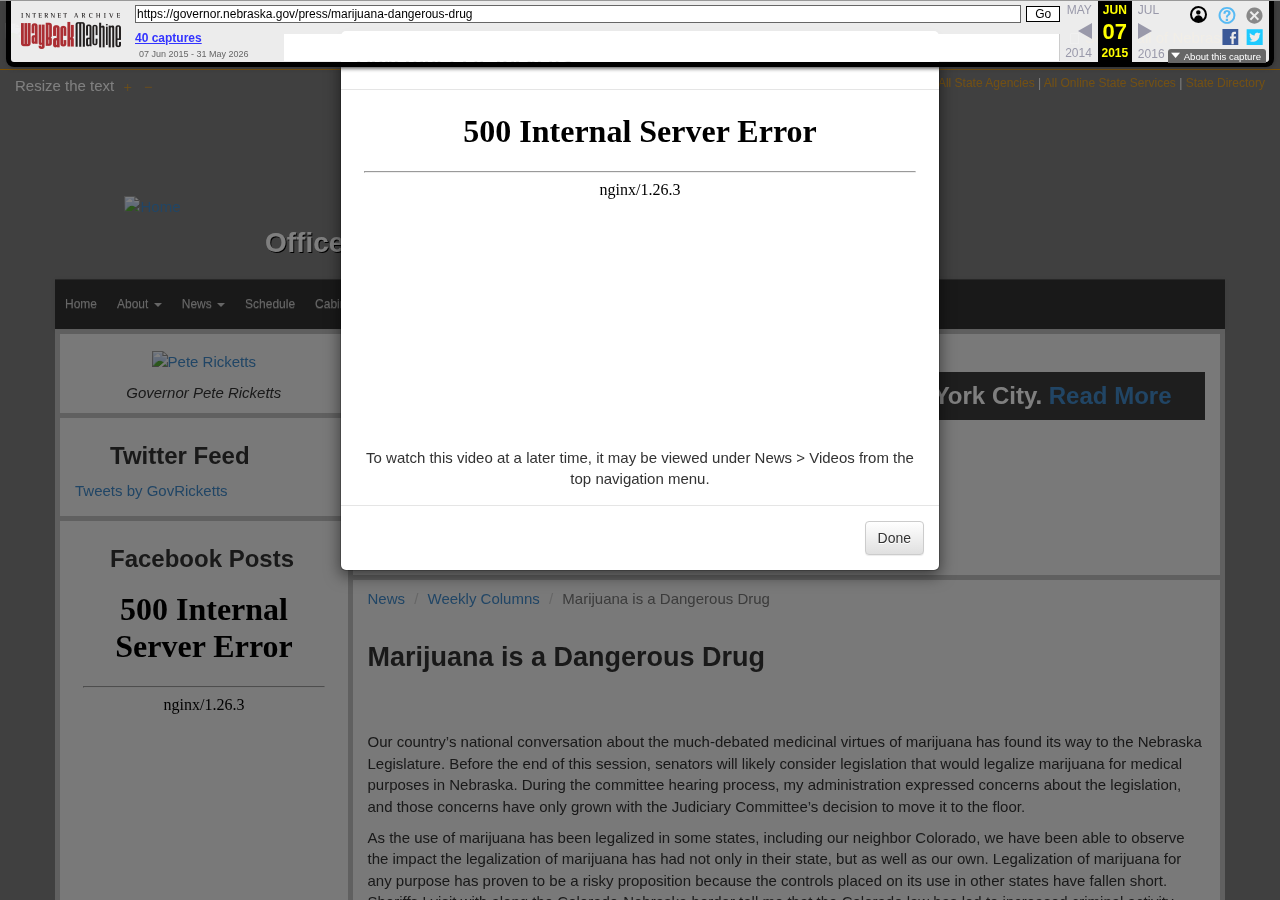
Pete Ricketts

Governor of Nebraska (R) · April 29, 2015

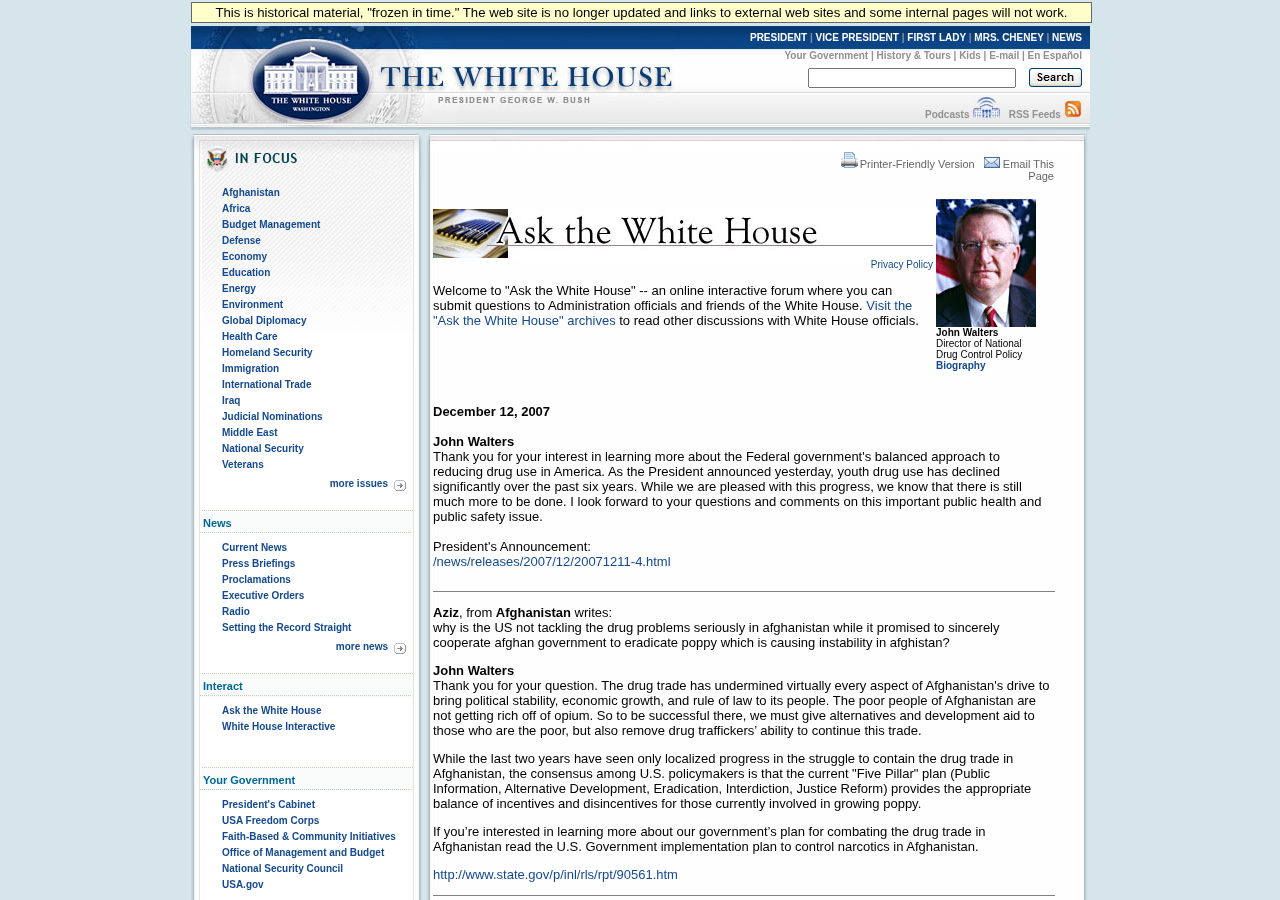
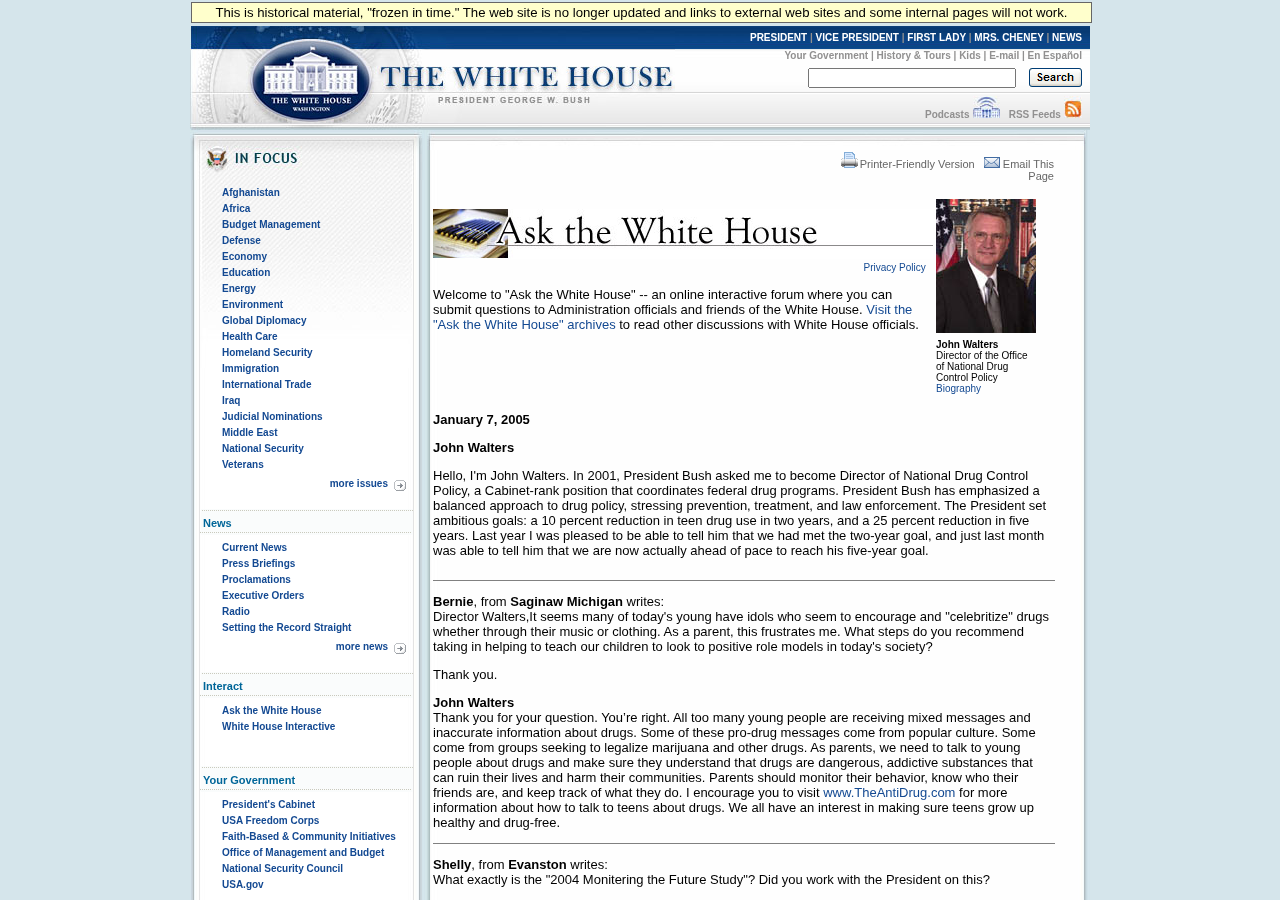
“In the absence of an FDA review, expert medical research shows that marijuana is dangerous. … We are already witnessing the results of an informal medical experiment play out here in our state. In recent years, the use of K2, a synthetic form of marijuana, has spread in Nebraska and the consequences of its use have been increasingly dire in spite of attempts by the Legislature to ban its use. Since April 12th, K2 has resulted in over 100 overdoses just in the Lincoln area alone. This is yet another reminder of how dangerous marijuana can be and why any medicinal use needs FDA oversight.”

Official weekly column, “Marijuana is a Dangerous Drug,” Office of Governor Pete Ricketts. The live governor.nebraska.gov page now returns 404; we opened the official text via Wayback (including a June 7, 2015, capture). The official page does not display a dateline; April 29, 2015, is the date of contemporaneous republication and discussion of the same column (a 420 Magazine thread timestamped that day). The ellipsis omits a paragraph citing a 2014 NEJM review and a Northwestern/Harvard study.

Screenshot is of the June 7, 2015, Wayback capture of the official governor’s column. The live governor.nebraska.gov URL now returns 404 on the current (Pillen) site.

The evidence

The Lincoln K2 outbreak was real and serious. K2 is not “a synthetic form of marijuana.” It is a class of synthetic cannabinoid receptor agonists, often much more dangerous than cannabis, and it spread precisely in illicit markets. Using those overdoses as “yet another reminder of how dangerous marijuana can be” is a category error. FDA review is the pathway for isolated drug products; it is not an argument that a plant already used medically in other states is simply “dangerous” until a federal agency signs off. NASEM later found substantial evidence of benefit for several conditions, alongside real risks that call for regulation and honest warnings, not this bait-and-switch with K2.1 10 55 72

Back to index

Snapshot of the source for Marco Rubio
Public record
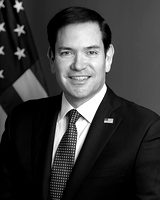
Official portrait of Marco Rubio
On record
Reported April 20, 2015
Photo: U.S. Department of State, Public domain

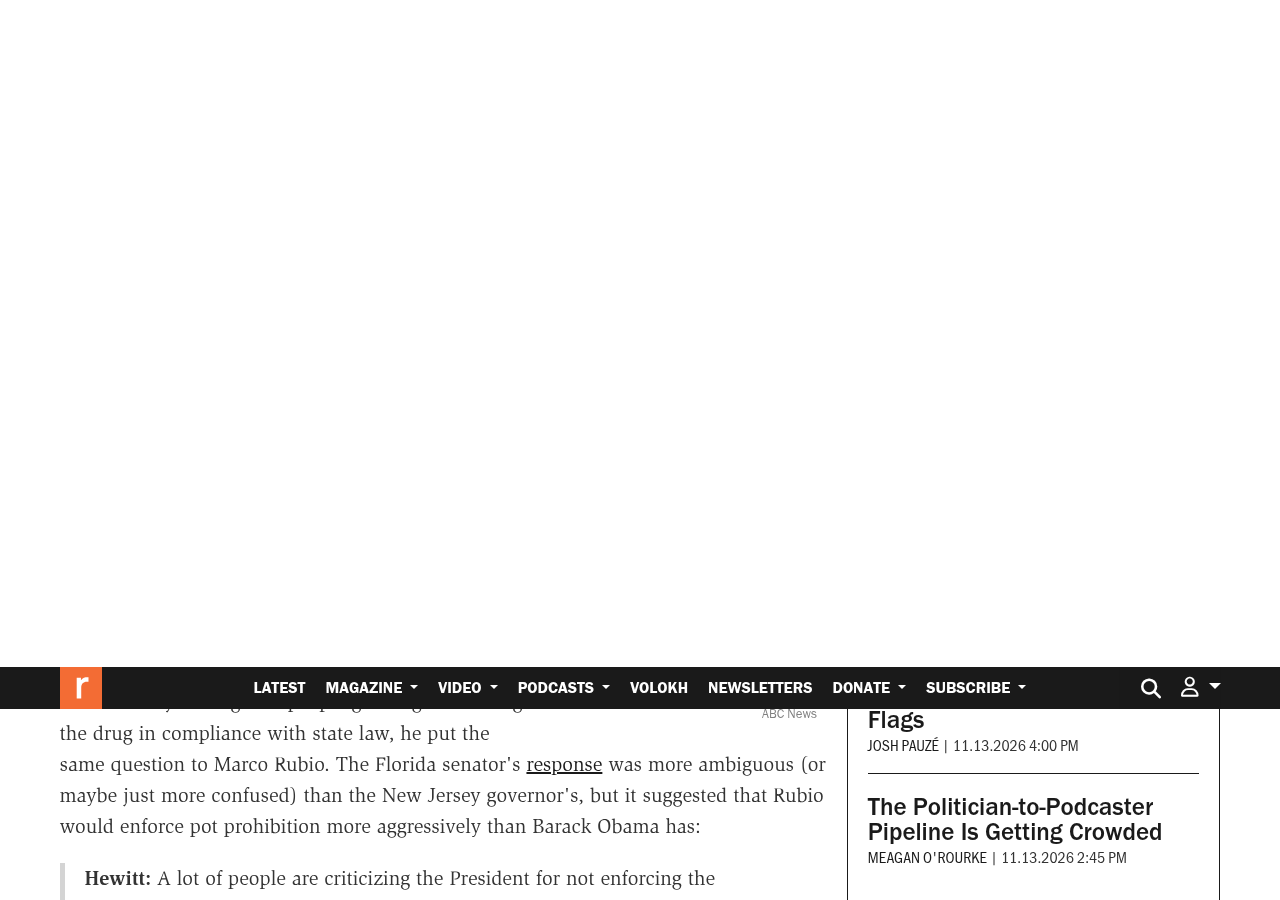
Marco Rubio

U.S. Senator (R-FL), later U.S. Secretary of State · Reported April 20, 2015

Secondhand source — contemporaneous news report

“I don't believe we should be in the business of legalizing additional intoxicants in this country for the primary reason that when you legalize something, what you're sending a message to young people is it can't be that bad, because if it was that bad, it wouldn't be legal.”

SECONDHAND: Reason’s report quoting Rubio’s answer in a radio interview with Hugh Hewitt. We did not open an audio transcript.

The evidence

Alcohol and tobacco are legal, and nobody thinks that means they “can’t be that bad.” Excessive drinking kills about 178,000 Americans a year. The youth-message theory is testable, and a study of high-school surveys from 1993 to 2019 found recreational legalization was not associated with more teen use. Legal status signals regulation, ID checks, and labels, not safety.2 3 53

Back to index

Snapshot of the source for Chris Christie
Public record
Official portrait of Chris Christie
On record
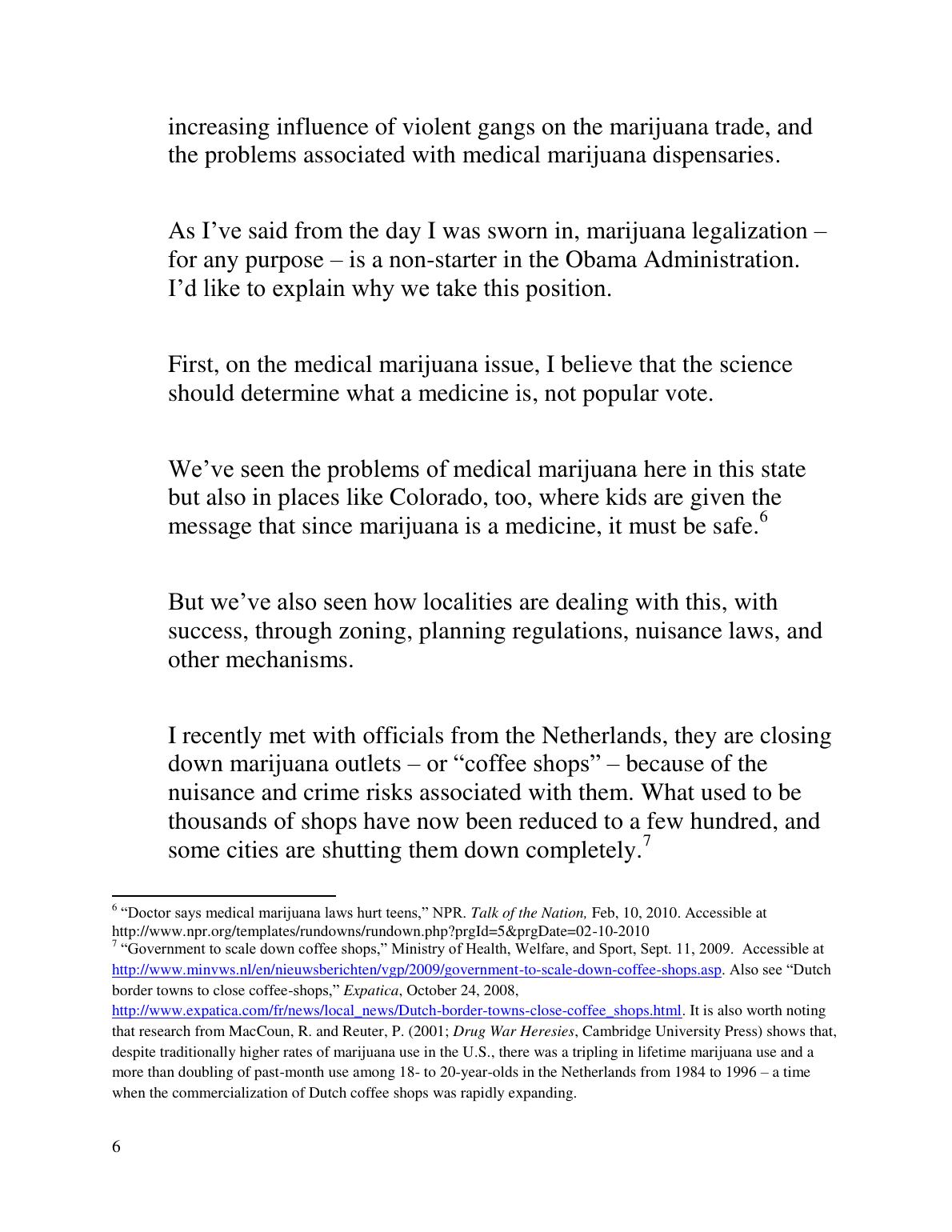
April 2015 (CNN aired the clip April 17, 2015)
Photo: Maryland GovPics, CC BY 2.0

Chris Christie

Governor of New Jersey (R) · April 2015 (CNN aired the clip April 17, 2015)

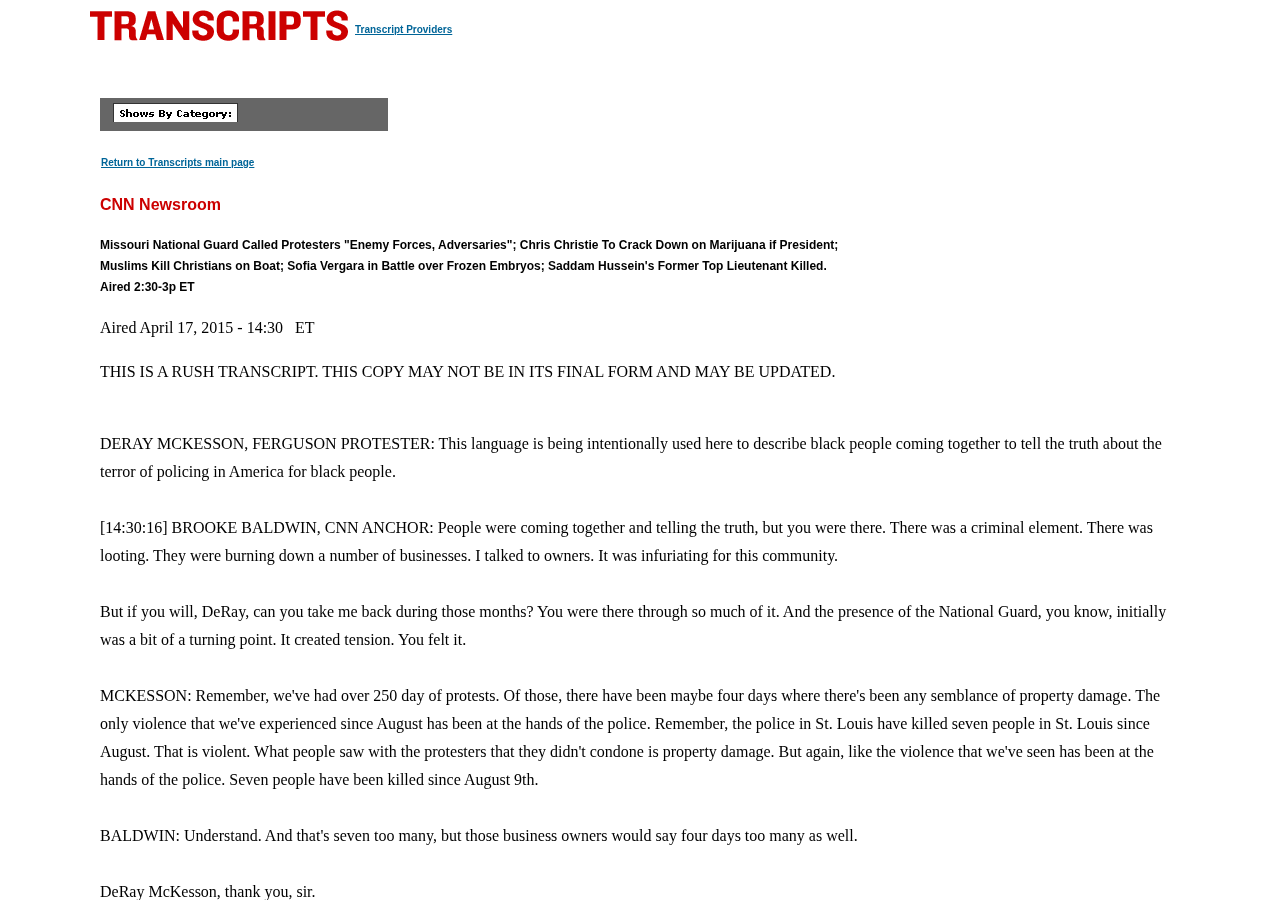
“Absolutely. I will crack down and not permit it. … Marijuana is a gateway drug. We have an enormous addiction problem in this country. And we need to send very clear leadership from the White House on down through the federal law enforcement. Marijuana is an illegal drug under federal law, and the states should not be permitted to sell it and profit from it.”

CNN transcript of a clip from Christie’s interview with Hugh Hewitt, aired April 17, 2015. Ellipsis marks a brief host interjection between the two answers. Source opened via a Wayback Machine capture of the CNN transcript.

The evidence

NIDA’s own gateway explainer is blunt: most people who use cannabis do not go on to use other drugs. A correlation with later drug use is better explained by shared risk factors and by a prohibition market that puts cannabis next to other illicit drugs. NESARC data found the transition from first use to dependence was less likely for cannabis than for nicotine. “Crack down and not permit” state-legal markets was a promise to override the voters of those states. Addiction is a real issue in America; the substances driving the overdose crisis are not cannabis.3 8 72

Back to index

Snapshot of the source for John Fleming
Public record
Official portrait of John Fleming
On record
May 29, 2014
Photo: U.S. Department of Commerce, Public domain

John Fleming

U.S. Representative (R-LA) · May 29, 2014

“Again, if we want to make a statement principle on the Tenth Amendment, fine, but don't do it on the backs of our kids and our grandkids. This is dangerous for them. How do we know this? The health risks: brain development, schizophrenia, increased risk of stroke. … Heart complications, three times normal in such use. … There is no acceptance of this by the medical community. It is not evidence-based.”

House floor debate opposing the Rohrabacher–Farr amendment, which barred the Justice Department from spending money to block state medical marijuana laws. The amendment passed and has been renewed ever since.

Snapshot shows an excerpt of the govinfo.gov page text around the quote (highlighted), with the page’s own header lines; rendered from the official text on 2026-11-14 06:45 PM America/Chicago.

The evidence

Medical marijuana was the subject, and the medical evidence was already there: randomized trials showed cannabis relieved neuropathic pain, and the FDA had approved THC-based medicines decades earlier. The National Academies later found conclusive or substantial evidence for chronic pain, chemotherapy nausea, and MS spasticity. In 2023, HHS found accepted medical use. Psychosis risk in heavy users is a real association and a reason for honest labeling; it is not a reason to raid state-legal patients.10 21 55 95 96

Back to index

Snapshot of the source for Andy Harris
Public record
Official portrait of Andy Harris
On record
May 29, 2014
Photo: US House of Representatives, Public domain

Andy Harris

U.S. Representative (R-MD) · May 29, 2014

“[M]arijuana is neither safe nor legal. Let's get it straight. The Controlled Substances Act makes marijuana in the United States illegal because it is not safe. … Mr. Chairman, this is not a medicine. This would be like me as a physician saying: You know, I think you need penicillin, go chew on some mold.”

Same House debate on the Rohrabacher–Farr medical marijuana amendment. This is a separate statement from Harris’s 2025 hemp remarks already on this page.

Snapshot shows an excerpt of the govinfo.gov page text around the quote (highlighted), with the page’s own header lines; rendered from the official text on 2026-11-14 06:45 PM America/Chicago.

The evidence

Clever line, wrong science. Plenty of real medicines come from plants and fungi, and the FDA has approved both a purified THC drug and a plant-derived CBD drug. More to the point, randomized placebo-controlled trials of whole smoked and vaporized cannabis cut neuropathic pain. The National Academies found conclusive or substantial evidence for chronic pain. In 2023, HHS found accepted medical use and recommended Schedule III. “Not a medicine” was already outdated in 2014.10 21 55 95 96

Back to index

Snapshot of the source for Jerry Brown
Public record
Official portrait of Jerry Brown
On record
March 2, 2014
Photo: State of California, Public domain

Jerry Brown

Governor of California (D) · March 2, 2014

Secondhand source — contemporaneous news report

“How many people can get stoned and still have a great state or a great nation? The world's pretty dangerous, very competitive. I think we need to stay alert, if not 24 hours a day, more than some of the potheads might be able to put together.”

SECONDHAND: NBC News report of Brown’s interview on NBC’s “Meet the Press.” We did not open a full show transcript.

Snapshot shows an excerpt of the nbcnews.com article text around the quote (highlighted); the live page shows a subscription/consent overlay to automated browsers. Rendered from the fetched article text on 2026-11-14 06:55 PM America/Chicago.

The evidence

This is a stereotype, not data. Most Americans now live in a state with legal adult-use cannabis, including California since 2016, and those states did not stop competing. Dependence risk for cannabis is far lower than for alcohol or nicotine, the two legal drugs nobody asked Brown to keep the nation “alert” from. Expert harm rankings put alcohol at the top for overall harm to users and others.2 8 125

Back to index

Snapshot of the source for Michele M. Leonhart
Public record
Official portrait of Michele M. Leonhart
On record
December 20, 2013
Photo: The original uploader was Kmangal at English Wikipedia. Later versions were uploaded by N at en.wikipedia., Public domain

Michele M. Leonhart

Administrator, Drug Enforcement Administration · December 20, 2013

“Those who aspire to see their own or others' children accomplish great things in life or who want to live in a nation of increasing prosperity should be very concerned about the increase in marijuana use by teenagers, including the fact that a staggering 12 percent of 13 and 14-year-olds are abusing the drug. The mixed messages being sent to America's teens about the harmfulness and legality of using record-high-potency marijuana are obscuring kids' awareness of the effects their use will have on them.”

Official DEA press release on the 2013 Monitoring the Future study. The live dea.gov page returned 403 in this pass; we opened the June 30, 2026, Wayback capture of the same official URL.

Screenshot is of the June 30, 2026, Wayback capture of the official DEA release; live dea.gov returned 403 to the headless browser.

The evidence

Monitoring the Future measures past-month and past-year use among students, not a clinical diagnosis of “abuse.” Calling 13- and 14-year-olds “abusing the drug” at a “staggering” 12 percent inflates a use statistic into a picture of widespread teenage addiction. Youth use is a legitimate concern, and 21+ laws exist for that reason. “Mixed messages” about legality also cuts both ways: refusing to distinguish adult use from adolescent use is itself a mixed message, and it is the same move used for alcohol, which remains legal for adults and far more lethal.1 3 10 72

Back to index

Snapshot of the source for Office of National Drug Control Policy
Public record
On record
November 19, 2012
No freely licensed portrait

Office of National Drug Control Policy

Office of National Drug Control Policy (Obama Administration) · November 19, 2012

“The Obama Administration continues to oppose legalization of marijuana and other illegal drugs because this approach runs counter to the public health approach to drug policy. Legalizing drugs would increase their availability and normalize their use, leading to increased negative health consequences, particularly among young people. … Studies also reveal that marijuana potency has almost tripled over the past 20 years, raising serious concerns about implications for public health – especially among adolescents, for whom long-term use of marijuana may be linked with lower IQ (as much as an average 8 point drop) later in life.”

Official ONDCP one-pager, “The Public Health Consequences of Marijuana Legalization,” preserved on the Obama White House archives. The date is the PDF creation timestamp (Nov. 19, 2012). Gil Kerlikowske was still ONDCP director. The ellipsis omits intervening bullets.

The evidence

The “average 8 point drop” is the headline number from Meier et al. 2012, a Dunedin cohort finding that has been debated ever since, including over confounding and whether the effect holds for people who do not use heavily from adolescence. NASEM 2017 found associations between cannabis and some cognitive outcomes, with the strongest concerns for heavy, early use — not a proven, population-wide 8-point IQ tax on legalization. Potency of seized cannabis has risen, but “almost tripled” is not a reason to treat every adult product as a youth crisis. A public-health approach can include legalization with age limits, dosing information, and advertising rules; alcohol and tobacco, which this paper compares, remain legal and far deadlier.1 3 10 23 72

Back to index

Snapshot of the source for John Hickenlooper
Public record
Official portrait of John Hickenlooper
On record
September 12, 2012
Photo: Renee Bouchard, United States Senate Photographic Studio, Public domain

John Hickenlooper

Governor of Colorado (D) · September 12, 2012

Secondhand source — contemporaneous news report

“Colorado is known for many great things — marijuana should not be one of them. Amendment 64 has the potential to increase the number of children using drugs and would detract from efforts to make Colorado the healthiest state in the nation. It sends the wrong message to kids that drugs are OK.”

SECONDHAND: HuffPost report of Hickenlooper’s written statement opposing Amendment 64 (CBS Colorado/AP carried the first sentence). Colorado voters approved Amendment 64 that November.

The evidence

The prediction about kids is the testable part, and it did not hold up nationally: a study of high-school surveys from 1993 to 2019 found recreational legalization was not associated with more teen marijuana use. Colorado went on to collect billions in cannabis tax revenue. Regulated stores check ID; dealers never did.53 57

Back to index

Snapshot of the source for Frank Wolf
Public record
Official portrait of Frank Wolf
On record
May 9, 2012
Photo: Online Guide to House Members and Senators, Public domain

Frank Wolf

U.S. Representative (R-VA) · May 9, 2012

“Marijuana is one of the most widely abused drugs in the United States. According to the DEA, more young people are now in treatment for marijuana dependency than for alcohol or all other illegal drugs combined. This amendment does not address the problem of marijuana abuse and possibly makes it worse by sending a message to young people that there can be health benefits.”

House floor debate opposing an amendment to stop the Justice Department from interfering with state medical marijuana laws.

Snapshot shows an excerpt of the govinfo.gov page text around the quote (highlighted), with the page’s own header lines; rendered from the official text on 2026-11-14 06:45 PM America/Chicago.

The evidence

Treatment counts are a poor yardstick for addiction because many cannabis admissions are referrals from the justice system rather than self-referrals. Population data are better: about 8.9% of cannabis users ever develop dependence, compared with 22.7% for alcohol and 67.5% for nicotine. And there are health benefits. Randomized trials found cannabis cut neuropathic pain, and HHS found accepted medical use in 2023. Telling young people the truth is not the problem.8 55 95

Back to index

Snapshot of the source for Gil Kerlikowske
Public record
Official portrait of Gil Kerlikowske
On record
2011
Photo: U.S. Customs and Border Protection, Public domain

Gil Kerlikowske

Director, Office of National Drug Control Policy (2011 National Drug Control Strategy) · 2011

“Marijuana and other illicit drugs are addictive and unsafe especially for use by young people. The science, though still evolving in terms of long-term consequences, is clear: marijuana use is harmful. Independent from the so called “gateway effect”—marijuana on its own is associated with addiction, respiratory and mental illness, poor motor performance, and cognitive impairment, among other negative effects. Despite successful political campaigns to legalize “medical” marijuana in 15 states and the District of Columbia, the cannabis (marijuana) plant itself is not medicine. … The Administration steadfastly opposes drug legalization.”

Official 2011 National Drug Control Strategy PDF on ojp.gov. Kerlikowske was ONDCP director. The date is the strategy year; the PDF itself is the 2011 edition. The ellipsis omits a paragraph on smoked marijuana versus FDA review.

Screenshot is page 30 of the official 2011 National Drug Control Strategy PDF, the page that contains the “plant itself is not medicine” and “steadfastly opposes drug legalization” lines.

The evidence

Youth use is a real concern, and cannabis can be dependence-forming. The strategy then leaps from those risks to the claim that “the cannabis (marijuana) plant itself is not medicine,” putting “medical” in scare quotes. That was a policy line, not a settled scientific conclusion. Isolated cannabinoid medicines were already FDA-approved, and NASEM later found substantial evidence of benefit for several conditions. HHS in 2023 recommended moving cannabis out of Schedule I, citing accepted medical use. “Steadfastly opposes drug legalization” also collapses cannabis, a plant with a very wide safety margin, into the same category as far more lethal illicit drugs.1 10 21 55 72

Back to index

Snapshot of the source for Joe Biden
Public record
Official portrait of Joe Biden
On record
December 23, 2010
Photo: Adam Schultz, Public domain

Joe Biden

Vice President of the United States (D) · December 23, 2010

“I still believe it's a gateway drug. I've spent a lot of my life as chairman of the Judiciary Committee dealing with this. I think it would be a mistake to legalize. The punishment should fit the crime. But I think legalization is a mistake.”

Exclusive interview with George Stephanopoulos, published on the ABC News political blog. The original blog URL is no longer a live ABC page; we opened the April 17, 2016, Wayback capture.

Screenshot is a local rendering of the April 17, 2016, Wayback HTML we opened. The live ABC blog URL is dead, and a headless load of the live Wayback URL returned HTTP 500.

The evidence

Biden was right that sentences should fit the offense, and wrong to treat that as a reason to keep cannabis illegal. The “gateway drug” claim is one of the most durable overstatements in this debate. NIDA has long noted that most people who use marijuana do not go on to use other drugs, and that alcohol and nicotine are also commonly used first. Association is not the same as cannabis causing later drug use; shared risk factors and the illicit market itself explain much of the sequence. The 2023 HHS rescheduling recommendation later undercut the idea that cannabis has no accepted medical use and a danger profile that justifies Schedule I status.10 55 72

Back to index

Snapshot of the source for Dianne Feinstein
Public record
Official portrait of Dianne Feinstein
On record
October 30, 2010
Photo: United States Congress, US Senate Photo/Becky Hammel, Public domain

Dianne Feinstein

U.S. Senator (D-CA) · October 30, 2010

“Proposition 19 is a dangerous experiment based on false arguments and fake promises. The last thing we need to do is make it easier for drug dealers to increase their consumer base by pushing pot on young people. Buying and consuming marijuana, in my view, is already too easy.”

Contemporaneous Los Angeles Times report of remarks at an opposition news conference. The paper presents the first sentence as a direct quotation, then the next two as what “she said.”

Screenshot is of the April 16, 2026, Wayback capture; live latimes.com blocked the headless browser (“Access to this site has been denied”).

The evidence

Feinstein framed adult legalization as a gift to drug dealers and a message that there is “nothing wrong with smoking marijuana.” California already had a large illicit and medical market; opponents of Prop. 19, including a former LAPD deputy chief at the same event, argued marijuana was already widely available. Adult-use legalization does not require selling to minors, and regulated markets are built around 21+ sales and licensing, not dealer recruitment of children. Cannabis is not harmless, especially for adolescents, but it is not in the same lethality class as the illicit drug trade Feinstein invoked. Most people who use cannabis do not go on to other drugs, and cannabis has a far wider safety margin than alcohol.1 2 3 10 72

Back to index

Snapshot of the source for Gil Kerlikowske
Public record
Official portrait of Gil Kerlikowske
On record
March 4, 2010
Photo: U.S. Customs and Border Protection, Public domain

Gil Kerlikowske

Director, Office of National Drug Control Policy · March 4, 2010

“As I’ve said from the day I was sworn in, marijuana legalization – for any purpose – is a non-starter in the Obama Administration. And the science, though still evolving, is clear: marijuana use is harmful. It is associated with dependence, respiratory and mental illness, poor motor performance, and cognitive impairment, among other negative effects.”

From an annotated-remarks PDF titled as his March 4, 2010, remarks. The file was opened from a third-party host (cannabisculture.com/files/030410_Chief.pdf). The official White House URL for the remarks was not located (a whitehouse.gov archive path returned 404). The same administration later published closely matching language in the official 2011 National Drug Control Strategy.

Screenshot is page 6 of the annotated-remarks PDF we opened, which contains the quoted “non-starter” and “marijuana use is harmful” lines.

The evidence

Kerlikowske treated any legalization, including medical programs, as off the table and described the science as “clear” that marijuana use is harmful. Associations with dependence, respiratory irritation among people who smoke, impaired driving, and cognitive effects with heavy adolescent use are documented. Calling those associations a blanket proof that legalization is a non-starter still overreaches. NASEM 2017 found substantial evidence of therapeutic effect for chronic pain, antiemesis, and multiple sclerosis spasticity, alongside real risks. Dependence risk exists and is lower than for alcohol, tobacco, or many Schedule II drugs. A public-health approach can regulate, age-gate, and warn without pretending the science forbids adult use.1 2 10 55 72

Back to index

Snapshot of the source for John P. Walters
Public record
Official portrait of John P. Walters
On record
December 12, 2007
Photo: Unknown authorUnknown author, Public domain

John P. Walters

Director, Office of National Drug Control Policy · December 12, 2007

“Marijuana potency has grown steadily over the past decade, with serious implications in particular for young people, who are being placed at not only increased risk for schizophrenia, depression, cognitive deficits and respiratory problems, but are further at significantly higher risk for developing dependency on other drugs, such as cocaine and heroin than are non-smokers.”

Official “Ask the White House” Q&A on the George W. Bush White House archives.

The evidence

Rising potency and adolescent-use risks are fair topics. NASEM found associations between cannabis and schizophrenia or psychosis, with the evidence stronger for heavy use and for people with other risk factors; most people who use cannabis never develop psychosis. The leap to a “significantly higher risk” of cocaine or heroin dependence restates the gateway theory. NIDA’s longstanding point still holds: most people who use marijuana do not go on to other drugs, and prior cannabis use does not, by itself, demonstrate that cannabis caused later cocaine or heroin use.10 23 72

Back to index

Snapshot of the source for Mark Souder
Public record
Official portrait of Mark Souder
On record
May 17, 2005
Photo: United States Government, Public domain

Mark Souder

U.S. Representative (R-IN), chair of the House drug-policy subcommittee · May 17, 2005

“Marijuana is the gateway drug. … This so-called medicinal marijuana has unfortunately been implying that marijuana's medicinal rather than that there are components in marijuana that we isolate like marinol that we should try to put in pill form and help people who cannot do other things, but marijuana is not medicinal. Marijuana is terribly addictive.”

House floor special-order speech, “Overview of the War on Illegal Narcotics.”

Snapshot shows an excerpt of the govinfo.gov page text around the quote (highlighted), with the page’s own header lines; rendered from the official text on 2026-11-14 06:45 PM America/Chicago.

The evidence

He conceded the key point in the same breath: Marinol is synthetic THC, an FDA-approved medicine. Whole-plant cannabis then beat placebo for neuropathic pain in randomized trials, and HHS found accepted medical use in 2023. “Terribly addictive” does not match national data: about 8.9% of cannabis users ever develop dependence, versus 22.7% for alcohol and 67.5% for nicotine. NIDA says most cannabis users never move on to other drugs.8 21 55 72 95

Back to index

Snapshot of the source for John P. Walters
Public record
Official portrait of John P. Walters
On record
January 7, 2005
Photo: Unknown authorUnknown author, Public domain

John P. Walters

Director, Office of National Drug Control Policy · January 7, 2005

“One of the reasons we have such a serious problem with marijuana in our country is because of the misinformation that has been spread about it over the past 30 years – that marijuana is “harmless” or a “soft drug” or a “rite of passage.” These are all myths – and for too many Americans they are costly myths.”

Official “Ask the White House” Q&A on the George W. Bush White House archives.

The evidence

Walters is right that “harmless” is a poor word for a psychoactive drug that can impair driving and, with heavy adolescent use, is associated with dependence and cognitive risk. Calling every milder description a costly myth still paints with a wide brush. Comparative risk research consistently ranks cannabis well below alcohol, tobacco, and many other drugs on lethality and overall harm. A “rite of passage” is a social observation, not a scientific claim, and rejecting it does not make cannabis equivalent to the harder drugs the drug-war framing implied. Honest education can say both: not harmless, and not in the same class as the substances it is routinely lumped with.1 2 3 10 25

Back to index

Snapshot of the source for Barry R. McCaffrey
Public record
Official portrait of Barry R. McCaffrey
On record
October 29, 1996
Photo: United States Army, Public domain

Barry R. McCaffrey

Director, Office of National Drug Control Policy (“drug czar”) · October 29, 1996

Secondhand source — contemporaneous news report

“This is not about passionately caring for the terminally ill. … How dare [215 sponsors] capitalize on the suffering of victims of cancer and AIDS, who deserve the best American medical care?”

SECONDHAND: Los Angeles Times report (Oct. 30, 1996) of a Tuesday news event opposing California’s Proposition 215. The same report says McCaffrey called the measure a “cruel hoax being played on the citizens of California” and a “Cheech and Chong approach to public policy.” Brackets are the Times’s.

Snapshot shows an excerpt of the latimes.com article text around the quote (highlighted); the live page shows a subscription/consent overlay to automated browsers. Rendered from the fetched article text on 2026-11-14 06:55 PM America/Chicago.

The evidence

California voters passed Proposition 215 a week later, and patients with cancer and AIDS were among its first users. The science caught up with them: randomized trials found smoked or vaporized cannabis reduced HIV-related neuropathic pain, and the National Academies found conclusive or substantial evidence for chronic pain and chemotherapy-induced nausea. A JAMA meta-analysis also found moderate-quality evidence for chronic pain and spasticity. The “hoax” turned out to be medicine.10 20 95 96

Back to index

Snapshot of the source for Ronald Reagan
Public record
Official portrait of Ronald Reagan
On record
July 30, 1986
Photo: Michael Evans, Public domain

Ronald Reagan

President of the United States (R) · July 30, 1986

“I also want to applaud you for helping the people of Oregon fight a misguided minority that would legalize marijuana. That would be the worst possible message to send to our young people.”

The evidence

“The worst possible message” is a values claim from the Just Say No era, not a prediction that held up as a law of nature. Alcohol was legal then and is legal now, heavily marketed, and far deadlier; CDC still attributes about 178,000 U.S. deaths a year to excessive alcohol use. Oregon later legalized adult-use cannabis by voter initiative. Youth protection is a reason for 21+ age limits, not for treating legalization itself as the worst thing a state can tell its kids — especially when the legal adult product next to it is alcohol.1 2 3

Back to index

Snapshot of the source for Richard Nixon
Public record
Official portrait of Richard Nixon
On record
July 14, 1969
Photo: Department of Defense. Department of the Army. Office of the Deputy Chief of Staff for Operations. U.S. Army Audiovisual, Public domain

Richard Nixon

President of the United States (R) · July 14, 1969

“These then are the first ten steps in the national effort against narcotic marihuana and other dangerous drug abuse. … I am confident that Congress shares with me the grave concern over this critical problem, and that Congress will do all that is necessary to mount and continue a new and effective federal program aimed at eradicating this rising sickness in our land.”

Special message to Congress. Ellipsis marks an omitted passage. Nixon here groups “marihuana” with narcotics as a “rising sickness.”

The evidence

Nixon’s own Shafer Commission later recommended decriminalizing personal marijuana use; he rejected that path. The 1969 message already lumped cannabis with heroin-era “narcotics” rhetoric. Comparative-risk science since then has not supported that grouping: cannabis has a far wider safety margin than alcohol or heroin, and expert harm rankings place alcohol well above cannabis. A 2016 Harper’s report quoted Nixon aide John Ehrlichman saying the administration knew it was lying about the drugs — a claim about motive from a later interview, not from this 1969 text.1 2 58 63

Back to index

Snapshot of the source for Harry J. Anslinger
Public record
Official portrait of Harry J. Anslinger
On record
July 1937
Photo: Wikimedia Commons, Public domain

Harry J. Anslinger

U.S. Commissioner of Narcotics · July 1937

“Not long ago the body of a young girl lay crushed on the sidewalk after a plunge from a Chicago apartment window. Everyone called it suicide, but actually it was murder. The killer was a narcotic known to America as marijuana, and to history as hashish. Used in the form of cigarettes, it is comparatively new to the United States and as dangerous as a coiled rattlesnake. How many murders, suicides, and maniacal deeds it causes each year, especially among the young, can only be conjectured. In numerous communities it thrives almost unmolested, largely because of official ignorance of its effects. Marijuana is the unknown quantity among narcotics. No one knows, when he smokes it, whether he will become a philosopher, a joyous reveler, a mad insensate, or a murderer.”

Opened via a April 4, 2004, Wayback capture of a cannabis.net reprint attributed as H. J. Anslinger, “Marijuana — Assassin of Youth,” The American Magazine, July 1937. This is a historical reprint, not a scan of the original magazine pages. The reprint continues with other long-circulated crime anecdotes, including a Florida ax-murder story often identified with the Victor Licata case.

The evidence

This is the foundational American reefer-madness text: cannabis as a murderer, a coiled rattlesnake, and a drug that might turn the next smoker into a killer. Those claims are not supported by modern epidemiology. Cannabis is not a lethal poison in ordinary use; comparative-risk research gives it a very wide safety margin, unlike alcohol. The gore stories Anslinger used to sell the 1937 Marihuana Tax Act, including later-repeated murder anecdotes, have been examined for decades as propaganda rather than careful case investigation. The article is historically important precisely because this is the tone federal cannabis policy was built on.1 2 3 58 63

Back to index

Follow the money

Who funds the fight against cannabis

Documented contributions and lobbying only, from campaign-finance records, lobbying disclosures, court records, and the reputable reporting that analyzed them. Each item links its sources and an archived copy. People and groups give for many reasons; we list what the records show, not motives. The only wrongdoing mentioned is a criminal conviction, and it is unrelated to cannabis politics.

Pharmaceutical

Insys Therapeutics: $500,000 against Arizona's Prop 205 (2016)

The fentanyl-spray maker gave $500,000 to Arizonans for Responsible Drug Policy, more than a third of the group's money. The company was developing a synthetic cannabinoid drug at the time. In 2019 a federal jury convicted its founder and four executives of racketeering conspiracy for bribing prescribers of its fentanyl spray, an official finding unrelated to the ballot measure.65 66 67

Archived copies: Washington Post · Phoenix New Times · U.S. Attorney (D. Mass.)

Alcohol

Liquor and beer wholesalers: Massachusetts and Arizona (2016)

Campaign-finance records showed the Wine and Spirit Wholesalers of Massachusetts gave $50,000 and the Beer Distributors of Massachusetts gave $25,000 to the campaign against Question 4. The Arizona Wine and Spirits Wholesale Association gave $10,000 to the Prop 205 opposition. Sam Adams's parent company told investors that legal marijuana “could adversely impact the demand” for its beer.68 69

Archived copies: WBUR · New York Magazine

Alcohol · hemp

Alcohol trade groups lobby Congress on hemp THC (2025)

Third-quarter 2025 federal lobbying disclosures listed hemp or cannabis issues for Anheuser-Busch, the Beer Institute, Bacardi, Diageo, the Distilled Spirits Council, Moet Hennessy, Molson Coors, the National Beer Wholesalers Association, the Wine and Spirits Wholesalers of America, and the Wine Institute. On Nov. 4, 2025, five producer groups (the American Distilled Spirits Alliance, Beer Institute, Distilled Spirits Council, WineAmerica, and Wine Institute) urged Congress “to act immediately to remove hemp-derived THC products from the marketplace until a robust federal regulatory framework is established.” The alcohol industry was not unanimous: the wholesalers' group WSWA opposed an outright ban and asked Congress to regulate instead.140 141

Archived copies: Marijuana Moment (LDA filings) · Marijuana Moment (Nov. 4 letter)

Police & prison guards

California police and prison-guard groups (2008, 2010, 2016)

Lobbying records showed police associations paid a Sacramento lobbyist more than $386,000 during the fight over Prop 19 (2010) and gave about $100,500 to a campaign account opposing it. The California Correctional Peace Officers Association spent $1 million in 2008 to defeat a measure that would have cut sentences for nonviolent drug offenders. In 2016, roughly half the early money raised against California's legalization measure came from police and prison-guard groups.70 71

Archived copies: Republic Report · The Intercept

Major donor

Sheldon Adelson: Florida 2014, and four states in 2016

The Las Vegas Sands founder contributed $5.5 million to defeat Florida's 2014 medical-marijuana measure. In the 2016 cycle he gave a combined $5 million against legalization measures in Nevada, Massachusetts, Arizona, and Florida, according to a review of state campaign-finance filings.137

Archived copies: VICE News

Major donor

The Semblers' drug-prevention groups: Colorado 2012, Florida 2016

Save Our Society From Drugs, founded by Mel and Betty Sembler, gave Smart Colorado $151,497 through September 2012, about 95 percent of the money the Amendment 64 opposition had raised. In 2016 Mel Sembler gave $1 million against Florida's medical-marijuana measure, the state's largest anti-marijuana donation after Adelson's.137 138

Archived copies: The Nation · VICE News

Major donor

Smart Approaches to Marijuana's California campaign (2016)

Campaign-finance filings showed a single donor's family trust gave more than $1.3 million to SAM's effort to defeat California's Prop 64, plus smaller sums against the Nevada and Massachusetts measures.137

Archived copies: VICE News

Public settlement money

Hope Florida grants and Florida's Amendment 3 (2024)

Records reported by the Herald/Times Tallahassee Bureau show $10 million from a Medicaid-contractor settlement went through the Hope Florida Foundation and was split between Secure Florida's Future and Save Our Society From Drugs. That October the two groups sent $8.5 million to Keep Florida Clean, a political committee controlled by the governor's then-chief of staff and created to defeat Amendment 3, the 2024 legalization measure.139

Archived copies: Miami Herald